
The hiring hoax 2026: Fraud doesn't end at the offer
What 3,000 managers revealed about AI and identity fraud post-hire

Ellen Kiehl
Author
Table of Contents
Checkr’s second annual report on AI, identity fraud, and candidate deception surveyed 3,000 US managers involved in hiring. As fraud tactics grow more sophisticated, the data shows how employers are rethinking their hiring processes to balance speed, compliance, and accuracy.
Introduction
Somewhere on a payroll right now, there’s an employee who lied their way in.
That’s not a hypothetical. More than one-third of hiring managers believe a fraudulent employee is on payroll in this year’s Hiring Hoax survey, Checkr’s ongoing look at how AI and identity fraud are reshaping the hiring landscape.
A year ago, our inaugural survey found that AI was already eroding the basic trust hiring teams place in a resume, a reference, or a face on a video call. This year, we went deeper. For our second annual survey, Checkr returned to 3,000 US managers involved in hiring to uncover not only what kind of fraud is happening, but where employers remain most exposed.
The result is a clearer picture of an evolving threat—and a critical blind spot in post-hire risk. After all, the hiring process doesn’t end when someone gets the job. Neither does the risk.
Let’s get into the key findings.
Summary of key findings
- 86% of organizations experienced at least one type of hiring fraud in the past year.
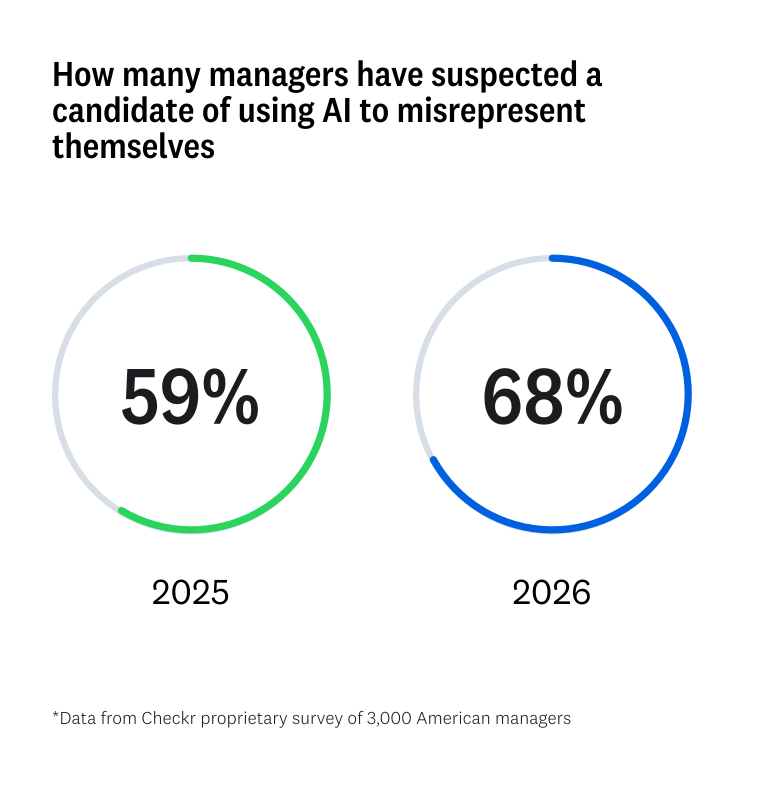
- 67% of managers have suspected a candidate of using AI to misrepresent themselves, up from 59% in 2025.
- 60% say AI has made virtual interviews harder to trust, up from 51% in 2025.
- 67% have confirmed or strongly suspected an interview proxy standing in for a candidate.
- 40% have personally interviewed a candidate later revealed to be using a fake identity, up from 31% in 2025.
- 63% of companies focus their fraud prevention on the pre-hire stage, while only 6% put the most weight on post-hire.
- 44% of companies lack a formal, written process for verifying identity after hire.
- 58% believe an employee may currently be working another job simultaneously without their knowledge.
- 38% suspect a fraudulent employee is already on their payroll.
- 71% of HR teams have received formal fraud training, up from 17% in 2025.
- 74% of managers say they have the resources and training they need, but only 23% are extremely confident their process would catch a fraudulent candidate.
Trust is eroding faster than detection can keep up
Candidates have been using AI to fake their way into jobs for a while now, from polished resumes and made-up work samples to deepfake video and cloned voices on interview calls. It’s now more common and more convincing than ever before. The more familiar hiring teams become with AI fraud, the less they trust what they see.
That erosion was evident in this year’s data. Sixty percent of managers now agree that AI has made it harder to trust a candidate in a virtual interview, up from 51% in 2025.
Additionally, 67% of managers say they've suspected a candidate of using AI to misrepresent themselves at some point during the hiring process, whether through a polished resume, a suspiciously fluent interview answer, or written communication that didn't quite match the person on the call.
Up from 59% last year, suspicion of AI deception is no longer an anomaly—it is now the standard hiring experience.
The belief that fraudsters have the upper hand also intensified this year. Sixty-eight percent of managers agree that job seekers are now better at faking their identities with AI than hiring teams are at catching them, up from 62% in 2025.
How much fraud is actually out there?
This year's survey also asked managers to estimate how much of this is going on, rather than just whether they suspected it, and the answers are higher than you might expect. Twenty-five percent of managers say a quarter of all applicants they've reviewed in the past year misrepresented themselves using AI, whether on a resume, in interview answers, or in submitted credentials.
To put that in perspective: for a recruiter screening 200 applicants for a single role, that’s 50 or more candidates who aren't being honest about who they are or what they can do.
What are managers catching before the hire?
Last year's survey asked managers whether they believed fraud was happening. This year, we asked them to describe what they'd actually experienced, and the shift between those two questions showed up immediately. Forty percent of managers have now personally interviewed a candidate who was later revealed to be using a fake identity, up from 31% a year ago. Additionally, 65% have uncovered a candidate who outright misrepresented their skills or experience, up from 60%.
Confirmed, not just suspected
Some of the fraud that managers described this year is hard to picture until you’ve witnessed it first-hand. Take interview proxies for example, when someone other than the actual candidate attends the interview.
Two-thirds of managers (67%) have encountered interview proxy fraud, up dramatically from 35% last year. Specifically, 34% have outright confirmed a proxy, while another 33% strongly suspected one but couldn't prove it. This shift reframes proxy fraud from a rare edge case into a mainstream threat.
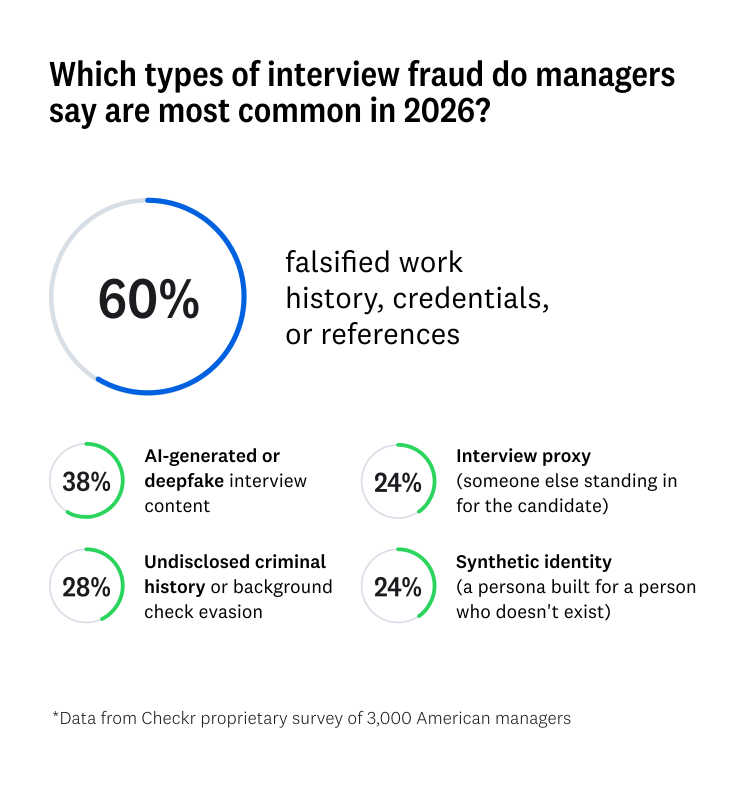
When asked about the specific fraud tactics caught in the past year:
- 60% caught candidates falsifying work history, credentials, or references.
- 38% reported AI-generated or deepfake interview content.
But why do candidates do this? Managers are split between two primary motivations: 41% believe candidates are trying to collect a paycheck without doing the work, while 40% believe it is an attempt to conceal a disqualifying background. Another 30% pointed to something less obvious: a candidate working multiple jobs at once without telling anyone, a pattern that resurfaces later in this report as a major post-hire threat.
When speed wins out over scrutiny
The most candid finding in this section is also the most uncomfortable one. Twenty-eight percent of managers admit they've knowingly moved a candidate forward despite suspecting dishonesty, simply because the role needed to be filled quickly. This puts a clear number on the tension every hiring team recognizes but rarely talks about.
Part of the reason so much fraud slips through is timing. Only 29% of companies verify identity as soon as someone applies, and 49% wait until after at least one live interview, with 18% waiting until the final interview or later. By then, a candidate using AI, a proxy, or a fake identity has often cleared the stages where hiring managers pay the closest attention.
How are HR teams responding to fraud?
Employers are no longer standing still. Compared with a year ago, more organizations are ramping up background checks, verifying government IDs, and investing heavily in employee training—though not every traditional tool is keeping pace.
Government-issued ID checks are now used by 61% of organizations (up from 58%), while third-party background checks saw the largest surge of any tool, from 53% to 62%.
Real-time video interviews dropped from 55% to 42%, reflecting a broader shift toward in-person rounds. Enterprise leaders including Google, Cisco, and McKinsey have reintroduced on-site interviews specifically to counter AI deception—a trend backed by recent Gartner research showing 72% of recruiting leaders now require in-person rounds to combat candidate fraud.
Formal defense efforts have expanded dramatically. A staggering 71% of HR teams have now received formal training on how to spot fraud and AI deception—a massive jump from just 17% in 2025.
Furthermore, 74% of managers surveyed believe they have the resources and training necessary to fight hiring fraud. However, as the next section reveals, having training and resources doesn't necessarily translate into stopping fraud after the hire.
Confident on paper, less certain in practice
While 74% of managers say they have the resources and training they need, a deeper look reveals a stark confidence gap: only 23% are extremely confident their hiring process would catch a fraudulent candidate, up just four points from 19% last year.
Teams feel equipped. They don't feel protected.
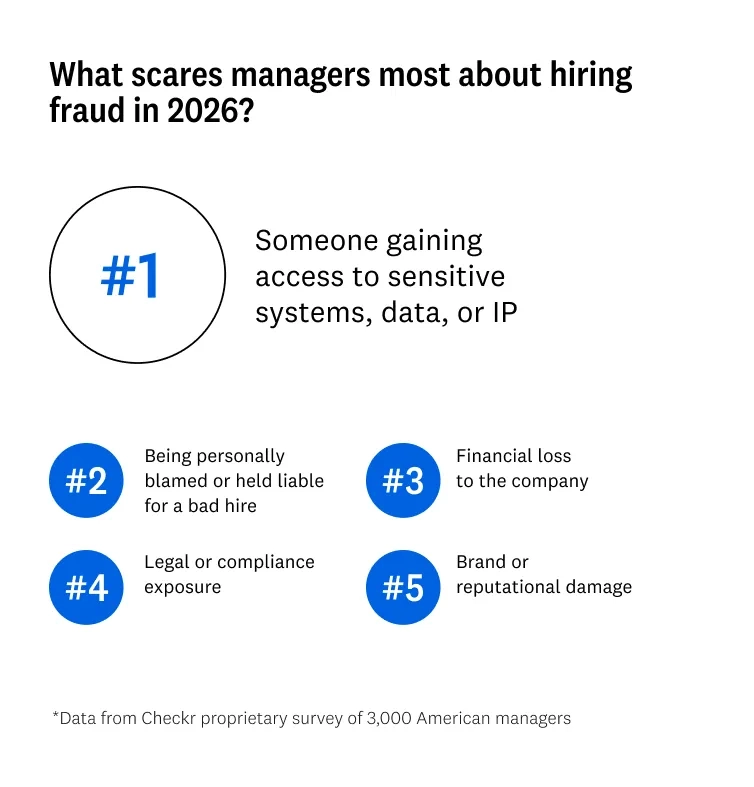
When asked to name their single biggest fear regarding hiring fraud, managers pointed to risks that are surprisingly personal:
- 26% fear unauthorized access to systems, sensitive data, or IP.
- 23% fear being personally blamed for a bad hire.
- 22% fear financial loss to the company.
Interestingly, legal exposure and reputational damage trailed well behind. For many hiring managers, the fear isn't about the company. Instead, it's personal, and deeply tied to what a fraudulent hire could access once they're inside.
The data validates that fear. Thirty-eight percent of managers believe a fraudulent employee is working at their company right now, simply undetected. While employers have invested heavily in preventing fraud during the hiring process, far less attention is being given to what happens once someone is officially on the payroll.
Fraud prevention ends at the hire, but the risk doesn’t
The biggest blind spot in this year’s data lies in what happens after an offer is accepted. Employers have built a heavily front-loaded defense: 63% of organizations concentrate their fraud prevention almost entirely on catching problems before someone joins, while only 6% prioritize the post-hire period.
Pre-hire screening is essential, but the real exposure occurs once an employee is inside. During an interview, the worst a bad actor can do is waste an afternoon. Once on the payroll, that same person gains system logins, client contacts, sensitive IP, and a regular paycheck. In fact, 41% of managers believe the primary motive behind candidate fraud is wage theft—collecting income without performing legitimate work.
Few companies keep checking after the hire
Given the stakes once an employee enters the building, ongoing identity verification should be standard practice. Yet 44% of companies lack a formal, written process for verifying identity post-hire—relying instead on informal checks, one-off onboarding reviews, or nothing at all.
A modern security posture requires continuous assurance: re-verifying identities on a set schedule, auditing access controls, and tying system permissions to ongoing verification rather than credentials granted months or years prior.
Moonlighting is the blind spot in practice
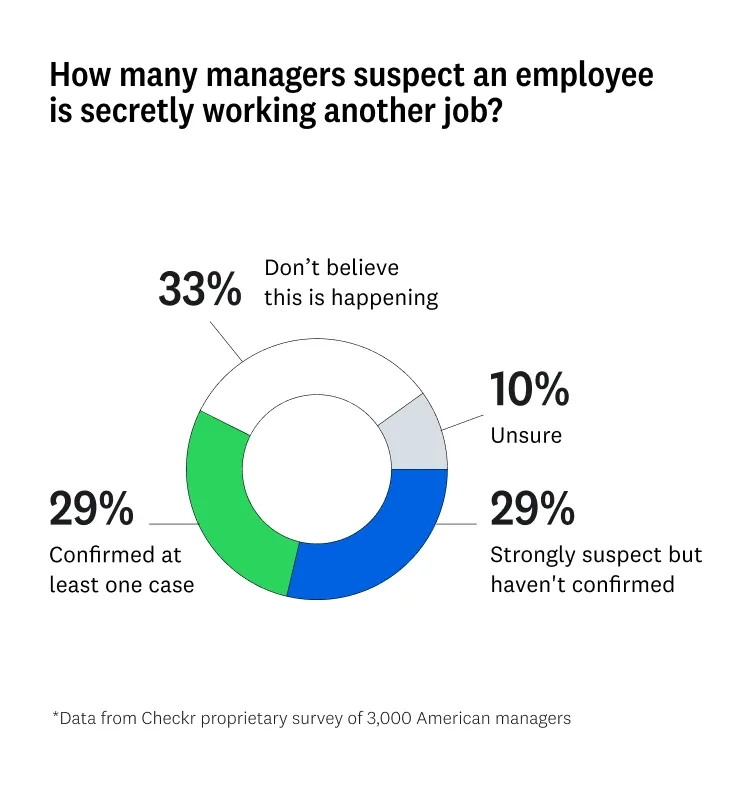
Dual employment clearly illustrates the danger of this post-hire void. A striking 58% of managers believe an employee at their company is currently working another full-time job simultaneously, with 29% having outright confirmed at least one case.
The fallout goes far beyond a policy breach in an employee handbook:
- Divided Loyalty & Productivity: An employee juggling two full-time roles cannot give either job full attention.
- Conflicts of Interest: Dual employment frequently crosses lines between direct competitors or overlapping industries.
- Data Security & IP Risk: Managing multiple corporate devices and credentials significantly increases the likelihood of proprietary data, trade secrets, or client information spilling across company lines.
Because dual employment requires intentional secrecy, every confirmed case represents a candidate who successfully bypassed initial checks. It raises the core question of this report: If a company missed this, what else is getting through?
What do companies do when they catch it?
When organizations finally uncover a fraudulent employee, the most common responses are reactive:
- 48% terminate the employee.
- 43% launch an internal investigation.
- 28% revoke system and data access.
Every one of these measures occurs after the damage has already been done. The longer fraud goes undetected inside an organization, the higher the financial, operational, and reputational cost.
What hiring fraud actually costs companies
The longer fraud goes unnoticed, the more devastating the financial impact becomes. According to the Association of Certified Fraud Examiners (ACFE) 2026 Report to the Nations:
- Fraud caught within 6 months carries a median loss of $40,000.
- Fraud undetected for 5+ years escalates to a median loss of over $1.1 million.
Checkr’s own 2026 State of Screening Compliance Report confirms that these financial losses are already landing. Over half of managers (51%) report that a fraudulent hire has cost their company time, money, or productivity multiple times in the past year.
Interestingly, direct financial losses reported in this year's survey trended smaller:
- Losses exceeding $50,000 dropped from 23% to 15%.
- Losses exceeding $100,000 fell from 10% to 7%.
- Companies reporting minimal losses (under $10,000 or none) climbed from 45% to 51%.
While this drop in high-dollar losses suggests that pre-hire investments (such as third-party background checks rising to 62%) are catching basic fraud earlier, the unmonitored post-hire period remains where catastrophic losses accumulate.
A growing disconnect with leadership
Frontline hiring managers believe corporate leadership is severely underestimating this threat. Seventy-four percent of managers believe hiring fraud poses a bigger financial risk than company leadership realizes—up from 70% in 2025.
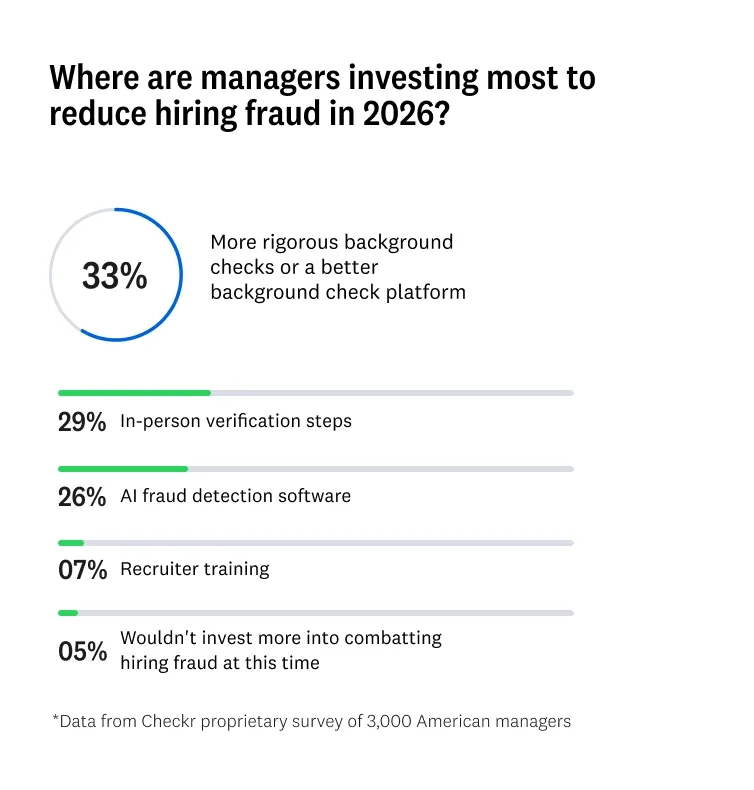
This concern is actively shaping where managers plan to allocate future budget and resources:
- 33% prioritize expanded background checks (taking the top spot over in-person verification at 29%).
- 26% plan to invest in AI fraud detection software.
- 7% prioritize recruiter and hiring manager training (up from under 5% last year)—a small but telling indicator that companies increasingly recognize human defense, not just tech tools, as critical to stopping fraud.
Looking ahead
Compared with 2025, hiring teams are more aware of fraud and more active in fighting it. They are running more background and ID checks, conducting more formal training, and managing cases of fake identities, proxy interviewers, and forged credentials so frequently that candidate deception can feel like an unavoidable cost of doing business.
However, the report's central revelation remains clear: the biggest vulnerability begins after the hire. The post-hire period remains largely unmonitored—even as 38% of managers suspect a fraudulent employee is working inside their organization right now.
Identity and fraud prevention can't end at the offer or onboarding stage. Most defenses are built around the front door, but trust must be maintained once someone is inside through scheduled re-verification, routine access reviews, and ongoing training. As fraud tactics continue to outpace traditional defenses, the organizations that keep checking long after the ink dries are the ones least likely to be caught off guard.
Methodology
All data in this report comes from a Checkr survey conducted online via a third-party platform from September 11-16, 2026. The survey included 3,000 employed US adults who identified as managers and had been involved in the hiring process within the past 12 months. Respondents were screened by role and employment status and instructed to answer truthfully to the best of their knowledge.
Disclaimer
The resources and information provided here are for educational and informational purposes only and do not constitute legal advice. Always consult your own counsel for up-to-date legal advice and guidance related to your practices, needs, and compliance with applicable laws.
Ellen Kiehl is the Head of External Communications at Checkr, leading the company's external narrative across media relations, executive thought leadership, data storytelling, and employer brand. With over 12 years of experience at high-growth technology companies, she has held senior roles at Udemy, Step, and Affirm, and began her career at Edelman.