The 2026 State of Screening Compliance Report

Introduction
How AI, fraud prevention, and consistency are fueling winning HR teams
This report draws on fresh survey data from 2,500 HR leaders hiring at scale in large organizations (1000+ employees) to reveal where background screening, fraud detection, and compliance programs stand today—and where they’re falling short.
The findings point to three priorities for HR teams that want to reduce risk and stay ahead:
- Strengthening compliance execution (despite high confidence, 42% still report errors)
- Building effective fraud prevention capabilities (58% have encountered hiring fraud)
- Developing AI governance frameworks (only 20% have documented, enforced policies)
Read the full report to learn how to turn compliance, fraud prevention, and AI into durable advantages rather than emerging liabilities.
Fast facts from the field
Compliance confidence is middling

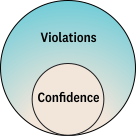
56% of organizations report complete confidence in their background check policy compliance, and 42% experienced at least one compliance error in the past 12 months.
HR generalists manage most compliance programs
60%
of organizations rely on HR or onboarding teams to handle screening compliance (versus only 8% with specialized teams).
Fraud prevention is now a majority concern
58%
of organizations encountered hiring fraud in the past year. Resume fabrication and document fraud are the most common types.
Most fraud isn’t detected until background screening
Background checks were cited as the most common hiring stage for successful fraud detection.

Fraud detection is still primarily manual, but effectiveness is in doubt
68%
use document authentication or manual HR review to detect fraud, yet only 31% rate their controls as highly effective.
AI governance is the next frontier
Just 20% have documented, actively enforced AI governance policies despite widespread tool deployment.

1
The starting point: Confidence in foundation, team, and policy
The data shows most organizations have built this foundation: the majority express confidence in their compliance policies, provide proper candidate authorization forms, and have some sort of designated team managing screening.
A strong compliance program starts with clear policies, informed teams, and solid processes, especially as fraud prevention becomes highly important in 2026 and beyond (stay tuned for more on that all-important topic).
But confidence alone doesn't guarantee execution. Understanding where gaps exist (and why) helps organizations strengthen their compliance programs in practical and measurable ways.
Confidence in compliance and policy readiness grows
We asked organizations how confident they are that their documented background check policies comply with federal, state, and local screening laws and regulations.
85% of respondents were fairly or completely confident—and complete confidence has risen since 2024. The 8% who are only somewhat confident and 2% lacking documented policies represent organizations with clear opportunities to strengthen their foundation.
HR leaders’ level of confidence in their background check compliance
2026
2024
Completely confident
Not completely confident
Authorization and disclosure compliance confidence
Missing authorization and disclosure forms during background checks are cited by our survey respondents as the top source of compliance violations year over year. Once again, we see a slight boost in confidence here since 2024, and 89% of respondents agree or strongly agree that they’re sending the right documents to candidates (up from 84%).
HR leaders: Are you sure you’re providing the right disclosures and authorizations forms for background checks?
2026
2024
Strongly agree
Agree
Neither, disagree, or strongly disagree
Perception v. reality
We dug into this a bit further and uncovered a telling contradiction: While only 11% of respondents were unsure about their documentation compliance, 16% told us they were aware of authorization and disclosure violations at their organization in the past 12 months.
This is a small, but meaningful, gap that points to an important opportunity for HR leaders. Actively tracking and reporting on compliance metrics will ensure your team doesn’t let positive confidence levels overshadow real risk events—and will help you spot and fill gaps quickly.
58% find compliance across multiple regions and properties challenging
We asked how difficult applying consistent screening processes across business and candidate locations is for HR leaders today.
Here, we see a much smaller percentage of hiring teams fully endorsing their current screening program—indicating this is one area of compliance where risk is higher and opportunities to fill gaps remain.
- Manufacturers hiring at scale feel this pain most acutely—with only 30% citing no difficulty with multi-location screening. This makes sense, given the increased safety and regulatory considerations for many factory, plant, and warehouse roles.
How difficult is ensuring background check consistency across regions, business units, franchisees, or roles?
All inustries
Manufacturing
Retail
Hospitality
Transportation
Staffing
8%
Very or extremely difficult
27%
Slightly difficult
22%
Moderately difficult
42%
Not difficult
9%
Very or extremely difficult
25%
Slightly difficult
36%
Moderately difficult
30%
Not difficult
8%
Very or extremely difficult
20%
Slightly difficult
28%
Moderately difficult
44%
Not difficult
8%
Very or extremely difficult
20%
Slightly difficult
28%
Moderately difficult
44%
Not difficult
6%
Very or extremely difficult
20%
Slightly difficult
26%
Moderately difficult
49%
Not difficult
7%
Very or extremely difficult
26%
Slightly difficult
22%
Moderately difficult
45%
Not difficult
What this tells us:
HR leaders who reported multi-location screening as “not difficult” likely already have centralized processes or limited geographic footprints, and were more likely to hire in less-regulated industries like retail and hospitality.
The more-than-half of all respondents coming up against multi-region roadblocks are dealing with real operational challenges of varying state laws and local ordinances.

Complex web of laws and screening regulations makes compliance challenging
FCRA
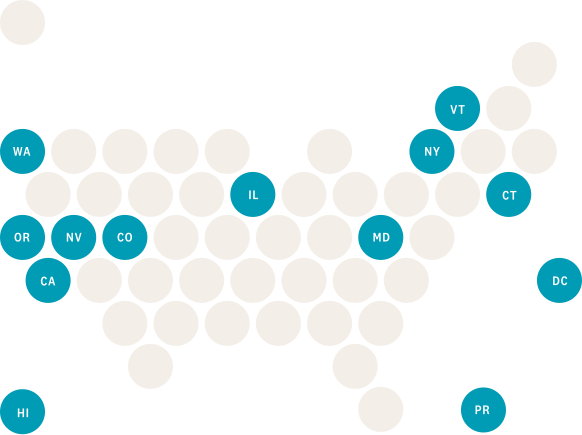
Legality of marijuana
Ban the box
Salary history
Credit history
FCRA is a federal law governing how companies order and consider information contained in a background check. It covers all 50 states, plus Washington DC and Puerto Rico.
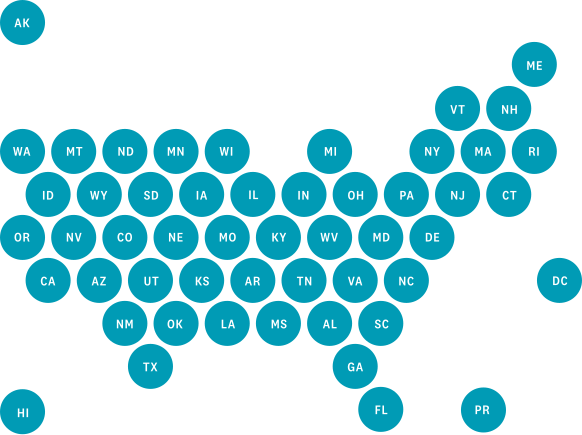
47 states plus Washington DC have enacted laws that make medicinal and/or recreational marijuana use legal for adults under at least some circumstances.
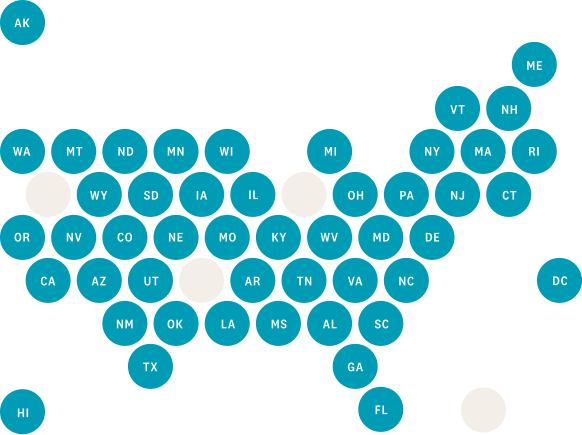
37 states and 190 cities/counties have enacted Ban the Box laws that vary greatly based on scope, nature, location and and jurisdiction, but generally restrict some employers from asking about a candidate’s criminal history on initial job application forms.

19 states and 19 cities/counties, plus Washington DC and Puerto Rico, have enacted salary history laws that vary based on location and jurisdiction, but generally prohibit employers from asking for previous salary information.
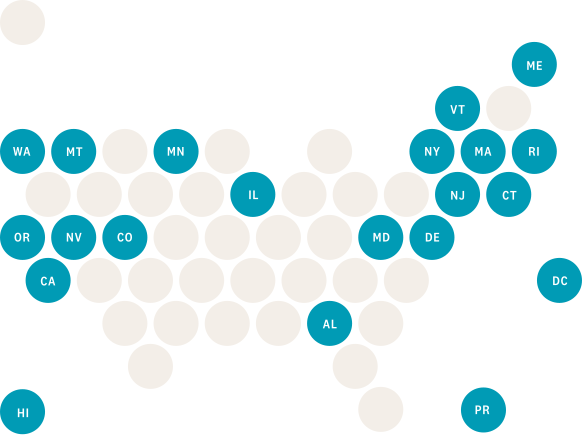
11 states and 3 cities, plus Washington DC and Puerto Rico, have enacted laws that restrict the use of credit information in hiring decisions.
Internal HR’s ownership of risk management is rising
A trend we saw emerge in the 2026 CHRO Insights Report is confirmed, once again, in this survey: HR leaders are being asked to take on more and more responsibility for risk and fraud management.
Since 2024, the volume of general HR teams who own screening compliance has risen by 18%, and at the same time the number of dedicated background check and adjudication teams has fallen by more than half.
The bulk of compliance ownership—including fraud prevention—now lives with general HR teams instead of specialists, and that represents both new hurdle and significant opportunity for HR leaders with their eyes on growth.
How does your HR tech stack measure up to expectations?
2026
2024
HR or onboarding team
Recruiting team
Operations team
Dedicated background check team
Another non-HR team (legal, trust, or third-party)
Across all the industries we surveyed, we saw most organizations consolidating screening compliance management into their broader HR team.
- Retail and transportation organizations were the most likely to have dedicated background check teams—but even so, only 10-12% are investing in specialists.
- Hospitality reported the lowest percentage of dedicated screening teams (4%).
Despite growing responsibility, 66% report no increase in resources
From rising threats of AI-powered fraud to the shift of compliance responsibility toward HR generalists, it’s clear there’s a growing demand for risk and compliance management support. So we wondered, is resource allocation matching demand?
Most organizations (59%) are managing increased compliance complexity with no change in resources, and a small percentage (7%) have actually decreased resources.
How has HR headcount and budget for compliance management changed in the past 12 months?
So why are only a third of HR teams increasing their compliance management resources?
A few culprits are likely at work here. First, when we surveyed 2,500 CHROs about their hiring strategies, we found that while HR teams drive significant business impact, 72% still don’t believe they have decision-making influence with executives. Without a seat at the table, securing proper resourcing and budget allocation can be challenging.
Common roadblocks to HR tech improvements—such as perceived integration and customization gaps—may also be a factor for teams that want to improve efficiency in compliance workflows but aren’t sure where to start. Onboarding the right tech tools and automations should be at the top of any HR leader’s compliance support list. Still, the challenges of finding or switching to a new screening vendor are real (but not insurmountable).
How to Seamlessly Switch Background Check Providers for High-Volume Hiring
Gaps drive risk: Common compliance errors in the past 12 months
To identify where the gap between confidence and execution is most likely to occur, we asked organizations which specific compliance errors they’ve experienced recently.
Compliance errors for organizations with 1000+ employees
Most common types of violations among those who reported compliance errors
Missing authorization forms and inconsistent criteria are the most common, both reflecting process control failures that compound with organizational complexity.
The takeaway: Focus on consistent execution in basic compliance first
The path forward centers on strengthening execution through better controls, clearer accountability, and additional capacity where necessary.
While most organizations have built a strong compliance foundation with clear policies and proper authorization processes, execution gaps still exist and drive significant risk. 42% experienced compliance errors this year, capacity has remained flat despite growing complexity, and multi-state operations create challenges for nearly one-third of respondents.
Ask your team
- Can we demonstrate that every background check conducted in the past 12 months included compliant disclosure and authorization?
- Where have we experienced compliance errors, and what systemic process failures created them?
- Does our team have the specialized knowledge and capacity to manage screening compliance across all our operating jurisdictions?
- How do we currently ensure consistent screening criteria across locations, business units, or franchisees?
Take this action
- Conduct a compliance audit of recent background checks to verify authorization, disclosure, and adverse action compliance across all locations.
- Map screening compliance requirements by state and role type to identify gaps in current processes.
- Assess whether compliance ownership sits with teams that have capacity, expertise, and clear accountability.
- Build process controls that prevent the most common errors: missing forms, inconsistent criteria, and late adverse actions. Pro tip: Background check partners like Checkr make this easy with customizable automations for every region and role.
2
HR teams race to identify fraud at scale
Hiring fraud has evolved from an occasional case to a challenge that most organizations now encounter often. The data is clear: 58% of HR teams we surveyed detected fraud in the past year. The rise of AI has, of course, played no small part in driving that growth.
This lack of regulatory movement on fraud combined with the rising stress levels it’s causing for hiring managers this year leaves HR teams in a tricky spot. Before hiring leaders can get their arms around this issue, we need to paint a clearer picture of what hiring fraud is in 2026.
Most common types of hiring fraud for HR teams hiring at scale
34%
Resume or credential fabrication
29%
Document fraud (falsified degrees, certifications, licenses, or work history)
20%
Interview fraud (proxy interview or AI-assisted impersonation)
15%
Identity fraud (stolen identity or fabricated personal details)
42%
We have not encountered any hiring fraud
Where in the hiring process is fraud most often identified?
Organizational impacts of hiring fraud
To quantify the true cost of a fraudulent candidate making it to the offer stage, we asked organizations to identify the most significant impacts fraud has created for their operations. Top responses ranked in order include:
- Wasted recruiting or talent acquisition team time
- Increased sourcing costs due to re-filling roles
- Additional spend on fraud-detection tools or technology
- Financial loss (theft, fraud, or liability)
- Team burnout or morale issues
The impact is primarily operational (wasted recruiter time and increased costs) though some face severe outcomes like financial loss or safety incidents. 38% of those we surveyed said they have not experienced a significant impact from hiring fraud.

"The hardest fraud cases aren't the obvious ones where a single signal stands out — they're the invisible ones where every individual stage looks clean. A résumé checks out, an interview goes well, and references respond. Fraud becomes visible only when you can correlate identity, behavior, and performance across the full hiring journey. That's a workflow problem that most hiring stacks weren't designed to solve."
Tim Bachman
Global VP Human Resources & Talent Acqusition, Phenom
Many teams are waiting too long to catch fraud
The meteoric rise in reports of AI-powered candidate fraud over the past year has left HR teams scrambling to keep up. Most aren’t catching fraud until they’ve already run a background check—a step that, depending on the hiring jurisdiction’s Ban the Box regulations, likely doesn’t happen until the candidate has already completed interviews or received a conditional offer. Or even later, during I-9 an onboarding procedures, once a candidate has accepted an offer.
About a third of teams are identifying fraud earlier on during resume and application screening, but that leaves 65% of HR spinning wheels, wasting resources, and opening themselves up to increased risk by keeping fraudulent candidates in the funnel.
Takeaway: Use existing data and impact metrics to build a fraud prevention foundation
Teaching your hiring team what fraud looks like and where it most often surfaces is a great first step in speeding up your detection timeline. Next, you’ll need to consider what tech gaps you need to fill immediately to lower risk, like automated identity verification early in the hiring flow.
The goal isn't to view every candidate with suspicion; it's to build reliable verification checkpoints that catch discrepancies before they become bad hires.
Ask your team
- What is the true cost of fraud to our organization when we calculate wasted recruiter time, sourcing rework, and potential security risks?
- Are we catching fraud early enough in the process, or are we discovering it at onboarding or post-hire when costs are highest?
- Is our current background check partner proactively sharing new solutions for fraud prevention?
Take this action
- Map fraud detection rates by hiring stage to identify where gaps exist in your verification processes.
- Analyze fraud patterns by worker type and role to determine where enhanced verification would provide the best ROI.
- Assess your background check partner’s readiness to prevent fraud through identity, document, and resume verification, in addition to traditional background checks.
3
Preventing fraud strengthens compliance—and tops the list of priorities for 2026
Yes, fraud is absolutely a growing challenge, and it increases your risk. It's stressful to encounter or hear about fake candidates, AI-assisted impersonation, and sophisticated fraud practices.
But here's the empowering reality: HR leaders are uniquely positioned to build a secure, reliable fraud prevention program that puts your organization ahead of the curve.
This shift doesn't mean every candidate is suspect or that hiring is impossible, but it means fraud prevention needs to become part of standard hiring practice, just like reference checks or employment verification. You can push your team to leap past emerging roadblocks faster by focusing on the solution, not just the fear.
The good news is that organizations have real tools at their disposal, and the most effective fraud detection happens at stages where you're already conducting verification.

"This data confirms what we're already hearing from customers every day: fraud has moved from an edge case to a default condition of hiring, especially for larger companies. Treating screening as the last line of defense before an offer is made is a misguided approach, as by then, recruiter time is spent, and the risk already exists within the pipeline.
The teams pulling ahead and managing their candidate fraud risk are pushing verification and trust signals to the very top of the funnel, combining structured hiring with responsible, well-governed AI so they catch bad actors early and keep real candidates moving fast. This streamlines fraud management, protects pipelines, and keeps your recruiters working efficiently.”
The teams pulling ahead and managing their candidate fraud risk are pushing verification and trust signals to the very top of the funnel, combining structured hiring with responsible, well-governed AI so they catch bad actors early and keep real candidates moving fast. This streamlines fraud management, protects pipelines, and keeps your recruiters working efficiently.”
Sagar Patel
Chief Technology Officer, Greenhouse
Manual review still accounts for 49% of fraud strategies
We asked HR leaders which fraud detection tools and processes they currently use to spot and stop fraud. While document screening topped the list, manual review was a close second.
Manual screening workflows often leave HR teams not only stretched thin but open to increased risk of human error and higher operational costs as hours get filled with repetitive hands-on tasks.
Fraud feels, in many ways, like a new challenge for HR—so it’s understandable that half of all teams are still doing their best to stop it on their own. But, manual workflows aren’t scalable. This should be a red flag to any HR leader who sees their team relying on individual hiring managers to expertly identify fraud, every time, without the help of the sophisticated (but easy to implement) identity verification tools currently leveraged by 35% of our survey respondents.
Fraud control effectiveness is split; only 31% is highly effective
Deployment matters less than results, so we asked organizations to rate how well their current controls actually catch fraud.
How effective are HR team’s fraud prevention strategies?
31%
Highly effective
37%
Fairly effective
33%
Somewhat, slightly, or not effective
Less than a third of HR teams consider controls highly effective despite widespread tool deployment. The effectiveness gap represents opportunity: improving fraud prevention means measuring which controls actually catch fraud, eliminating what doesn't work, and strengthening what does.
Takeaway: Evaluate verification performance and target fraud-focused upgrades
The data shows organizations are already deploying fraud detection tools: document authentication, manual review, identity verification technology. The question isn't whether tools are being used, but whether they're working.
Effective fraud prevention doesn't require elaborate systems for every hire, but it does require implementing the right verification controls at the right stages and measuring whether they actually work. Again, more opportunity for HR leaders to shine.
Ask your team
- Which of our fraud detection tools have actually caught fraud, and which are deployed but unproven?
- How do we measure fraud detection effectiveness, and do we have data showing which controls work?
- Are we deploying fraud detection tools because they're available, or because we've validated they catch the fraud types we're experiencing?
Take this action
- Implement detection effectiveness tracking to measure which controls catch fraud and at what cost.
- Eliminate fraud detection tools that aren't catching fraud or that duplicate other controls without adding value.
- Focus investment on controls that demonstrably work: document authentication, identity verification, and thorough background checks. Pro tip: A comprehensive background check provider should provide all verifications through one centralized workflow, even for dispersed hiring teams.
4
AI governance relies on HR leadership, not outside regulation
AI is reshaping both the threat landscape and hiring defense capabilities. Candidates use AI to fabricate resumes, impersonate others in interviews, and bypass screening controls. Organizations deploy AI to accelerate verification, detect fraud patterns, and scale compliance.
Even so, widespread or comprehensive regulations on AI use in hiring—for candidates or employers—has yet to emerge. This is a new and evolving area of compliance, and regulations are just now starting to be proposed or adopted at the state and local level.
And so, hiring and people teams have the great responsibility and opportunity to set the tone and mitigate risk for their organization. Teams that build thoughtful AI governance now will have clarity and protection as AI adoption accelerates across the industry.

“Here's the thing about AI governance: most leaders treat it like a speed bump. It's a launchpad. Every time I've seen an HR team rush implementation without a clear framework, they end up burning time, trust and sometimes candidate relationships. Build the AI governance model first so you can move at the speed of AI when it counts.”
Trent Cotton
Head of Talent Insights & Analyst Relations, ICIMS
Where AI policy is most needed
To understand where AI anxiety is concentrated, we asked organizations to identify their single biggest concern about AI's role in hiring and screening. While about a third of respondents were not concerned about AI in hiring, fraud and data privacy topped the list for those who are more on-edge about having AI in the room.
What concerns HR teams the most about AI in hiring?
The state of AI governance for HR
Concern matters, but governance determines action, so we measured whether organizations have formal AI policies in place for hiring decisions.
Only 20% have documented, actively enforced AI policies. The 26% developing policies shows encouraging progress. The combined 28% with either informal guidance or no policy represent organizations potentially increasing risk by using AI without governance frameworks.
How do HR leaders rate their team’s AI maturity and policies?
Does AI reduce or increase compliance and fraud risk?
To assess how organizations view AI's impact, we asked whether they believe AI is reducing or increasing their overall compliance and fraud risk.
The largest segment (32%) sees AI as neutral; a tool whose risk profile depends on implementation quality. The split we see here between reducing and increasing risk (with a 10% advantage going to reducing risk) suggests AI's impact may depend heavily on governance quality.
Takeaway: Build AI policy now to mitigate long-term compliance risks
AI is simultaneously a fraud enabler and fraud detector, creating both new risks and new capabilities. Building resilience doesn’t come from avoiding AI; it relies upon formal governance frameworks that provide clarity on acceptable use, required reviews, and risk management.
Organizations are most concerned about AI-assisted candidate fraud (17%), but governance maturity lags: just 20% have documented, enforced AI use policies. Views on AI's net impact are divided, with perspectives depending largely on implementation quality.
Ask your team
- Do we have a documented AI governance policy that covers hiring and screening, and is it actually enforced? Or, are we deploying AI tools faster than we're building the governance infrastructure to manage them responsibly?
- What specific AI-related risks are we most exposed to: candidate fraud, compliance violations, bias, or candidate trust erosion?
- How do we measure whether AI is reducing or increasing our overall compliance and fraud risk?
Take this action
- Audit current AI tool usage to identify which systems are deployed, what risks they create, and whether governance exists for each, and take into account any regional regulations on AI in the workplace.
- Train HR and compliance teams on AI-specific risks in screening: candidate fraud capabilities, explainability requirements, disparate impact potential.
- Communicate clearly with candidates about when and how AI is used in hiring to maintain trust and meet emerging disclosure requirements.
From risk exposure to resilient screening
Screening compliance in 2026 presents HR leaders with a defining opportunity. Fraud prevention, AI governance, and multi-state compliance are no longer specialized concerns—they're core capabilities that separate leading organizations from those playing catch-up. The good news? You're already closer than you think.
The data shows most organizations have strong foundations: documented policies, proper authorization processes, and fraud detection tools in place. The issue is the gap isn't awareness, instead it's the overall execution. That's where strategic HR leaders can make their mark by transforming deployed tools into effective programs, turning compliance checkboxes into successful processes, and building fraud prevention capabilities that really work.
This is your moment to lead. Build the fraud prevention program your organization needs. Implement identity verification and document authentication that catches issues before they become bad hires. Establish AI governance frameworks before competitors do. The organizations winning in 2026 will be led by strategic-thinking HR professionals who saw this shift coming and built the capabilities to match.
Turn compliance into a competitive advantage with Checkr
Checkr is the data platform that powers safe and fair hiring decisions. Our modern background check technology integrates seamlessly with your hiring tech stack and provides transparency, automation, and trust at scale. 140,000+ customers use our solutions to modernize their verifications and deliver an outstanding candidate experience, without losing the human touch.
Ready to unlock HR’s strategic potential with better background checks?


Survey methodology
All data found within this report is derived from a survey conducted online via a third-party survey platform. HR managers and senior HR leaders responsible for background check processes at organizations with 1,000+ employees were surveyed. Respondents represented five key industries: retail, hospitality, manufacturing, transportation, and staffing, with 500 respondents per industry for a total of 2,500 participants. All participants were screened to confirm their involvement in background check decision-making. Participants were asked to answer all questions truthfully and to the best of their knowledge and abilities.
Disclaimer
The resources and information provided here are for educational and informational purposes only and do not constitute legal advice. Always consult your own counsel for up-to-date legal advice and guidance related to your practices, needs, and compliance with applicable laws.

About the author
Cheri Saito covers verification and Form I-9 compliance topics at Checkr, drawing on research and analytics experience at technology companies including Stripe and Twitter. Her writing connects screening practices to real-world hiring outcomes.