Marketplaces

The verification platform built for marketplace scale

One platform to verify workers, screen users, and stay compliant—no matter how fast you grow.

The platform that powers the gig economy

Checkr runs more marketplace verifications than any other provider—with the speed and scale to match.

90%

of gig economy background checks run on Checkr.

89%

of national criminal record checks complete within one hour.

260M+

real identities mapped, covering 96% of US adults

Every person in your ecosystem. Verified.

Whether you need to screen new workers, assess community risk, or build a trusted marketplace—Checkr handles it all.

Workforce

Get workers on the job before they go somewhere else

In the gig economy, workers move fast between platforms. Whether you're onboarding drivers, delivery workers, handymen, or caregivers, Checkr's AI-powered background checks are built for speed.

  • Fast, accurate screenings like criminal background checks, driving record checks, and identity verification speed candidates through the hiring funnel.
  • Checkr AI normalizes criminal charge data, so your team spends less time decoding results.
  • Automated adjudication tools reduce manual workflows by up to 80%.
  • Automated candidate communications and in-platform support reduce the burden on your ops team.
  • Built-in regional compliance tools simplify risk management across hiring locations.
  • 200+ integrations and our custom API make it easy to seamlessly add Checkr to your hiring flow.

Trust

Protect the people on your platform—not just the workers

Most platforms only screen their workers. Checkr lets you verify anyone in your ecosystem—buyers, sellers, renters, or guests—with real-time risk signals that help you act before an incident occurs.

  • Identity verification at signup stops fraudulent accounts before they reach your community.
  • Instant criminal checks screen users in under a second, without adding friction to onboarding.
  • Driver's license status checks save on DMV & MVR costs without sacrificing accuracy.
  • Our flexible API integrates directly into your onboarding and in-app workflows.
  • Reliable, Checkr-owned data sources increase speed and accuracy.

Personal

Stand out, whether you work for a platform or for yourself

In a crowded marketplace, workers with verified profiles get hired faster. Checkr profiles travel with individuals across every platform they work on, reducing friction and giving workers a genuine competitive edge.

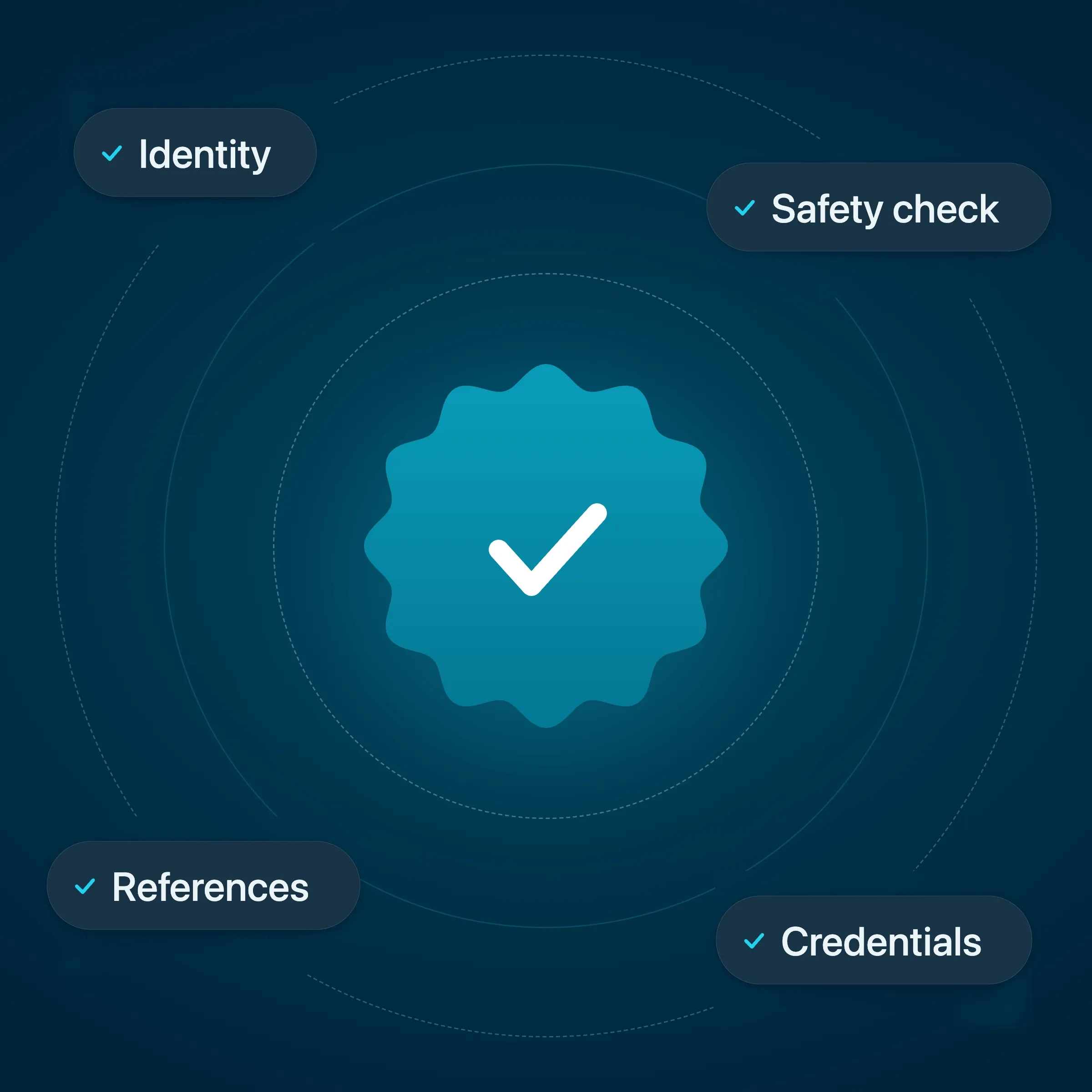
  • Verified identity, safety, education, and employment experience—all in one portable profile.
  • Checkr Profile badges help workers stand out and build trust on your platform.
  • Fewer repeat verifications save time and money as workers move between gigs.
  • Trusted job boards and marketplaces surface verified workers, helping them get hired faster.

Tenant

Screen tenants with confidence—on any housing platform

For housing platforms and property management software, tenant screening needs to be fast, fair, and consistent. Checkr verifications are built for platforms that need compliant decisioning at scale—without the manual overhead.

  • Criminal, income, employment, asset, and credit screening give you a complete financial and safety picture of every applicant.
  • Fair-housing-aware decisioning and configurable adverse action workflows keep you compliant across every market you operate in.
  • Built for housing platforms and property management software—flexible enough to fit how your product works.

Why leading marketplaces and platforms choose Checkr

"Checkr has had a great impact on Lyft's business, and that's why we have a long-term partnership."
Allen Lohse
Director of Legal and Regulatory, Lyft
"Checkr gives us the reliability that we’re reducing risk, and can do it at a speed that’s important to help us grow at the scale we’re currently seeing."
Joey Dempsey
Chief Financial Officer, Hyer
"When a new client comes on, and we know we need to run thousands of checks, we don't have to say no. Because of Checkr, we can take that business and have a successful outcome."
Mitch Catino
Co-founder and COO, Gigsmart

Explore resources for marketplaces and platforms

Frequently asked questions

Learn more about healthcare background checks

Whether hiring healthcare providers or non-clinical support staff, it’s critical for healthcare organizations to thoroughly vet candidates when bringing on new employees. Medical background checks can be vital (and sometimes mandated by law) to protect public health, patient safety, minimize organizational risk, and mitigate the risk of legal liability. Let’s take a closer look at the types of information a healthcare background check may include, how long it takes to complete, and ways employers can remain compliant with federal, state, and local laws.  

What is a healthcare background check?

A healthcare background check is a type of screening used by healthcare organizations to determine a candidate's qualifications for a job. Generally they screen for healthcare sanctions, criminal records, and other potential red flags. Healthcare background checks can help employers thoroughly vet a healthcare worker’s background to ensure that a candidate is trustworthy and has the proper professional licensing, education, experience, and qualifications for a role.

The healthcare industry is heavily regulated due to the sensitive nature of patient care and public safety. Healthcare background checks are typically used by hospitals, urgent care facilities, medical practices, medical staffing agencies, and other types of employers that provide healthcare services or support the healthcare industry. 

What are the requirements of a healthcare background check?

Healthcare background check requirements vary based on the individual organization and position, but often include criminal history, professional license verification, healthcare sanctions, and drug testing. Background check requirements in the healthcare industry are complex, so employers should consult their legal counsel, but generally physicians and nurses may be subject to more rigorous screenings than medical assistants or caregivers. Healthcare background checks may also be required by law, depending on the nature of the role. Each state has its own licensing requirements for home health agencies (HHAs) and other caregiver organizations. 

Organizations that are contracted within the TRICARE network, the US military’s healthcare program, must comply with certain healthcare background check requirements for certain physician and non-physician candidates. Additionally, organizations that receive federal grants or other federal funding are required to conduct healthcare sanctions checks as part of the background screening process.

Healthcare employers may also be required to run post-hire screenings, such as healthcare sanctions and professional license verification rechecks, at regular intervals during the employee's tenure. 

Employers that work with a consumer reporting agency (CRA) to conduct background checks for healthcare employees must adhere to the guidelines of the Fair Credit Reporting Act (FCRA), which requires providing written notice to the candidate of your intent to conduct a background check and receiving written consent from the candidate before proceeding. Should an employer choose not to hire a candidate based on information from the results of a background screening, they must also follow the adverse action process.  

What is a Level 2 background check for healthcare workers?

A Level 2 background check for healthcare workers is a type of FACIS® (Fraud and Abuse Control Information System) search to show any exclusions, debarments, sanctions, or disciplinary actions against healthcare professionals. 

There are four FACIS screening levels–1, 1M, 2, and 3–that search various primary sources and lists, including the Federal Office of Inspector General (OIG) List of Excluded Individuals and Entities (LEIE); System for Award Management (SAM) database; and state-specific Medicare and Medicaid data (where available). 

More comprehensive search results are returned with each level, so employers may choose different search levels depending on the type of position being filled, the type of risk, and federal or state requirements for the screening. Checkr offers level 1M and level 3 screenings to help your organization meet state and federal requirements for healthcare background checks

What shows up on a healthcare background check?

A background check for healthcare workers can show many types of information about a candidate, depending on the type of screening being conducted and the nature of the role. 

Here are common healthcare background screenings and what may show up:

Type of screening Results may indicate
Criminal background check Candidate's criminal record, such as felony and misdemeanor convictions, history of arrests and incarcerations as an adult. Some searches are name-based while others involve fingerprinting.
Sex offender registry search Whether a candidate is a registered sex offender, including registration date and current status.
Social Security number trace Potential address history and aliases. This information can help determine which counties and other databases to search for additional public records.
Healthcare sanctions checks Any disciplinary action against a healthcare candidate, including exclusions, preclusions, penalties, suspensions, and debarments.
Professional license verification Current license status and standing. This is typically used for physicians, nurses, CNAs and other healthcare providers.
Driving record checks Candidate's motor vehicle history, such as license status, class type, moving violations. This may be important for roles that require a candidate to operate a vehicle, such as EMTs and paramedics
Employment verification Employment history, including previous employers, positions held, and dates of employment.
Education verification Enrollment history, dates of attendance, degree(s) earned, and graduation date. This type of screening is important for healthcare roles that require specialized degrees.
Health screenings and physicals Medical background checks to evaluate a candidate's overall health and capabilities of performing job-related responsibilities.
Drug testing Certain controlled substances or alcohol. In some cases, this type of screening may be required by law for certain types of positions.

Do HIPAA violations show up on a healthcare background check?

Health Insurance Portability and Accountability Act (HIPAA) violations may show up on a healthcare background check, depending on the nature of the offense and if there is resulting disciplinary action, such as civil or criminal penalties. 

For example, if a healthcare worker commits a HIPAA violation that is also a violation of the Social Security Act, the violation must be reported by the employer to law enforcement and the US Department of Health and Human Services (HHS), the organization that oversees HIPAA enforcement. The case is then tried by the Department of Justice, which may result in a criminal conviction and therefore would appear on a criminal background check for healthcare workers. 

Common HIPAA violations that may result in disciplinary action include prohibited disclosures of protected health information, failure to perform an organization-wide risk analysis, and denying patients access to their records. 

Other violations may not result in legal or financial penalties, such as charging an unreasonable amount to provide a patient with a copy of their PHI, and therefore would not show up on a healthcare background check. 

What may disqualify a candidate during a healthcare background check?

Certain results of a healthcare background check may disqualify a candidate for employment based on your hiring criteria. Reasons for disqualification may include felony or misdemeanor criminal convictions, such as fraud or patient abuse; healthcare sanctions, such as HIPAA violations, Medicare or Medicaid violations, or disciplinary actions against a license; an inactive professional license; or positive results on a drug screening. 

These disqualifications may be based on requirements mandated by state law, such as professional licenses for physicians, nurses, and aides. Other types of checks may be required as part of a healthcare organization’s hiring policy, such as a drug-free workplace. 

Roles that require operating a vehicle, such as EMTs, paramedics, and other transport workers may require a clean driving record. If an MVR shows a history of accidents or vehicle-related crimes, the candidate may be disqualified. Other types of medical roles, especially those that have access to sensitive populations, like children and the elderly, may disqualify candidates with relevant criminal records.

How far back does a hospital background check go?

Lookback periods for hospital background checks, along with other types of healthcar e pre-employment screenings, vary depending on the type of checks being performed and who is conducting the background check. For example, healthcare sanctions have differing lookback periods depending on the type of exclusion. Permissive exclusions typically remain on the OIG list for three years or less and mandatory exclusions remain for five years or 10 years if the individual has received two mandatory exclusions. If an individual has received three or more mandatory exclusions, the record will remain permanently.

Employers conducting background checks for healthcare employees that choose to partner with a CRA, like Checkr, to conduct healthcare background checks are subject to limits set by the FCRA for certain types of reports. For example, criminal convictions can be reported indefinitely for most searches, but there is a seven-year limit for non-conviction criminal information (such as arrest records, paid tax liens, and civil judgments). A candidate’s civil history, including credit information, judgements, and tax liens, is also limited to seven years. Bankruptcies, however, can be reported up to ten years. Lookback limits may not apply if the expected salary for the role is $75,000 or higher. 

How long do hospital pre-employment background checks take?

A background check for hospital employment can take a few minutes to several weeks to complete. Turnaround times typically depend on who is performing the background check, the type of screenings being conducted, and the role.

Hospital human resources professionals that conduct background checks directly may be able to access some records online, such as OIG/SAM database checks and professional license verifications. Other types of healthcare background screenings for hospitals may require placing phone calls, mailing forms, or visiting the courthouse. 

Healthcare organizations that decide to partner with a CRA, like Checkr, can benefit from quicker, more accurate results. Checkr’s advanced technology gathers and sorts data from thousands of databases and record sources. In addition, Checkr’s candidate portal provides both employers and candidates a transparent view of screening statuses during every stage of the background check process. 

Get a healthcare background check from Checkr

Healthcare background checks are often part of comprehensive pre-employment screenings in the healthcare industry to help protect patient safety, prevent costly violations, and improve patient outcomes. Healthcare employers that partner with a professional background check provider, like Checkr, can benefit from faster turnaround times and more accurate results. Plus, Checkr’s multiple background check options, including healthcare-specific screenings like healthcare sanctions and professional license verification, help employers save time and support compliance with federal, state, and local guidelines. Get started.

Disclaimer

The resources provided here are for educational purposes only and do not constitute legal advice. We advise you to consult your own counsel if you have legal questions related to your specific practices and compliance with applicable laws.

The gig economy runs on Checkr. See why.