The Alignment Advantage Report
Closing the Gap Between HR Teams and Job Seekers

HR's new north star: The alignment advantage
Hiring is changing fast—but for HR teams, the challenge isn’t just keeping up, it’s cutting through. With thousands of tools and tactics competing for attention, and AI adding new complexity, it can be hard to know what really matters.
That’s why Checkr surveyed 6,000 people—3,000 HR managers and 3,000 job seekers—who are actively participating in the hiring process right now. Instead of just asking about general attitudes, we got specific: What tools are they using? What pain points are showing up? Where is there alignment—or friction?
This report distills their responses into clear, practical insights designed to help HR leaders sort signal from noise, spot emerging trends, and prioritize strategies that improve hiring for everyone.
Top takeaways
AI adoption is real, but fragmented
Candidates use AI too
Transparency is lacking
Agreement on automation’s benefits
Both groups recognize that AI and automation speed up communication and reduce manual work.
But human interaction still matters
Where HR managers and candidates align
Despite different roles in the hiring process, HR managers and job candidates share surprising alignment on several key issues.
From the benefits of automation to the importance of data privacy and ethical AI use, both sides are looking for a faster, fairer, and more transparent experience. This common ground offers a powerful opportunity for HR leaders to build trust, improve processes, and drive better outcomes for everyone involved.
AI can help—when it fills a need
HR teams see real impact from AI in reducing manual work—72% agree it boosts efficiency. Some candidates agree too: 26% say automation improved communication and sped up the process.
Top automations candidates want
Top-rated AI tools for HR performance
Ethical concerns are top of mind
Both HR managers and job candidates rank privacy, fairness, and transparency as the top ethical considerations for AI in hiring.
- HR ranks #1: Candidate data privacy
- Candidates rank #1: Privacy of personal data
- Both place transparency in the top three
Shared ethical priorities
- Candidate data privacy
- Transparency into how AI-generated outputs impact hiring decisions
- Fairness across demographic groups
- Human oversight
- Candidate consent/opt-out
- Accuracy of AI-generated outputs
Fraud is a shared concern
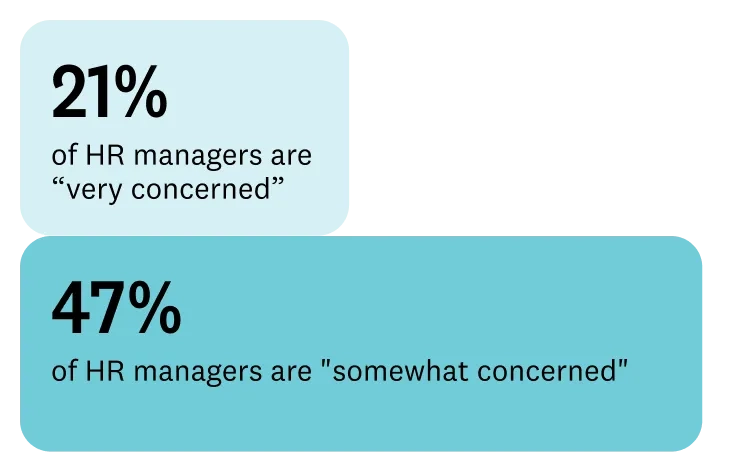
AI-assisted candidate fraud isn’t just hypothetical—it’s happening, and HR is worried.

How do we define AI-assisted fraud in hiring?
58%
Using AI to generate fake or exaggerated resumes
40%
Using voice-cloning or avatars to complete interviews
42%
Submitting AI-generated writing samples or test responses without disclosure
29%
Using job-matching AI to apply to roles without reviewing job requirements
43%
Sharing AI-altered headshots or video content with employers
34%
Using undisclosed AI listening tools to provide answers during an interview
8%
I don’t consider any use of AI as fraud during the job search or interview process
Where HR managers and candidates disagree
While there’s common ground, the data also reveals critical disconnects between HR managers and candidates—especially around fairness, transparency, and communication.
These gaps can lead to friction, missed expectations, and reduced trust in the hiring process. Understanding where and why these misalignments occur is key to building a more candidate-centered, effective recruitment strategy.
Perceptions of fairness
There’s a gap in trust when it comes to fairness in AI assessments.
Is AI as fair as a human reviewer during hiring?
HR managers
Candidates
This disconnect could lead to friction if HR relies too heavily on AI without reinforcing transparency and accountability.
Communication and transparency still lacking
Despite regulatory momentum and best-practice conversations, communication about AI use is still limited.
HR managers are trying to be transparent
- 35% share when humans vs. AI review materials
- 36% disclose the specific tools being used
- 32% allow opt-outs or human review upon request
But it’s not always coming through to candidates; only 23% say they were clearly informed of AI use in hiring.
There’s a clear opportunity here: Candidates want to understand how AI is used—and they factor it into decision-making.
Candidates: How important is transparency about how AI-powered tools are used during hiring when deciding to apply for a job?
The human element
HR may underestimate how much human interaction matters to candidates.
This is where tactical changes matter. Even automated systems should include ways to personalize experiences and make humans more visible throughout the journey.
What this means for employers: Actions to take
The gaps and opportunities revealed in this data point to clear actions HR teams can take to improve hiring outcomes.
From increasing transparency to using AI more strategically, these insights offer practical steps to build trust, streamline processes, and create a more effective and equitable hiring experience for both candidates and employers.
Build trust with transparency
Ask your team
“Do candidates know when and how AI is used in our process?"
Action to take
Consider adding a short disclosure statement in every hiring stage—especially for screening or interview evaluation.
Use AI where it adds value—not where it creates doubt
Ask your team
“Are we focused on the right AI efficiency tools (scheduling, screening, summarizing)?”
Action to take
Avoid using AI in final evaluations without human review—this is where trust drops off.
Close the feedback loop
Ask your team
"Are we automating communication without losing tone or empathy?”
Action to take
Offer candidates timely insights into their status, even if just to say, “We’re still reviewing.”
Train your team (and candidates)
Ask your team
“Have we properly trained our team and educated our candidates on our hiring process and AI usage?”
Action to take
Work to ensure proper training is provided and that curious candidates are well-aware of AI usage during the hiring process.
The big idea
This report isn’t just about AI—it’s about creating clarity, consistency, and trust across every stage of the hiring journey. While headlines often focus on the promise or peril of automation, our data shows something more nuanced: candidates and hiring teams agree on many of the same values—speed, fairness, transparency—but still experience the process very differently.
That disconnect rarely stems from bad intent. Instead, it’s a product of unclear communication, inconsistent practices, and the growing complexity of modern hiring.
As HR teams adopt new tools and technologies, the real opportunity is to create systems that reinforce—not replace—the human elements of hiring.
The future of HR strategy will belong to organizations that turn automation into an advantage, while maintaining empathy, transparency, and accountability.
That means using data to identify weak points, training teams to understand new tools, and keeping candidates informed every step of the way. When both sides know what to expect, trust grows—and so does your ability to attract, hire, and retain top talent.
How Checkr can help
Checkr is the data platform that powers safe and fair hiring decisions. Our modern background check technology integrates seamlessly with your hiring tech stack and provides transparency, automation, and trust at scale. More than 140,000 HR teams use our solutions to modernize their screening process and deliver an outstanding candidate experience, without losing the human touch.
Ready to unlock HR's strategic potential with better background checks?
Connect with our team to take action as a key problem-solver for your HR organization.
More resources for strategic thinkers


The 2025 CHRO Insight Report
This report examines the insights and priorities of 500 Chief Human Resources Officers (CHROs) across multiple industries, uncovering their top challenges, sought-after solutions, and strategies for enhancing organizational impact.

How to Choose a Background Check Provider for Hiring at Scale
Get our buyer’s guide to selecting a background check partner that helps you get ahead in your hiring market—including the questions you need to ask and must-have solutions when choosing a provider.
Survey methodology
All data found within this report is derived from a survey conducted by Checkr using the online platform Pollfish. A total of 6,000 respondents were surveyed, including 3,000 HR managers and 3,000 job candidates who had applied for a job and completed an interview within the past six months. The survey was conducted over a three-week period in July 2025. All participants were asked to respond truthfully and to the best of their knowledge and experience.
Disclaimer
The resources and information provided here are for educational and informational purposes only and do not constitute legal advice. Always consult your own counsel for up-to-date legal advice and guidance related to your practices, needs, and compliance with applicable laws.