The 2026 State of Screening Compliance Report for Hospitality

Introduction
How compliance consistency, fraud detection, and AI governance are shaping hospitality hiring in 2026
This report draws on survey responses from 500 HR leaders at hospitality organizations with 1,000+ employees to reveal where compliance, fraud detection, and credential verification stand today across an industry shaped by seasonal hiring, multi-property complexity, and guest-facing risk.
Three priorities define hospitality screening compliance in 2026:
- Closing the policy-to-execution gap (Only 42% report complete confidence in compliance)
- Moving fraud detection earlier (49% encountered hiring fraud, led by resume and credential fabrication at 29%)
- Documenting AI governance (just 7% have a documented, enforced AI policy)
Hospitality organizations that act on these priorities can lower compliance risk, catch fraud earlier, and bring property-level execution in line with documented policy.
Fast facts from the field
Compliance confidence dips, but solutions are within reach

42% of hospitality HR leaders report complete confidence in compliance policies, the lowest of any industry surveyed. Closing this gap should be HR's top priority this year.
Most compliance ownership sits with HR
57%
of hospitality organizations place screening oversight in HR. Operations teams own another 13%.
Resume fabrication leads fraud
29%
of hospitality orgs encountered resume or credential fabrication in the past year.
Most fraud isn’t detected until background screening
33% of hospitality orgs identify fraud at background check review, and 12% are still finding it post-hire, after the candidate is already at work.


Most teams are searching for answers to fraud
57%
of hospitality teams are seeing hiring fraud result in outcomes like wasted recruiter time, increased sourcing costs, and lower team morale.
AI governance is a key opportunity this year
Only 7% of hospitality orgs have a documented, enforced AI policy—meaning most teams can reduce risk this quarter by leading the charge on policy creation.

1
Confidence in foundation, team, and policy
The data shows most hospitality organizations have built this foundation. The majority express confidence in their compliance policies, provide proper candidate authorization forms, and have some sort of designated team managing screening.
A strong compliance program starts with clear policies, informed teams, and solid processes, especially as fraud prevention becomes highly important in 2026 and beyond (stay tuned for more on that all-important topic)
Confidence alone doesn't guarantee execution. Understanding where gaps exist (and why) helps hospitality organizations strengthen their compliance programs in practical and measurable ways.
Hospitality HR confidence in compliance grows
We asked hospitality organizations how confident they are that their documented background check policies comply with federal, state, and local screening laws and regulations.
76% of hospitality HR leaders were fairly or completely confident, and complete confidence has risen since 2024.
Hospitality HR leaders’ level of confidence in their background check compliance
2026
2024
Completely confident
Not completely confident
Hospitality HR authorization and disclosure compliance confidence
Missing authorization and disclosure forms during background checks are cited by our survey respondents as the top source of compliance violations year over year. Hospitality HR leaders are holding steady since 2024, with 81% of respondents agreeing or strongly agreeing that they're sending the right documents to candidates.
Hospitality HR leaders: Confidence in providing compliant disclosure and authorization forms
2026
2024
Strongly agree
Agree
Neither, disagree, or strongly disagree
Perception v. reality
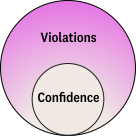
Hospitality shows tighter alignment between confidence and reported errors than other industries, but confidence doesn't equal compliance. The bigger flag is the 7% running background checks without any documented policy. That's not just a compliance risk; it's an adverse action liability waiting to happen.
51% need better compliance solutions across multiple regions and properties
Hospitality operations span properties, brands, and ownership structures that create layered compliance complexity. Franchise agreements, management contracts, and seasonal staffing mean screening consistency rarely comes standard.
How difficult is it to ensure background check consistency across regions, business units, franchisees, or roles?
49%
Not difficult
26%
Moderately difficult
20%
Slightly difficult
4%
Very difficult
2%
Extremely difficult
What this tells us:
The 49% reporting no difficulty likely reflects single-property operators or organizations with centralized HR. The 51% experiencing friction are dealing with the real complexity of multi-property hospitality, where seasonal hiring spikes, franchise agreements, and local ordinances vary significantly even within the same metro area.

Internal HR's ownership of risk management is rising
A trend we saw emerge in the 2026 CHRO Insights Report for Hospitality is confirmed, once again, in this survey. Hospitality HR leaders are being asked to take on more and more responsibility for risk and fraud management.
The bulk of compliance ownership, including fraud prevention, now lives with general HR teams instead of specialists, and that represents both a new hurdle and significant opportunity for hospitality HR leaders with their eyes on growth.
Who owns the process in hospitality?
2026
2024
HR or onboarding team
Operations team
Recruiting team
Dedicated background check team
Another non-HR team (legal, trust, or third-party)
Despite growing responsibility, 71% report no increase in resources
Hospitality compliance demand is rising. Seasonal hiring spikes, multi-property complexity, and sharper fraud patterns are stacking up, but capacity isn't keeping up. 71% of hospitality HR leaders report flat headcount and budget for compliance management in the past year.
As seasonal hiring surges and fraud sophistication increases, hospitality organizations face a structural resource question. Compliance demand is growing, but capacity isn't.
How has HR headcount and budget for compliance management changed in the past 12 months?
How to Seamlessly Switch Background Check Providers for High-Volume Hiring
Risk moments emerge: Common compliance errors in the past 12 months
Compared to other industries surveyed, hospitality HR leaders reported a lower overall compliance error rate. The most frequent violations reveal where all organizations should keep focus to maintain—or obtain—a clean compliance record.
Compliance errors for hospitality organizations with 1000+ employees:
Most frequent violations among organizations reporting errors
All process control failures, the kind that compound when seasonal hiring spikes meet property-level autonomy.
Build the infrastructure behind the policy
The compliance picture in hospitality isn't primarily a policy problem. Most organizations have something documented, but exposure shows up in execution. Seasonal volume, distributed ownership, and flat resources create the conditions where process errors compound.
Ask your team
- Does your background check partner automate regional disclosure and authorization forms, or is your team managing that manually? If it's the latter, that's where compliance risk concentrates.
- Pick two properties with different general managers. Ask each one to walk you through what happens from the moment a background check is initiated to when a hiring decision is made. If the answers are different, you know lack of consistency is increasing your risk level.
- When is your next seasonal hiring surge? Map out how many background checks your team will need to process at peak. Does your current setup handle that volume without cutting corners?
Take this action
- Audit whether your screening criteria are consistent across every property and role. If different GMs are initiating checks with different packages, your exposure isn't a policy problem, it's a configuration one. Standardizing packages by role type in your screening platform closes that gap without adding headcount.
- Evaluate whether your current screening setup lets you build consistent, role-specific packages across every property without rebuilding from scratch each time. The right platform should let you customize by role and location while keeping your team out of the manual configuration weeds.
- Confirm that your background check provider automates disclosure and authorization forms by region, flags missing or mismatched information before a report is processed, and handles candidate communications without manual follow-up. If your team is managing any of those steps by hand, that's where compliance gaps form.
2
Hospitality HR teams race to identify fraud
Hospitality hiring volume creates fraud exposure that's easy to underestimate. 49% of hospitality organizations encountered fraud in the past year. Fast turnaround, high turnover, and property-level hiring autonomy give fraudulent candidates more surface area to slip through than in industries with more centralized screening.
Most common types of hiring fraud among hospitality HR teams
29%
Resume or credential fabrication
20%
Document fraud
12%
Interview fraud
11%
Identity fraud
51%
No fraud encountered
Where hospitality organizations are identifying fraud
Most teams see real business impact from fraud cases
Hospitality HR leaders were asked which impacts of fraud had been most significant in the past 12 months. 57% named at least one. The pattern reflects an industry where HR teams are already stretched thin.
Most significant organizational impacts of hiring fraud
- Wasted recruiting time
- Increased sourcing costs
- Team burnout
Team burnout is a specific signal in the hospitality context. When the same HR team managing seasonal hiring spikes is also processing fraudulent applications without better upstream filters, it compounds an already high-pressure environment. Organizations catching fraud earlier aren't just protecting the bottom line, they're protecting their compliance teams.
Post-hire detection comes with compounding costs. In hospitality, a fraudulent hire who clears onboarding is already interacting with guests, handling cash, or accessing secure areas before the problem surfaces. The cost isn't just a wasted hire, it's the liability created during the window between start date and discovery.
Earlier-stage resume and document verification, where 28% of organizations catch fraud, shows what's possible with stronger upstream verification.
Hospitality fraud risk doesn't concentrate in one worker type
Hospitality shows a distributed fraud pattern. Nearly half of respondents couldn't identify a single worker type most affected, suggesting fraud surfaces across the entire workforce rather than in a predictable segment.
Move detection earlier and tighten post-hire visibility
Late-stage detection paired with flat compliance resources is where hospitality fraud risk lives. The fix isn't more tools, it's better timing and clearer reporting.
Ask your team
- Pull fraud cases from the last 12 months. For each one, note the role type and the property. Is the pattern random, or concentrated somewhere specific? If you can't run that report, that's your first problem to fix.
- How does a property GM know when to run identity verification, document verification, and a background check? Are we acting consistently, or guessing?
- If an identity verification or background check flags an issue mid-process, what's your resolution protocol? Map out who gets notified, how quickly, and what happens to the candidate's status in the meantime.
Take this action
- For every role, add identity verification early in the application flow. Confirming a candidate is who they claim to be before the interview catches fabricated credentials at the front door, not after an offer is extended.
- Train hiring managers to initiate identity and credential verifications at each point in the hiring process where identity may previously have presumed (but not verified).
- Segment your fraud reporting by role type and property starting this quarter. Even a simple report tracking where fraud cases originate will show you patterns that aren't visible in aggregate numbers.
3
Preventing fraud strengthens compliance and tops the list of priorities for 2026
Fraud in hospitality is operationally different from most industries. Falsified credentials and fabricated documents are designed to clear background checks, not just delay them. A forged food handler certification or falsified employment history at a competitor property can pass through an unverified screening process entirely. Guest trust, liquor licensing, and cash handling make identity verification a safety issue, not just an HR one.
46% of hospitality organizations still need to automate fraud detection
Hospitality organizations were asked which fraud detection tools and processes they currently deploy. While about half are using document verification services, almost as many are still relying on manual reviews to detect AI-assisted fraud. This leaves an essential gap, and HR teams should prepare to detect AI with... AI.
Tools and processes used to detect fraud in hospitality
26% rate their fraud controls as highly effective
Tool deployment matters less than results. Hospitality organizations rated how effectively their current controls prevent bad hires.
How effective are hospitality teams' fraud prevention strategies?
26%
Highly effective
37%
Fairly effective
38%
Somewhat, slightly, or not effective
38% rate their controls as somewhat effective or worse. Combined with the 17% running no controls at all, that points to a meaningful slice of hospitality organizations that have identified their fraud detection as inadequate but haven't yet addressed it.
Start with coverage before optimizing for performance
For hospitality organizations with no fraud controls, the first priority is deployment, not optimization. For those already using tools, the question shifts to whether those tools are actually catching fraud or just adding process overhead.
Ask your team
- List every property in your portfolio. For each one, identify who is responsible for fraud detection and what tools they use. If the answers vary significantly across properties, you have a coverage problem before you have a performance problem.
- Pull your last five fraud cases. Were they caught by a tool, by a person, or by accident? If the answer is mostly "by accident" or "post-hire," your controls aren't functioning as a system.
- What does a seasonal hire look like at your highest-volume property during peak? Walk through every verification step and clock how long each one takes. If the honest answer is "we skip some steps when we're busy," that's where fraud enters.
Take this action
- If you have properties running no fraud controls, pick the highest-volume one and add identity verification this month. One property, one tool, and a measurable starting point.
- Submit a test application at your fastest-hiring location with one altered credential. If it clears, you've found your problem without waiting for a real fraud case to expose it.
- Audit your verification vendor stack this quarter. List every tool that touches identity, documents, or background checks. Prioritize creating a single workflow; if your background check provider can't also run your identity verifications from the same dashboard in your ATS, it's time to switch.
4
AI governance lags across hospitality HR
AI governance in hospitality is largely aspirational. With 7% of organizations operating a documented, enforced AI policy, most hospitality HR leaders are either not using AI in hiring at all or using it without any formal framework governing how it's applied.
AI-assisted fraud is already arriving in hospitality hiring. Generated resumes, deepfake video interviews, and altered credential images are tools available to any candidate willing to use them. Organizations without governance aren't just unprepared to defend their AI use, they're also unprepared to recognize when AI is being used against them.
Data privacy is the top AI concern, but 46% have no concerns at all
Hospitality organizations identified their single biggest concern about AI's role in hiring and screening.
What concerns hospitality HR teams the most about AI in hiring?
7% enforce a documented AI policy
The organizations that have formal policies are outliers. The majority are either building toward something, operating informally, or have nothing at all.
How hospitality HR leaders rate their team's AI maturity and policies
Does AI reduce or increase compliance and fraud risk?
Hospitality organizations assessed whether AI is reducing or increasing their overall compliance and fraud risk.
Build frameworks now instead of reacting to future issues
Hospitality's AI governance imbalance is too wide to close with a single policy document. The starting point is understanding what AI is already in use, because in most organizations it's more than HR realizes.
Ask your team
- Ask every vendor your team uses one question. Does your platform use AI in any part of its functionality? Include your ATS, background check provider, scheduling tools, and communication platforms. The answers may surprise you.
- Look at your last round of interview scheduling. Were any AI tools used to screen, rank, or communicate with candidates? If you're not sure, that's your governance issue.
- When a background check platform flags a candidate, do you know what triggered the flag? If the answer is no, your team is making compliance decisions without being able to explain them.
Take this action
- This week, build a simple list of every tool your team uses in hiring. Note whether each tool uses AI and whether there's documented governance for it. That list is your governance inventory and the foundation for everything that follows.
- Before your next seasonal hiring push, run a 20-minute session with your hiring managers on what AI-generated resumes and deepfake interviews look like. Show real examples. Recognition is the first line of defense when formal tools aren't in place.
- When evaluating any hiring or screening vendor, ask two questions: What data does your AI use to make decisions, and do you have governance documentation to back it up? If a vendor can't answer both clearly, that's a red flag. AI transparency should be a baseline qualification, not a nice-to-have.
From compliance management to true competitive advantage
Hospitality enters 2026 with a defining compliance opportunity. Compliance execution, earlier fraud detection, and AI governance are no longer specialized concerns. They're core capabilities that separate leading organizations from those playing catch-up.
Three priorities should anchor the work ahead. Align documented policy with day-to-day execution at the property level. Move fraud detection earlier in the hiring funnel. Establish foundational AI governance before adoption outpaces oversight.
Hospitality organizations that treat compliance as an operational advantage can build safer workplaces, more consistent hiring outcomes, and a steadier experience for employees and guests alike.
Turn compliance into a competitive advantage with Checkr
Checkr is the data platform that powers safe and fair hiring decisions. Our modern hospitality background check technology integrates seamlessly with your hiring tech stack and provides transparency, automation, and trust at scale. 140,000+ customers use our solutions to modernize their verifications and deliver an outstanding candidate experience, without losing the human touch.
Ready to unlock HR’s strategic potential with better background checks?



Survey methodology
All data found within this report is derived from a survey conducted online via a third-party survey platform. HR managers and senior HR leaders responsible for background check processes at hospitality organizations with 1,000+ employees were surveyed, with 500 respondents total. All participants were screened to confirm their involvement in background check decision-making. Participants were asked to answer all questions truthfully and to the best of their knowledge and abilities.
Disclaimer
The resources and information provided here are for educational and informational purposes only and do not constitute legal advice. Always consult your own counsel for up-to-date legal advice and guidance related to your practices, needs, and compliance with applicable laws.