The 2026 State of Screening Compliance Report for Manufacturing

Introduction
Compliance, fraud, and AI are reshaping manufacturing hiring
This report draws on fresh survey data from 500 manufacturing HR leaders at large organizations (1,000+ employees) to show where background screening, fraud detection, and compliance programs stand today, and where they're falling short.
The findings point to three priorities for manufacturing HR teams that want to reduce risk and stay ahead:
- Strengthening compliance execution (despite high confidence, 45% still report errors)
- Building effective fraud prevention capabilities (61% have encountered hiring fraud)
- Developing AI governance frameworks (only 20% have documented, enforced policies)
Manufacturing organizations that move first in these areas can turn compliance, fraud prevention, and AI into durable advantages rather than emerging liabilities.
Fast facts from the field
Compliance confidence is split

51% of manufacturers are completely confident in their compliance policies, and 45% experienced at least one compliance error in the past 12 months.
HR generalists manage most compliance programs
63%
of manufacturers rely on HR or onboarding teams to handle screening compliance, while only 7% have a dedicated background check team.
Fraud prevention is now a majority concern
61%
of manufacturers encountered hiring fraud in the past year. Resume fabrication and document fraud are the most common types.
Most fraud isn’t detected until background screening
Background checks were cited as the most common hiring stage for successful fraud detection in manufacturing.
Fraud detection is mostly manual, and effectiveness is in doubt
56%
use manual HR review and 55% use document authentication, yet only 25% rate their controls as highly effective.
AI governance is the next frontier
Just 20% of manufacturers have documented, actively enforced AI governance policies despite widespread tool deployment.

1
Strong compliance starts with foundation, team, and policy
Screening compliance in manufacturing isn't a back-office checklist. It's what keeps your workforce safe, your floor running, and your operations defensible. Hiring fraud is climbing fast in safety-sensitive and high-volume roles, and that pressure is reshaping what HR teams need to do.
Identity verification and document authentication are no longer optional. The faster you build them in, the harder it gets for bad actors to slip through.
This report draws on responses from 500 manufacturing HR leaders. Most have built solid foundations, but execution gaps are showing up across the board. The leaders who close those gaps first set the standard for the rest of the industry.
51% of manufacturers are completely confident in their compliance policy
To assess where manufacturers stand on compliance readiness, we asked how confident they are that their background check policies comply with federal, state, and local screening laws.
Another 32% are fairly confident, bringing the combined total to 83% who feel solid about their compliance footing. Complete confidence is trending up compared to 2024.
Confidence levels in manufacturing HR leaders
2026
2024
Completely confident
Not completely confident
Authorization and disclosure compliance ticks up
Missing authorization and disclosure forms during background checks are cited by survey respondents as the top source of compliance violations year over year. Once again, we see a slight boost in confidence since 2024, and 89% of manufacturers agree or strongly agree that they're sending the right documents to candidates (up from 84%).
Sending the right disclosures and authorizations
2026
2024
Strongly agree
Agree
Neither, disagree, or strongly disagree
Perception v. reality
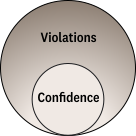
Just 10% of manufacturers expressed uncertainty about their disclosure compliance, but 16% reported actual violations in the past 12 months. Confidence is running higher than outcomes, which is the kind of disconnect that may compound risk.
Tracking compliance metrics regularly keeps confidence levels from overshadowing real risk events, and helps you spot gaps before they show up in an audit.
Manufacturers feel multi-site compliance pain the hardest
Manufacturing operations often span multiple states and facilities. Each location comes with its own local regulations. We asked how difficult organizations find applying consistent screening processes across different locations, business units, or role types.
Manufacturers reported the highest level of difficulty across all five industries surveyed. Distributed footprints, shifting state laws, and role-specific requirements create real operational friction for compliance teams trying to keep screening consistent across the floor.
Multi-site screening difficulty in manufacturing
What this tells us:
Manufacturing's high difficulty score reflects operational reality. Plants and warehouses span multiple states, each with its own screening laws, fair chance rules, and role-specific requirements.
The teams reporting 'not difficult' likely have centralized processes or limited footprints. For everyone else, multi-site compliance is an operational problem, not a paperwork one.

63% of manufacturing compliance work lands on HR generalists
To understand who actually owns screening compliance in manufacturing, we asked which team primarily manages the process.
Manufacturing has one of the highest rates of HR-owned compliance, second only to staffing. Dedicated background check teams have nearly disappeared, dropping by more than half since 2024. Compliance work is consolidating into general HR teams that already juggle multiple priorities.
Manufacturing teams that own screening compliance
2026
2024
HR or onboarding team
Operations team
Recruiting team
Dedicated background check team
Another non-HR team (legal, trust, or third-party)
Compliance demand is up, capacity is flat
To understand whether resources are keeping pace with rising compliance complexity, we asked manufacturers how their headcount and budget for compliance management has changed over the past 12 months.
Most manufacturers are managing more compliance work with the same team and budget they had a year ago. A small group actually pulled back resources, which tracks with broader workforce pressures hitting the industry. Few grew their compliance investment, leaving the majority of HR teams stretched thinner as expectations keep rising.
Compliance capacity changes in the past 12 months
So why aren't more manufacturers growing their compliance teams?
A few culprits are likely at work. When we surveyed 500 manufacturing CHROs about their hiring strategies, we found that while HR teams drive significant business impact, 66% still don't have full decision-making influence with executives. Without a seat at the table, securing proper resourcing and budget allocation can be a real challenge.
Common roadblocks to HR tech improvements, like perceived integration and customization gaps, may also be a factor for teams that want to improve efficiency in compliance workflows but aren't sure where to start. The right tech tools and automations should be at the top of any HR leader's compliance support list. The challenges of finding or switching to a new screening vendor are real, but not insurmountable.
Switch background check providers without disrupting high-volume hiring
Gaps drive risk: Manufacturing compliance errors in the past 12 months
To see where execution actually breaks down, we asked manufacturers which specific compliance errors they experienced in the past 12 months.
Inconsistent screening criteria and missing authorization forms top the list, both pointing to process control failures that compound as organizational complexity grows.
Compliance errors for 1,000+ manufacturers
Most common types of violations among manufacturers who reported errors
Takeaway: Focus on consistent execution before adding new layers
While manufacturers have built strong compliance foundations with clear policies and proper authorization processes, execution gaps still exist and drive significant risk. Compliance errors hit nearly half of manufacturers this year, capacity stayed flat despite growing complexity, and multi-site operations created challenges for the majority.
The path forward centers on strengthening execution through better controls, clearer accountability, and additional capacity where teams are stretched thinnest.
Ask your team
- Can we demonstrate that every background check across every facility included compliant disclosure and authorization?
- Where have we experienced compliance errors, and what process failures created them across different sites?
- Does our team have the capacity and expertise to manage screening compliance across all manufacturing locations?
- How do we ensure consistent screening criteria across facilities, shifts, and role types?
Take this action
- Audit recent background checks across every facility to confirm authorization, disclosure, and adverse action compliance.
- Map screening requirements by state and role type to surface gaps across your manufacturing footprint.Identify which sites have unowned compliance gaps and assign a named owner for each before your next audit cycle.
- Standardize screening criteria, disclosure forms, and adverse action workflows across every location. Pro tip: Background check partners like Checkr make this easy with customizable automations for every region and role.
2
Hiring fraud climbs across the manufacturing floor
Hiring fraud has evolved from an occasional case to a challenge that most manufacturers now encounter often. Resume fabrication tops the list of fraud types at 41%, and AI-assisted interview impersonation already accounts for nearly a quarter of cases.
Manufacturers feel the impact harder than most. Resume fabrication, document fraud, and AI-assisted interview impersonation all cluster around the high-volume and credential-heavy roles that define manufacturing hiring.
Most common types of hiring fraud in manufacturing
41%
Resume or credential fabrication
27%
Document fraud (falsified degrees, certifications, licenses, or work history)
24%
Interview fraud (proxy interview or AI-assisted impersonation)
11%
Identity fraud (stolen identity or fabricated personal details)
39%
We have not encountered any hiring fraud
Background checks catch most manufacturing fraud
Background check adjudication is where most manufacturers actually catch fraud, with resume and application screening close behind. Earlier-stage detection is rare, leaving fraudulent candidates in the funnel through interviews and offers before flags surface.
Where in the hiring process fraud is most often identified in manufacturing
Organizational impacts of hiring fraud in manufacturing
To quantify the true cost of a fraudulent candidate making it to the offer stage, we asked manufacturers to identify the most significant impacts fraud has created for their operations. The top responses, ranked:
- Wasted recruiting or talent acquisition team time
- Increased sourcing costs due to re-filling roles
- Additional spend on fraud-detection tools or technology
- Workplace safety incidents
- Reputational harm to the organization
The impact is primarily operational, though some manufacturers face severe outcomes like workplace safety incidents tied to fraud. Another 39% said they have not experienced a significant impact from hiring fraud.
Many manufacturers are waiting too long to catch fraud
AI-powered candidate fraud has accelerated faster than most manufacturing hiring stacks were built to handle. Background checks remain the most common catch point, which means fraud often isn't surfacing until the candidate has interviewed, received an offer, or reached onboarding. By then, recruiter hours are spent and a fraudulent hire is one shift away from a safety-sensitive role.
About a third of manufacturers catch fraud earlier during resume and application screening. The remaining manufacturers absorb the cost of late detection, from sourcing rework to safety risk on the floor.
Takeaway: Build fraud prevention into the manufacturing hiring flow
Teaching your hiring team what fraud looks like on the manufacturing floor and where it most often surfaces is a great first step in speeding up your detection timeline. Next, you'll need to consider what tech gaps you need to fill immediately to lower risk, like automated identity verification early in the hiring flow.
The goal isn't to view every manufacturing candidate with suspicion. It's to build reliable verification checkpoints that catch discrepancies before they become bad hires on the production floor.
Ask your team
- Where are we most vulnerable to fraud in our manufacturing hiring process, and where do we actually catch it?
- What is the true cost of fraud to our operations, including safety incidents and production disruptions?
- Which manufacturing roles experience the most fraud, and are our verification processes proportional to that risk?
- Are we catching fraud before people reach the production floor, or discovering it after safety-sensitive work has begun?
Take this action
- Map fraud detection rates by hiring stages across all manufacturing facilities to identify where verification gaps exist.
- Pull last quarter's fraud cases and tally recruiter hours spent, production hours lost, and any incident reports tied to bad hires.
- Analyze fraud patterns by role type, then prioritize enhanced verification for the roles with the highest safety risk.
- Add identity verification, document authentication, and resume verification to your background check stack to catch fraud before candidates reach the floor.
3
Fraud prevention tops the list of manufacturing priorities for 2026
Fraud is a growing challenge, and it raises your risk. It's stressful to encounter or hear about fake candidates, AI-assisted impersonation, and sophisticated fraud schemes hitting the floor.
Manufacturing HR leaders are uniquely positioned to build a secure, reliable fraud prevention program that puts your organization ahead of the curve. This shift doesn't mean every candidate is a suspect or that hiring is impossible. It means fraud prevention needs to become standard practice, right alongside reference checks and employment verification.
You can push your team past emerging roadblocks faster by focusing on the solution, not just the fear. Manufacturers already have real tools at their disposal, and the most effective fraud detection happens at stages where you're already conducting verification.
Manual review is still the top fraud prevention tool in manufacturing
We asked manufacturing organizations which fraud detection tools and processes they currently use to spot and stop fraud. Document authentication and manual review topped the list, with identity verification technology following close behind.
Fraud detection tools currently used by manufacturers
Manual screening workflows leave manufacturing HR teams stretched thin and exposed to human error, with hours piling up on repetitive tasks.
Fraud is a relatively new challenge for many manufacturers, so it's understandable that more than half of teams are still trying to stop it on their own. Manual workflows aren't scalable. Any HR leader watching their team rely on individual hiring managers to spot fraud without sophisticated identity verification tools should treat that as a red flag.
25% of manufacturers rate their fraud controls as highly effective
Deployment matters less than results, so we asked manufacturers to rate how well their current controls actually catch fraud.
How effective are manufacturing HR teams' fraud prevention controls?
25%
Highly effective
38%
Fairly effective
37%
Somewhat, slightly, or not effective
Just a quarter of manufacturing HR leaders rate their fraud controls as highly effective, even though most have multiple tools in play. Stronger fraud prevention starts with tracking what actually works, cutting what doesn't, and investing more in the controls that prove themselves.
Takeaway: Pressure-test your fraud stack and rebuild for results
Manufacturers have already deployed fraud detection tools, but only a quarter rate those tools as highly effective.
The opportunity isn't buying more software. It's figuring out which controls genuinely catch fraud, dropping the ones that don't, and going all in on what actually works for manufacturing HR leaders.
Ask your team
- Which of our fraud detection tools have actually caught fraud in manufacturing hiring, and which are deployed but unproven?
- How do we measure fraud detection effectiveness across facilities, and do we have data showing which controls work?
- Are we deploying fraud detection tools because they're available, or because we've validated they catch the fraud types we're experiencing?
- What separates effective fraud prevention from ineffective deployment in our hiring process?
Take this action
- Audit fraud detection tools across all manufacturing facilities to flag which ones have actually caught fraud and which haven't.
- Track every fraud incident by which tool flagged it, so you have a clear picture of what's catching fraud and what isn't.
- Drop fraud detection tools that aren't catching fraud or that duplicate other controls without adding value.
- Reinvest the budget freed up by retired tools into the controls that consistently catch fraud, including document authentication, identity verification, and thorough background checks.
4
AI governance in manufacturing depends on HR leadership, not regulation
A maintenance technician applies with polished credentials, a clean interview, and references that respond fast. Three weeks in, you find out the resume was AI-generated and the person operating heavy machinery isn't who they claimed to be. The same AI driving fraud risk on the floor is also the technology that can stop it, if the governance is there to direct it.
Candidates are using AI to fake resumes, run proxy interviews, and bypass traditional screening controls. Manufacturers are using it too, mostly to verify identity faster, flag fraud patterns earlier, and stretch compliance teams further.
Manufacturers that put governance frameworks in place now will move into the next wave of AI adoption with the clarity and protection their teams need. Waiting until regulation forces the conversation usually means scrambling to catch up while competitors set the standard.
Most manufacturers are still building AI governance
We asked manufacturing HR leaders to identify their single biggest concern about AI's role in hiring and screening, and AI-assisted candidate fraud and data privacy tied at the top of the list. The 13% citing lack of internal expertise points to a real capability gap, with manufacturers deploying AI without fully understanding it.
What concerns manufacturing HR teams the most about AI in hiring?
The state of AI governance for manufacturing HR
Concern alone doesn't mitigate risk, but governance does. To assess where manufacturing stands on AI policy, we measured whether formal AI policies exist for hiring decisions across the industry.
The 27% of manufacturers actively developing policies signals real momentum in the right direction. The combined 30% with either informal guidance or no policy at all represent manufacturers using AI without a governance framework, which creates real compliance exposure as the regulatory landscape catches up.
How manufacturing HR leaders rate their AI maturity
Manufacturers are split on whether AI reduces or increases risk
To assess how manufacturers view AI's impact, we asked whether they believe AI is reducing or increasing their overall compliance and fraud risk.
The 26% viewing AI as neutral see it as a tool whose risk profile depends on implementation quality. The split between manufacturers who see AI reducing risk and those who see it increasing risk suggests AI's impact in manufacturing depends heavily on governance quality.
Takeaway: Build AI governance before regulators do it for you
AI is both a fraud enabler and a fraud detector, creating new risks and new capabilities for manufacturers in the same breath.
The path forward isn't avoiding AI. It's building governance plans that bring clarity to how AI gets used, what reviews are required, and how risk gets managed across hiring workflows.
Ask your team
- Do we have a documented AI governance policy that covers hiring and screening across all manufacturing facilities, and is it actively enforced?
- What specific AI-related risks are we most exposed to, including candidate fraud, data privacy violations, bias, or compliance issues?
- Are we deploying AI tools in manufacturing hiring faster than we're building the governance infrastructure to manage them?
- How do we measure whether AI is reducing or increasing our overall compliance and fraud risk?
Take this action
- Draft a formal AI governance policy for manufacturing hiring that addresses transparency, compliance, bias, and candidate communication.
- Audit current AI tool usage across all manufacturing facilities to map which systems are deployed, what risks they create, and whether governance exists for each.
- Train HR and compliance teams on AI-specific risks in manufacturing screening, including candidate fraud capabilities, data privacy requirements, and disparate impact potential.
- Add candidate-facing AI disclosure language to your hiring process so candidates know when and how AI is being used in manufacturing decisions.
From risk exposure to resilient screening
Screening compliance in 2026 gives manufacturing HR leaders a defining opportunity. Fraud prevention, AI governance, and multi-site compliance are core capabilities that separate leaders from those playing catch-up. You're already closer than you think.
Most manufacturers have built strong foundations with documented policies, proper authorization processes, and fraud detection tools in place. The gap isn't awareness, it's execution. That's where HR leaders can sharpen their programs by turning deployed tools into measurably effective systems and building fraud prevention that works across every facility.
This is your moment to lead the floor. Build the fraud prevention program your manufacturing operation needs, bring identity verification into the hiring flow before bad hires reach the production line, and set up AI governance frameworks before competitors do. The manufacturers winning in 2026 are the HR leaders who saw the shift coming.
Turn manufacturing compliance into a competitive advantage with Checkr
Checkr is the data platform that powers safe and fair hiring decisions. Our modern manufacturing background check technology integrates seamlessly with your hiring tech stack and provides transparency, automation, and trust at scale. 140,000+ customers use our solutions to modernize their verifications and deliver an outstanding candidate experience, without losing the human touch.
Ready to unlock manufacturing HR's potential with better background checks?


Survey methodology
All data found within this report is derived from a survey conducted online via a third-party survey platform. HR managers and senior HR leaders responsible for background check processes at manufacturing organizations with 1,000+ employees were surveyed, with 500 respondents total. All participants were screened to confirm their involvement in background check decision-making. Participants were asked to answer all questions truthfully and to the best of their knowledge and abilities.
Disclaimer
The resources and information provided here are for educational and informational purposes only and do not constitute legal advice. Always consult your own counsel for up-to-date legal advice and guidance related to your practices, needs, and compliance with applicable laws.