2026 Staffing CHRO Insights Report

Retention pressure meets the push to modernize
Retention is the workforce challenge staffing leaders are racing to solve. 29% of staffing CHROs named it their single biggest challenge for 2026, ranking above rising compensation pressure, skills gaps, and labor shortages individually.
Drawing on insights from 500 staffing CHROs, with select comparisons to all industries for context, the findings reveal how staffing leaders are tackling four key priorities.
- Modernizing hiring with AI and automation.
- Balancing talent strategy with candidate trust.
- Measuring success with metrics that tie to business outcomes.
- Preparing for the workforce challenges ahead.
Facts from the field
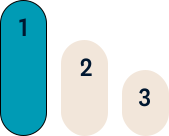
Background checks lead the AI agenda
#1
Background check speed and accuracy
#2
Resume screening and early filtering
#3
Interview scheduling and coordination
AI adoption in staffing hiring is nearly universal
8%
of staffing leaders have no plans to deploy AI, signaling that adoption is quickly becoming the standard, not the exception.
Fraud prevention gaps persist in staffing
33%
of staffing CHROs say they have strong fraud prevention controls in place, mirroring trends across all industries as hiring fraud grows more sophisticated.
Retention is the top workforce challenge for staffing leaders
- Retention
- Rising compensation pressure
- Skill gaps
Technology satisfaction trends positive, but not exceptional
50%
say tools meet expectations
28%
say tools exceed expectations or are exceptional
23%
say tools are marginal or unsatisfactory
The hybrid leader wins
- 47% say a balanced mix of technical and human skills defines high-performing HR leaders
- 18% prioritize technical skills alone

1
Measurement turns influence into credibility
Every executive wants something different from staffing. The only way to satisfy all of them is rigorous measurement that connects workforce outcomes to business performance.
29% of staffing CHROs say employee experience is the most critical planning question
Staffing leaders are grappling with transformation on multiple fronts simultaneously.
Top staffing planning priorities
Staffing teams are balancing operational modernization with a strong commitment to experience and measurement, an approach that positions them to build credibility with leadership.
KPIs driving staffing accountability in 2026
Staffing leaders are aligning on a clear set of performance metrics, with an emphasis on measures that reflect placement quality rather than volume.
KPIs staffing teams are tracking in 2026
- Quality of hire
- Employee retention rate
- Employee engagement scores
- Total program ROI and efficiency
- Time to fill roles
Quality of hire leads the list for staffing, just as it does across every other industry surveyed. Time to fill ranks last, signaling that staffing leaders are prioritizing long-term workforce outcomes over speed metrics alone.
Executive perception is shifting, but not settled
The C-suite's view of staffing determines whether CHROs get a seat at strategic planning tables or get called in after decisions are made.
46%
view staffing as something other than a strategic partner
25%
view staffing as a strategic partner without decision-making influence
29%
view staffing as a strategic leader with a seat at the table
71% of staffing HR leaders say they don't have executive decision influence. Gaining and retaining a seat at the table relies on connecting workforce decisions to outcomes leadership actually tracks, like revenue risk, compliance costs, and time to productivity.
Connect workforce outcomes to business metrics
Staffing strengthens its position when leaders can articulate the business impact of workforce decisions, not just report on activity and efficiency.
Ask your team
- Can we articulate the business impact of an X% improvement in quality of hire or retention?
- What metrics do our CEO and CFO actually look at when assessing staffing performance?
- Are we invited to strategic planning sessions, or informed of decisions afterward?
- Do we have a consistent narrative that connects our initiatives to competitive advantage?
Take this action
- Build a simple dashboard with 5-7 metrics that tell a coherent story about workforce health and staffing effectiveness.
- Translate top KPIs into business language by framing results around cost savings, revenue impact, and risk reduction instead of headcount and time-to-fill.
- Schedule quarterly business reviews with functional leaders to discuss how staffing initiatives are supporting their goals.
- Stop reporting on activities and start reporting on outcomes. Lead with improved quality of hire, reduced backfill costs, and faster time to productivity.
2
64% of staffing CHROs say background check speed is where AI matters most
Staffing hiring runs on speed and scale. When roles go unfilled, client commitments slip, margins shrink, and recruiters absorb the fallout. That's why staffing leaders are betting on AI to cut manual friction from hiring workflows without sacrificing accuracy.
What staffing CHROs want from AI in 2026
Staffing leaders aren't experimenting with AI for the sake of innovation. They're targeting the steps that slow hiring down the most.
Staffing
All industries
- Background check speed and accuracy
- Resume screening and early-stage filtering
- Interview scheduling
- Managing recruiter workload and application queues at high volume
- Identity fraud detection
Staffing priorities closely mirror the all-industry average. Interview scheduling ranks higher for staffing, reflecting the coordination demands of placing candidates across multiple clients and roles.
The hiring tech reality check
Staffing leaders want better technology. Few have it working the way they hoped. It's not the tools themselves. It's budget realities, disconnected systems, and organizational inertia.
Top tech roadblocks cited by staffing leaders
Budget is the clear frontrunner, but the remaining barriers carry nearly identical weight. These challenges are systemic, and fixing one alone won't solve the broader problem.
Hiring tool performance falls short of expectations
Staffing leaders offered a balanced assessment of their technology stack, with most saying tools are functional but not exceptional.
Staffing
All industries
Modernize where it matters most
Technology modernization in staffing succeeds when it speeds up placements and removes the manual work that buries recruiters.
Ask your team
- Where do recruiters lose the most time between job order and placement?
- Which screening and verification steps still require manual follow-up?
- Are our systems integrated, or are recruiters toggling between platforms to move candidates forward?
- Do our tools actually reduce time-to-fill, or just shift the bottleneck somewhere else?
Take this action
- Map your placement workflow end to end and identify the two or three steps where manual effort is highest.
- Prioritize integrations between your ATS, background check provider, and onboarding tools before adding new point solutions.
- Set baseline metrics for recruiter capacity, time-to-fill, and screening accuracy, then measure improvements against real placement outcomes.
- Run a pilot with your background check provider to validate AI-powered verification before scaling it across clients.
3
Candidate trust is now a talent strategy requirement
Staffing candidates have more options than ever, and they're paying attention to how employers treat them during hiring. Speed matters, but so do clarity, fairness, and trust.
35% of staffing CHROs bet on AI to win top talent
Staffing leaders prioritize AI-driven hiring acceleration as their top competitive edge, closely followed by employee experience at 30% and tech transformation at 21%. The tight clustering signals these strategies are interconnected, not competing.
Strategic HR priorities in 2026
Staffing
All industries
Protecting hiring integrity as technology scales
Candidates want faster hiring, but they're wary of the very technology that makes speed possible. Only 33% of staffing CHROs say they have strong fraud prevention controls in place, leaving the majority navigating gaps as AI makes misrepresentation easier to execute.
Confidence levels in fraud prevention
Staffing leaders are also watching the other side of the equation. 42% are moderately or extremely concerned that AI could negatively impact candidate trust if not implemented carefully.
Employee value propositions that actually close the deal
Competitive salary and health benefits aren't enough anymore. Staffing talent expects development, flexibility, and compensation together.
Top staffing EVPs
Career growth leads by a slim margin, but work-life balance and competitive pay are right behind it. Organizations that invest in only one of these will lose.
Flexible work wins across every generation
Four generations in the workforce means four different sets of expectations and communication preferences. The temptation is to create separate strategies for each cohort. The smarter approach is universal principles with flexible execution.
Most effective cross-generational hiring strategies
- Flexible work options
- Tailored recruitment messaging
- Inclusive, multi-generational training
Building candidate confidence at every touchpoint
Ask your team
- When candidates drop out of our placement process, do we know why, and are AI friction points showing up in their feedback?
- Can candidates easily understand what happens to their data and how decisions get made?
- Are we testing our EVP messages with actual target talent, or assuming what resonates?
- Do our flexibility policies exist on paper or in practice, and can candidates tell the difference?
Take this action
- Create a candidate-facing explanation of how AI is used in your hiring process and where human judgment remains central.
- Survey recent placements and near-miss candidates about their experience, specifically around trust and transparency.
- Map your EVP claims against actual employee experiences to identify misalignment before candidates discover it.
- Pilot generational segmentation in messaging while maintaining consistent underlying value propositions.
4
Retention and compensation reshape staffing
The future isn't some distant abstraction. It's arriving in quarterly increments. AI capabilities that seemed experimental 18 months ago are now baseline expectations. Talent that once accepted traditional employment models now demands fundamentally different arrangements.
Workforce risks on the horizon
Staffing CHROs identified the single biggest workforce threat if left unaddressed. Their answers cluster around three interconnected challenges: keeping people, paying people, and ensuring people have the right skills.
Top future workforce risks
Retention leads, but only by eight points over compensation pressure. These risks aren't independent. They're different manifestations of the same underlying dynamic, and talent has more leverage than in previous decades.
Where staffing stands on AI adoption
Staffing organizations report steady progress toward AI adoption, with many teams moving beyond early exploration into more defined use cases.
AI maturity levels in HR
Staffing
All industries
Staffing shows slightly higher adoption maturity than the all-industry average, with fewer teams reporting no AI usage. The industry's volume-driven model creates a natural proving ground for AI tools focused on speed, screening, and coordination.
Build for retention, readiness, and resilience
Workforce continuity, skills availability, and leadership adaptability will determine how well staffing organizations withstand ongoing labor pressure.
Ask your team
- Which workforce risks pose the greatest threat to client service reliability over the next few years?
- How far has our technology adoption progressed beyond pilots and isolated tools?
- Do staffing leaders have the blend of judgment, adaptability, and technical fluency needed to guide teams through change?
- Are we proactively building capabilities, or responding only when challenges surface?
Take this action
- Treat retention and skills readiness as foundational to operational stability.
- Evaluate AI adoption honestly to identify where maturity and capability gaps remain.
- Develop leaders who can translate workforce strategy into real operational outcomes.
- Integrate skill-building directly into execution so learning supports day-to-day performance.
Staffing teams that build capability and leadership readiness now will be best positioned as workforce demands shift.
5
Staffing HR's next competitive advantage
The staffing CHROs we surveyed are managing a function in fundamental transition. The administrative foundations remain essential, but they're no longer sufficient.
AI adoption is accelerating, but not recklessly. Efficiency gains are pursued, but not at the expense of candidate trust. Metrics are becoming more sophisticated, connecting staffing actions to business outcomes rather than just tracking activity.
What separates the highest performers isn't better technology or bigger budgets. It's the discipline to connect investments to strategy, the courage to measure what actually matters, and the ability to adapt as quickly as the environment demands.
Faster, fairer staffing background checks at scale
Checkr is the data platform that powers safe and fair hiring decisions. Our modern staffing background checks integrate seamlessly with your hiring tech stack and provide transparency, automation, and trust at scale. For staffing teams, that means faster screenings across high-volume roles, streamlined compliance, and a mobile-first candidate experience built for workers who need to get started quickly.
Learn more about staffing background checks with Checkr.
Ready to unlock staffing HR’s strategic potential with better background checks?

Survey methodology
All data in this report is derived from a survey conducted online via a third-party platform. In total, 500 Chief Human Resources Officers (CHROs) working in the staffing industry were surveyed over a two-week period spanning December 2025 and January 2026. All respondents were screened to confirm their senior HR leadership role. Participants were asked to answer all questions truthfully and to the best of their knowledge and abilities.
Disclaimer
The resources and information provided here are for educational and informational purposes only and do not constitute legal advice. Always consult your own counsel for up-to-date legal advice and guidance related to your practices, needs, and compliance with applicable laws.