The 2026 State of Screening Compliance for Retail

Introduction
Compliance consistency, fraud detection, and AI governance now define retail hiring
This report draws on survey responses from 500 HR leaders managing hiring in retail organizations with 1,000+ employees. It benchmarks where compliance and fraud detection stand today in an industry built on high-volume hiring, multi-location operations, and a workforce that mixes salaried managers with seasonal hourly workers.
Three priorities define retail's screening compliance agenda in 2026:
- Sustaining compliance execution (despite high confidence, 49% still report errors)
- Closing the gap on hiring fraud (59% have encountered hiring fraud in the past year)
- Developing AI governance frameworks (only 25% have documented, enforced policies)
Retail teams that move first in these areas will turn compliance, fraud detection, and AI into durable advantages rather than emerging liabilities.
Fast facts from the field
Compliance confidence remains high, but errors persist

63% of retail HR leaders report complete confidence in compliance policies. Yet 49% experienced at least one compliance error in the past year.
Compliance ownership now sits primarily with HR
58%
of retailers place screening compliance with HR or onboarding teams, compared with 12% that use dedicated background check teams.
Resume fabrication leads retail hiring fraud

34% of retail teams encountered resume or credential fabrication in the past year, narrowly ahead of document fraud at 30%.
Background screening is still the main fraud checkpoint
41%
of retailers identify hiring fraud at background check adjudication, making it the most common detection point. Earlier-stage controls could surface more candidates before recruiters spin wheels.
Automating fraud detection can be a quick win in 2026
47%
of retail HR still relies on manual review to detect fraud, and only 34% rate their controls as highly effective.
AI governance is the next frontier for retail
25% of orgs have a documented, enforced AI policy for hiring, and 50% are still developing one, relying on informal guidance, or operating without a policy. (The remainder don’t use AI.)

1
Confidence in foundation, team, and policy
Retail organizations enter 2026 with compliance programs built for complexity. High-volume hiring, many locations, and a mix of role types have pushed retailers to formalize policies and processes.
That foundation matters, but scale still creates risk. The more hiring happens across locations and teams, the harder it is to maintain consistent execution.
For retail HR leaders, the challenge is keeping compliance consistent across every store, role, and hire.
Compliance policy readiness has climbed since 2024
We asked retail HR leaders how confident they are that their documented background check policies comply with federal, state, and local screening laws and regulations.
63% are completely confident, and that number has risen since 2024.
Retail HR leaders' level of confidence in their background check compliance
2026
2024
Completely confident
Not completely confident
Authorization and disclosure compliance confidence
Missing authorization and disclosure forms remain the top source of compliance violations across industries year after year. Retail shows strong execution, with 90% strongly agreeing or agreeing that they provide compliant forms for every background check, up from 75% in 2024.
Retail HR leaders: Are you providing compliant disclosure and authorization forms?
2026
2024
Strongly agree
Agree
Neither, disagree, or strongly disagree
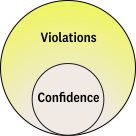
49% of retailers reported compliance errors in 2026
Strong policy confidence and high authorization compliance don't prevent all failures. Retail organizations identified specific compliance breakdowns in the past 12 months. 49% experienced at least one error, a significant share given the volume of hires in retail processes annually.
Compliance errors among transportation organizations with 1,000+ employees
Most common types of violations reported by retail HR teams in 2026
- Missing or incomplete candidate authorization or disclosure forms
- Non-compliant disclosure documents
- Inconsistent screening criteria applied across locations, roles, or business units
- Incorrect or late adverse action notices
- Failure to provide a pre-adverse action notification before a final decision
- Failure to conduct required individualized assessments
Perception v. reality
A revealing disconnect runs through the data. While only 11% of retail respondents expressed uncertainty about their authorization and disclosure compliance, 19% reported missing or incomplete authorization or disclosure forms in the past 12 months.
Most retail organizations have strong compliance policies on paper, but the downfalls come from execution across dozens or hundreds of locations. Individual managers and recruiters make daily screening decisions without real-time visibility into compliance. Consistency requires both infrastructure and documentation.
Multi-state screening challenges 56% of retailers
We asked how difficult it is for retail HR leaders today to apply consistent screening processes across regions, business units, franchisees, or roles.
Here, we see a much smaller percentage of retail teams fully endorsing their current screening program. This is one area of compliance where risk is higher, and opportunities to fill gaps remain.
- Multi-state retail chains and franchise operations feel this friction most acutely, where store-level hiring decisions must align with corporate compliance standards and varying state and local ordinances.
How difficult is it to ensure background check consistency across regions, business units, franchisees, or roles?
44%
Not difficult
28%
Slightly difficult
20%
Moderately difficult
6%
Very difficult
2%
Extremely difficult
What this tells us:
Retail organizations reporting no difficulty likely benefit from centralized compliance functions or operate through a standardized franchise model with consistent national practices. More than half of the people experiencing friction are managing the operational reality of layered state laws and local ordinances that don't map cleanly onto a single national policy.
For multi-state retailers, jurisdiction-specific compliance isn't a regional HR problem. It's potentially a central operations problem.

Compliance ownership shifts from recruiting to HR in retail
A trend we saw emerge in the 2026 Retail CHRO Insights Report is once again confirmed in this survey. Retail HR teams are taking on more responsibility for risk and fraud management.
Since 2024, the role of retail recruiting teams in screening compliance has nearly halved, dropping from 19% to 10%. Dedicated background check teams held flat at 12%. General HR teams now own 58% of retail screening compliance, up from 55% in 2024.
The bulk of compliance ownership in retail now sits with general HR teams. Specialist teams have stayed stable while recruiting teams stepped back, leaving HR with the broadest mandate.
Who owns the screening compliance process in retail?
2026
2024
Hr or onboarding team
Dedicated background check team
Recruiting team
Operations team
Another non-HR team (legal, trust, or third-party)
Across the industries we surveyed, retail's allocation to dedicated background check teams stands out.
- At 12%, retail's dedicated background check team share runs higher than the all-industries average (8%) and has held flat since 2024.
- Retail operations teams now own 6% of compliance ownership, up from 2% in 2024, as some chains push compliance accountability closer to store operations.
Despite growing responsibility, 63% of retailers haven't grown compliance resources
From rising threats of AI-powered fraud to the shift of compliance responsibility toward HR generalists, demand for risk and compliance management support continues to grow in retail. The question is whether resource allocation matches that demand.
Most retail organizations (55%) are managing increased compliance complexity with no change in resources, and a small percentage (8%) have actually decreased resources.
How has retail HR headcount and budget for compliance management changed in the past 12 months?
So why are only 37% of retail HR teams growing compliance resources?
As we saw in the 2026 Retail CHRO Insights Report, 73% of retail HR leaders still don't believe they have decision-making influence with executives. Without a seat at the table, securing a budget can be challenging.
Tech roadblocks such as integration gaps are another factor. The right tools and automations should be a top priority for any retail HR leader, and switching to a new screening vendor can deliver the ROI boost teams need to drive impact.
Consistency and automation fill compliance gaps
Ask your team
- Pull background check records from three recent hires across different store locations. Can you confirm the authorization timing, the screening criteria applied, and the adverse action notices for each one?
- List every role type you hire, from seasonal cashiers to district managers. Do you have pre-built screening packages in your background check dashboard that show which checks apply to each role in each state?
- How does your team ensure the right disclosure and authorization forms are used for each candidate based on role and jurisdiction? If that process depends on manual lookup, you likely have a consistency gap.
Take this action
- Audit your current screening workflow to confirm that form selection, notice timing, and check packages are built into the system by role and location. If those steps still happen outside the platform, that’s where compliance risk can grow.
- Configure role- and jurisdiction-specific screening packages in your background check platform so the right checks are applied automatically for each hire. Compliance should be built into the workflow, not managed through static reference sheets.
- Choose a screening partner with transparent reporting and configurable workflows. In a scaled retail program, compliance management should run automatically through the system, not through manual spot-checking.
From Speed to Trust: How Retail HR Leaders Are Fixing Hiring With AI
2
Retail HR teams race to catch hiring fraud
Retail hiring volume creates fraud exposure that can compound with every new location. The same speed that drives competitive hiring also creates openings for resume fabrication, identity fraud, and increasingly sophisticated AI-assisted deception.
59% of retail HR leaders encountered hiring fraud in the past year. Less visible is where that fraud concentrates, when it's caught, and what it actually costs across recruiting, safety, and legal exposure.
Most common types of hiring fraud in retail
- Resume or credential fabrication
- Document fraud (falsified degrees, certifications, licenses, or work history)
- Interview fraud (proxy interview or AI-assisted impersonation)
- Identity fraud (stolen identity or fabricated personal details)
At what stage in the hiring process do retail orgs identify fraud?
When fraud becomes a financial and safety problem
To quantify the true cost of a fraudulent candidate reaching the offer stage, we asked retail organizations to identify the most significant impacts of fraud on their operations. Top responses ranked in order include:
- Wasted recruiting or talent acquisition team time (33%)
- Increased sourcing costs due to re-filling roles (23%)
- Additional spend on fraud-detection tools or technology (16%)
- Financial loss from theft, fraud, or liability (16%)
- Litigation or legal exposure (13%)
The impact for retail is primarily operational and financial (wasted recruiter time and increased costs). 37% of retail respondents said they have not experienced a significant impact from hiring fraud.
The takeaway: Many retail teams are catching fraud too late
The rise in AI-powered candidate fraud has many HR teams scrambling to keep up. Most aren't catching fraud until background check review, a step that typically happens after applications, phone screens, and often in-person interviews. Detection sometimes comes even later, during I-9 onboarding, once a candidate has accepted an offer.
About a third of retail teams catch fraud earlier during resume and application screening. That leaves 64% of retail HR teams spinning wheels, wasting resources, and opening themselves to increased risk by keeping fraudulent candidates in the funnel.
Front-load verification before the investment in the interview
Most retail fraud surfaces too late, after recruiter time, manager interviews, and onboarding coordination have already happened. The fix isn't more screening at the end. It's earlier verification checkpoints, like automated identity verification at the application stage, that catch discrepancies before they reach interview scheduling.
The goal isn't to view every candidate with suspicion. It's to build reliable verification at the application and screening stages, before fraudulent candidates move through the funnel.
Ask your team
- How much time do recruiters or managers spend on candidates before identity verification begins, and where could earlier verification reduce wasted effort?
- Pick your three highest-turnover locations. Do they have a higher fraud rate? If so, where are HR managers assuming identity instead of verifying it?
- At what point in your hiring workflow is fraud most often detected today, and what would it take to surface that risk earlier?
Take this action
- Identify every step in your hiring flow where candidate identity is assumed, but not verified. Those are risk gaps that you can quickly close with an automated screening solution.
- Move fraud controls earlier in the workflow by choosing a verification partner that can trigger identity and document checks automatically based on role, risk level, or workflow stage. In a high-volume retail program, earlier detection should come from workflow design, not manual enforcement.
- Choose a screening partner gives your team clear visibility into where fraud checks run, what gets flagged, and compliance requirements for background checks in conjunction with identity verification. In a scaled retail program, detection should be systematic and easy to monitor.
Get The HR Leader’s Guide to Preventing Fraud With Identity Verification
3
Preventing fraud strengthens compliance and tops 2026's priority list
Hiring fraud in retail isn't abstract. It's resume fabrication slipping past overworked hiring managers and fraudulent identities reaching onboarding, while legitimate candidates wait. Small issues compound faster than manual processes can catch them.
Retail HR leaders have an advantage. You've built the infrastructure for high-volume screening, and fraud prevention plugs into the stages you're already running.
Document authentication leads, but manual review still handles 47%
Retail organizations were asked which fraud-detection tools and processes they currently use to identify credential fraud, identity theft, and falsified employment histories.
Tools and processes used to detect fraud in retail
Fraud feels like a new challenge for retail HR, which makes it understandable that nearly half of the teams still rely on manual review. The risk is that manual workflows can't keep pace with retail's hiring volumes, leaving individual store managers and recruiters to spot fraud without the help of automated verification tools.
34% of retail leaders rate fraud controls as highly effective
Processes and tools only work when the output matches the effort. Retail organizations rated how effectively their current controls actually prevent fraudulent hires before they occur.
How effective are retail teams' fraud prevention strategies?
34%
Highly effective
38%
Fairly effective
28%
Somewhat, slightly, or not effective
Fewer than 4 in 10 retail HR leaders rate their controls as highly effective. The 28% rating controls as somewhat effective or worse, represent a sizable share of organizations carrying screening risk they've already identified as inadequate.
Evaluate verification performance and target fraud-focused upgrades
Retail organizations deploy a solid verification stack, but tool presence and tool performance are different metrics. The strategic question is which controls are actually catching fraud, which are creating false positives that slow hiring, and which are duplicating effort without adding protection.
Ask your team
- Can your team clearly see which verification steps are catching fraud today, and where in the workflow those signals appear?
- Are identity, document, and background check workflows configured to work together in a way that reduces duplicate effort and surfaces risk earlier?
- Does your current verification setup give you enough visibility to understand which controls improve outcomes versus which ones simply add friction?
Take this action
- Look for places where identity, document, and background check steps may be fragmented across systems or vendors. The more disconnected the workflow, the harder it is to catch fraud efficiently.
- Review whether your verification workflow gives your team clear reporting on where fraud is detected, which checks are generating signals, and where exceptions require attention.
- List every vendor touching your screening workflow. If more than one is doing the same check, consolidate. Fragmentation is where fraud slips through, and it's also where your budget leaks.
- Switch to a screening provider that combines fraud prevention, screening, and reporting workflows into one dashboard (ideally, integrated into your ATS/HRIS), so your team can improve fraud detection without adding manual review or unnecessary complexity.
4
AI governance in retail relies on HR leadership, not outside regulation
AI is reshaping the fraud landscape from both sides. Some candidates may be using it to fabricate credentials, generate fake resumes, and simulate competence in virtual interviews. Retail organizations are using it to screen faster across high-volume pipelines and flag patterns that manual review misses.
What's missing for most organizations is a governance framework that makes AI use intentional and defensible. Retail organizations that build that framework now will be ready when scrutiny arrives.
Fraud expansion is the top AI concern for retail HR
70% of retail organizations have concerns about AI's role in hiring and screening. Here’s what’s keeping them up at night.
HR leaders: If you are worried about AI’s impact on retail hiring, what’s most concerning?
Retail AI governance is fractured
Concern about AI risk doesn't translate to protection on its own. Documented, enforced governance does. In retail, the picture is fractured. A quarter of organizations operate with formal policies, another quarter is actively building them, and the rest operate somewhere between informal guidance and nothing at all.
How do retail HR leaders rate their team’s AI maturity and policies?
Get ahead of AI risk with clear governance
Retail’s window to put clear AI governance in place is narrowing. Organizations that define acceptable use, require human oversight, establish candidate disclosure practices, and set standards for bias testing now will be better prepared for future regulatory scrutiny.
Ask your team
- List every AI tool touching your hiring workflow. Think outside the box and ask SMEs for input—AI is often working in more places than you think. For each one, ask whether documented policies, guidelines, or disclosures exist.
- Ask each AI vendor what their platform actually does with AI, what data trains it, and how flagged decisions are made. Vague answers are a red flag.
- Look at AI-assisted fraud cases from the past year. How were candidates using it, and what caught it?
Take this action
- Establish a review process for any new AI tool added to the hiring workflow this quarter, including documented guidelines for approved use. Clear guardrails help teams move faster without creating governance gaps.
- Before adopting a new AI vendor, ask for written documentation on how AI is used, what data informs the system, and how outputs can be reviewed or explained. If those answers aren’t clear, treat that as a signal to dig deeper.
- Before expanding AI use in hiring, identify where human review should remain part of the process, especially for higher-risk decisions. Clear escalation points and oversight expectations make AI use more consistent, defensible, and easier to govern.
From compliance management to true competitive advantage
Retail HR leaders in 2026 operate with a compliance infrastructure built to handle complexity. Policy confidence at 63%, authorization execution at 89%, and growing investment in fraud detection tools confirm that the foundational work is in place.
The strategic challenge isn't whether the framework exists. It's whether execution matches intent across every location, every role type, and every hire. The 49% who experienced compliance errors this year didn't fail for lack of policies. They failed because compliance is hard to enforce consistently across retail's distributed operations.
The path forward runs through three priorities.
- Bring policy confidence and execution consistency together.
- Move fraud detection earlier in the hiring funnel, before interview time is wasted.
- Build AI governance before it's too late.
Retail organizations that execute on these priorities won't just reduce compliance risk. They'll hire faster, more safely, and more efficiently than competitors, while still managing compliance reactively.
Turn compliance into a competitive advantage with Checkr
Checkr is the verification platform that powers safe and fair hiring decisions. Our modern retail background checks integrate with 200+ ATS/HRIS platforms and provide transparency, automation, and trust across high-volume hiring. 140,000+ customers use our solutions to modernize their verifications and deliver an outstanding candidate experience, without losing the human touch.
Ready to unlock retail HR's strategic potential with better background checks?



Survey methodology
All data in this report is derived from an online survey conducted via a third-party platform. HR managers and senior HR leaders responsible for background check processes at retail organizations with 1,000+ employees were surveyed, for a total of 500 respondents. All participants were screened to confirm their involvement in background check decision-making. Participants were asked to answer all questions truthfully and to the best of their knowledge and abilities.
Disclaimer
The resources and information provided here are for educational and informational purposes only and do not constitute legal advice. Always consult your own counsel for up-to-date legal advice and guidance related to your practices, needs, and compliance with applicable laws.