
Ready to run background checks the modern way?
Why identity verification matters now
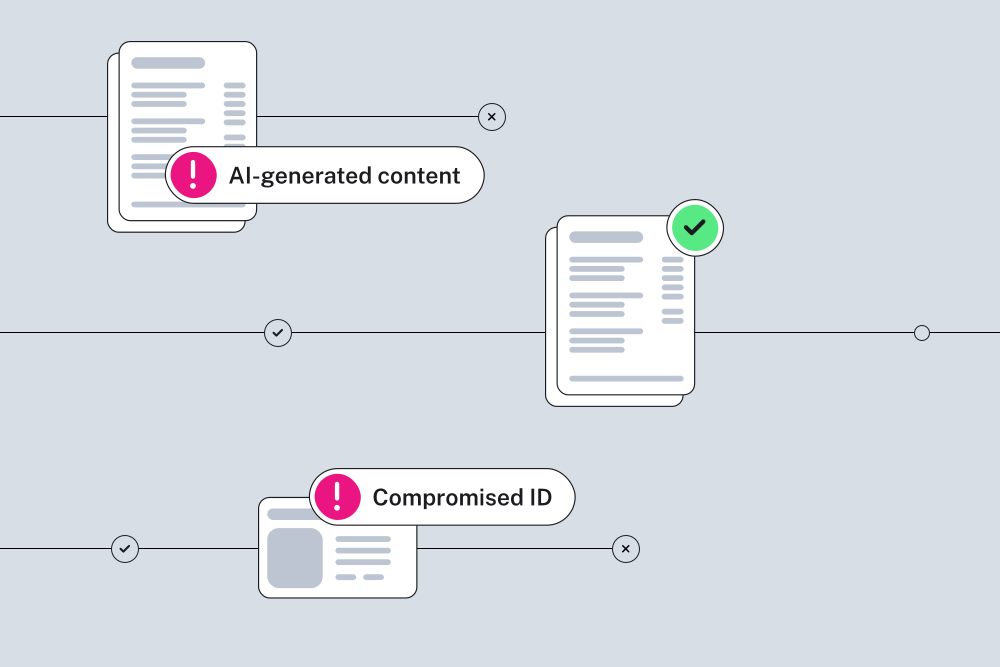
Hiring fraud is evolving in real time, and the rules of hiring are changing. AI-generated resumes, stolen identities, proxy applicants, and deepfake interviews are appearing in pipelines before teams even realize it. With over half of managers now suspecting candidate misrepresentation, organizations must build hiring strategies that balance speed and verification in a world where deception moves as fast as technology.
For HR teams hiring distributed workforces, identity verification has become essential. As companies increasingly hire across cities, states, and even countries, the challenges of confirming a candidate’s identity grow exponentially. Remote interviews, virtual onboarding, and decentralized teams create gaps that fraudsters can exploit.
Current market signals that validate urgency include:
- Only 31% of CHROs are extremely confident in their organization’s ability to prevent hiring fraud.
- Identity fraud detection is now a top-five AI-driven priority for HR leaders in 2026.
- 40% of HR leaders want faster background checks; 35% want more reliable fraud detection, underscoring the pressure to modernize without sacrificing candidate trust.
What is the impact of unverified candidates?
- Wasted time interviewing and onboarding individuals who misrepresent themselves
- Operational delays that slow offers and disrupt workforce planning
- Compliance, security, and reputational risks when fraudulent hires gain access to systems or sensitive data
Decision insight
Organizations that hire at scale, handle sensitive information, or operate in regulated industries can prevent costly mis-hires by embedding identity verification early in the workflow. It’s a proactive safeguard, not just a compliance checkbox.
Help stop fraud early in your hiring funnel
Checkr’s Identity Verification (IDV) solution helps organizations reduce fraud risk while maintaining a smooth candidate experience.
With IDV, you can:
- Establish verified identity upfront: Confirm candidate identity before advancing them in your hiring process.
- Reduce wasted time and screening spend: Prevent fake, stolen, or misrepresented identities from advancing to interviews, background checks, or onboarding.
- Strengthen compliance and audit readiness: Maintain documented proof of reliable identification records to support compliance, security, and internal risk reviews.
Market context
With nearly 40% of HR leaders concerned about candidate trust in AI-driven hiring, verification solutions must balance security with transparency and ease of use.
Where to add IDV in the hiring funnel (remote + high-volume roles)
Not every role or stage requires the same level of verification. Use the below matrix to guide different pilot programs.
Candidate risk | Hiring volume | Recommended IDV approach |
High-risk (compliance, finance, healthcare) | Low/Medium | Verify identity at key points of the hiring process and before the background check. Extra verification reduces fraud and regulatory exposure. |
High-volume roles (retail, warehouse, remote contractors) | High | Verify identity before the background check to scale efficiently. Candidates who pass move automatically to the background check; those who can’t be verified are flagged for follow-up, preventing wasted resources and reducing risk. |
Decisions prompts:
- Which roles have the highest exposure to identity fraud?
- Which hiring stages can IDV be embedded in?
- Where can IDV first deliver a measurable impact?
Tip: Start small with high-risk roles or a smaller hiring class, then expand once KPIs show success.
Buyer's checklist: how to evaluate an identity verification provider
Instead of just comparing features, evaluate solutions based on business impact, integration, and candidate experience.
Topic | Checkr IDV | Questions to ask providers you evaluate |
Integration | Integrates with 200+ ATS and HRIS systems to keep your hiring workflows running smoothly. | Does verification feed directly into existing workflows, or does it require manual steps? |
Fraud Detection | Analyzes ID, selfie, liveness (proof of presence), and device/location signals. | Can it detect sophisticated fraud beyond basic selfie checks? |
Candidate Experience | Fully integrated into the background check flow, with candidate information pre-filled upon verification. Mobile-first experience completed in ~2 minutes. | Are candidates redirected or prompted to create new logins? Do they have to fill in information in multiple places? Is there a mobile-optimized experience? |
Compliance and Security | NIST 2, ISO 27001, SOC 2 Type 2, CCPA/BIPA | Which certifications are held? How is adherence to local laws enforced? |
Decision insight:
Prioritize IDV solutions that reduce candidate friction, integrate seamlessly, and provide verifiable risk reduction, as these are the biggest drivers of adoption and business impact.
Implementation checklist: rolling out IDV across teams
Step 1
Step 2
Step 3
Step 4
Step 5
Assess vendor fit
- Conduct discovery to ensure the solution aligns with hiring needs.
- Ensure alignment with applicable privacy and data handling expectations.
- Confirm integrations: auto-trigger background checks, pre-fill candidate data, handle failed/incomplete results.
- Ensure advanced fraud detection beyond standard ID and face scans.
Define placement
- Identify the hiring stage where IDV will have the most impact (e.g., before the background check).
- Highlight workflow points with highest fraud risk.
- Assess timing to introduce IDV without increasing candidate drop-off.
- Optionally, map roles by risk and volume to prioritize.
Set internal policies
- Decide how to handle failed, canceled, or incomplete verifications.
- Review policies with legal counsel for compliance and approval.
- Include escalation steps for exceptions or flagged fraud.
Prepare internal and candidate facing communications
- Align recruiters on IDV workflow and candidate messaging.
- Provide mobile-first instructions and guidance on acceptable IDs/selfies.
- Request a candidate FAQ from the provider.
- Share best practices for handling candidate issues or drop-offs.
Pilot and monitor
- Test IDV with a small candidate group to validate workflow and experience.
- Track KPIs: completion rates, time-to-verify, drop-off, fraud detected.
- Refine communications, policies, and workflow based on pilot results.
- Gradually scale rollout once success metrics are met.
Quick action checklist
- Map hiring stages and high-risk roles where IDV will be implemented.
- Define internal policies for handling failed or canceled results with your HR, Risk, and Legal teams.
- Train teams on the candidate experience and workflow.
- Confirm legal/privacy compliance for data collection and handling.
- Test the IDV flow internally or with a small pilot group.
- Refine workflow based on pilot results before full rollout.
Business outcome framing
Early IDV adoption strengthens quality-of-hire metrics, builds executive confidence, and demonstrates HR’s ability to manage risk — all while accelerating hiring.
Safeguard your hiring funnel
FAQs
How does identity verification help prevent deepfake interviews?
Modern IDV solutions use a combination of government-issued ID validation, live selfie capture, and liveness detection to ensure candidates are physically present and not using prerecorded videos, AI-generated faces, or impersonation tools. These checks make it difficult for fraudsters to rely on deepfakes, stand-ins, or manipulated media during remote interviews.
By verifying identity early in the funnel and linking results to background checks and hiring systems, HR teams can confidently move forward knowing the candidate behind the screen is authentic. This reduces wasted interview time, protects hiring teams from sophisticated fraud tactics, and helps maintain trust in virtual hiring processes.
When should I run identity verification for remote contractors—before or after the background check?
Identity verification can be run at multiple points in the hiring process, depending on your risk profile and operational needs. Many organizations choose to run IDV before the background check so only verified candidates move forward. This can help prevent time and money from being spent on background checks for individuals who cannot confirm their identity.
Some employers also use IDV as a standalone check for higher-risk or sensitive roles, especially when rapid onboarding is required. In these cases, identity verification acts as an early screening step before interviews or final offers.
An effective approach is to align IDV placement with role risk, hiring volume, and compliance requirements. For remote and high-volume hiring, running IDV upfront (before background screening) typically delivers the greatest efficiency and fraud prevention impact.
What’s the difference between identity verification and a background check?
Identity verification and background checks serve different but complementary roles in preventing hiring fraud.
Identity verification confirms that a candidate is who they claim to be by validating government-issued ID, biometric data, liveness, and device signals. It establishes a verified foundation for the hiring process and helps prevent fake, stolen, or synthetic identities from entering the funnel.
A background check, by contrast, evaluates a candidate’s history and qualifications, such as criminal records, employment, and education. These checks rely largely on name-based records and public databases. Confirming identity can help provide a more complete view in background check results.
Together, IDV and background screening create a layered, end-to-end approach to hiring. Identity verification anchors the process in trust, while background checks add context and insight, which gives HR teams a complete view of each candidate without adding unnecessary friction.
Does identity verification slow down hiring?
Identity verification shouldn’t slow down hiring.
At Checkr, identity verification is built directly into a mobile-optimized candidate flow, so applicants stay within the same experience they’re already familiar with from the background check. There are no redirects, extra logins, or separate accounts required.
In contrast, some providers require candidates to create digital wallets or complete verification outside of the hiring workflow, which can introduce friction and delays.
In testing, we’ve seen candidates complete identity verification in minutes when it’s embedded seamlessly into the hiring process—without impacting overall hiring speed.