The 2026 State of Screening Compliance for Staffing

Introduction
Fraud prevention and AI governance are reshaping the staffing screening playbook
Fraud prevention and AI governance are reshaping the staffing screening playbook for 500 HR leaders at staffing organizations with 1,000+ employees.
The findings point to three priorities for staffing HR teams that want to reduce risk and stay ahead:
- Strengthening compliance execution (despite high confidence, 43% still report errors)
- Building effective fraud prevention capabilities (61% have encountered hiring fraud)
- Developing AI governance frameworks (only 25% have documented, enforced policies)
Staffing teams that address these priorities will turn compliance, fraud prevention, and AI governance into durable advantages rather than emerging liabilities.
Fast facts from the field
High confidence doesn’t eliminate errors

Nearly two-thirds of staffing HR leaders say they’re confident in their compliance policies, but 43% still reported at least one compliance error in the past year.
HR owns compliance
69%
In staffing, screening compliance is most often managed by HR or onboarding teams. 69% of organizations rely on those teams, while only 7% use a dedicated background check function.
Hiring fraud starts with resumes and credentials
36%
of staffing organizations encountered resume or credential fabrication in the past year, with document fraud close behind at 32%.
Fraud occurs across the funnel
Application screening and background check review are the two most common stages where staffing organizations identify fraud.

Manual review falls short
51%
of staffing organizations rely on manual HR review to detect fraud, yet only 33% rate their controls as highly effective.
AI governance is the next frontier for staffing
Just 25% of staffing organizations have documented, actively enforced AI governance policies despite widespread tool deployment.

1
Confidence in foundation, team, and policy
The data shows that most HR staffing organizations have built this foundation. The majority express confidence in their compliance policies, provide appropriate candidate authorization forms, and have designated teams to manage screening.
Every placement crosses jurisdictional lines, client requirements, and role-specific screening standards at once. The organizations that have built systematic compliance programs have done so out of necessity, because the cost of getting it wrong lands on both the staffing firm and the client.
Confidence alone doesn't guarantee execution. Understanding where gaps exist, and why, helps staffing organizations strengthen their compliance programs in practical and measurable ways.
Confidence in compliance and policy readiness grows
Staffing HR leaders were asked how confident they are that their documented background check policies comply with federal, state, and local screening laws and regulations.
63% are completely confident, and that number has risen since 2024.
Staffing HR leaders’ level of confidence in their background check compliance
2026
2024
Completely confident
Not completely confident
Authorization and disclosure compliance confidence
Missing authorization and disclosure forms during background checks are cited by respondents as the top source of compliance violations year over year. Staffing shows strong execution here, with 92% of respondents agreeing or strongly agreeing that they provide compliant forms for every background check, one of the highest rates of any industry surveyed.
Staffing HR leaders: Are you sure you're providing the right disclosures and authorization forms for background checks?
2026
2024
Strongly agree
Agree
Neither, disagree, or strongly disagree
Perception v. reality
A revealing disconnect runs through the data. While only 8% of staffing respondents expressed uncertainty about their authorization and disclosure compliance, 18% reported missing or incomplete authorization or disclosure forms in the past 12 months.
The divide likely reflects an execution pattern unique to staffing, where authorization processes are well-designed at the firm level but break down when placement speed, client-specific workflows, and multi-jurisdiction requirements collide in the same hire.
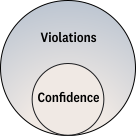
43% of staffing organizations reported compliance errors in 2026
Staffing organizations identified specific compliance breakdowns over the past 12 months. The error distribution reflects the industry's core challenge of managing screening consistency across clients, roles, and jurisdictions simultaneously.
Compliance errors for staffing organizations with 1000+ employees:
Most common types of violations reported by staffing HR teams in 2026
Inconsistent criteria and missing authorization forms are the most common, both reflecting process control failures that compound as organizational complexity increases.
55% find compliance across clients, roles, and jurisdictions challenging
We asked how difficult it is for HR leaders to apply consistent screening processes across business and candidate locations today.
Here, we see a much smaller percentage of hiring teams fully endorsing their current screening program, indicating this is one area of compliance where risk is higher, and opportunities to fill gaps remain.
- Staffing HR leaders feel this pain acutely, with 55% citing difficulty with multi-location screening, the highest share of any industry surveyed. This reflects the operational reality of layered client requirements that shift by engagement, role, and jurisdiction.
How difficult is it to ensure background check consistency across clients, roles, and jurisdictions?
45%
Not difficult
48%
Slightly or moderately difficult
7%
Very or extremely difficult:
What this tells us:
The 55% reporting difficulty is notable for staffing. Moderate friction in a high-volume placement environment means compliance inconsistency occurs regularly rather than occasionally. Each placement that goes out with inconsistent screening criteria poses a client-relationship risk and a potential liability.

HR holds 69% of compliance ownership
A trend we saw emerge in the 2026 Staffing CHRO Insights Report is once again confirmed in this survey. Staffing HR teams are taking on more responsibility for risk and fraud management.
Since 2024, the share of general HR teams that own screening compliance in staffing has risen by 31%, while dedicated background check teams and recruiting teams have both more than halved their ownership.
The bulk of compliance ownership in staffing now rests with general HR teams rather than specialists, and that represents both a new hurdle and a significant opportunity for staffing HR leaders focused on growth.
Who owns the screening compliance process in staffing HR?
2026
2024
Hr or onboarding team
Dedicated background check team
Recruiting team
Another non-HR team (legal, trust, or third-party)
Operations team
Despite growing responsibility, 66% report no increase in resources
From rising threats of AI-powered fraud to the shift of compliance responsibility toward HR generalists, demand for risk and compliance management support continues to grow in staffing. The question is whether resource allocation matches that demand.
Most staffing organizations (57%) are managing increased compliance complexity with no change in resources, and a small percentage (7%) have actually decreased resources.
How has staffing HR’s headcount and budget for compliance management changed in the past 12 months?
How to Seamlessly Switch Background Check Providers for High-Volume Hiring
Build client-level screening logic into the process, not around it
Staffing compliance breaks down when client requirements are managed as exceptions rather than as built-in workflow logic. The lowest-error organizations systematize requirements at the platform level so the right checks run automatically.
Ask your team
- Pull background check records from three recent placements across different clients. Can you confirm the authorization timing, the screening criteria applied, and the adverse action notices for each one?
- List every client engagement type you support. Do you have a documented screening matrix that shows which checks apply to each client in each state?
- When a new client engagement opens in an unfamiliar jurisdiction, how do recruiters know which checks and disclosures apply?
Take this action
- Shift compliance execution from team knowledge to system design by embedding client-specific screening rules into your verification workflow. (If you can’t, it’s time to switch providers.)
- Review your adjudication and notice workflows to confirm pre-adverse and adverse action steps are built into the process—and automatically compliant with regional regulations—rather than handled manually.
- Establish a regular review of exception data to identify where compliance issues are being introduced, especially across clients, geographies, or high-volume roles.
2
Staffing HR teams race to catch hiring fraud
Staffing organizations face a fraud challenge that compounds with every client and every placement. A fraudulent candidate placed at a client site doesn't just affect the staffing firm. It affects the client relationship, the client's operations, and in some cases, the client's liability. That exposure makes fraud prevention a service quality issue, not just an HR efficiency concern.
61% of staffing HR leaders encountered hiring fraud in the past year. Less visible is where that fraud concentrates, when it's caught, and what it actually costs across recruiting, safety, and client relationships.
Most common types of hiring fraud in staffing HR
- Resume or credential fabrication
- Document fraud (falsified degrees, certifications, licenses, or work history)
- Interview fraud (proxy interview or AI-assisted impersonation)
- Identity fraud (stolen identity or fabricated personal details)
At what stage of the hiring process are staffing orgs identifying fraud?
Organizational impacts of hiring fraud in staffing
To quantify the true cost of a fraudulent candidate reaching the placement stage, we asked staffing organizations to identify the most significant impacts that fraud has had on their operations. Top responses ranked in order include:
- Wasted recruiting or talent acquisition team time
- Increased sourcing costs due to refilling roles
- Additional spending on fraud-detection tools or technology
- Financial loss (theft, fraud, or liability)
- Team burnout or morale issues
The impact is primarily operational (wasted recruiter time and increased costs). 40% of staffing respondents said they have not experienced a significant impact from hiring fraud.
Staffing catches fraud earlier than most
Staffing is unique among industries surveyed. Application screening (38%) edges out background check review (36%) as the top fraud detection stage. That shift matters operationally because catching fraud before interview scheduling means fraudulent candidates don't consume recruiter hours or reach client-facing stages.
Protect the client relationship by expanding early fraud detection
For staffing firms competing on placement speed, early detection is a throughput advantage, not just a risk reduction.
Organizations that have moved detection to early screening stages, using tools like automated identity verification, have fundamentally changed the risk equation. Earlier detection isn't just operationally efficient; it's a client protection mechanism.
Ask your team
- At what point in the hiring workflow are identity, document, and background check steps introduced today, and are those checks happening before candidates advance to client-facing stages?
- Which roles, clients, or placement types follow a different verification path, and are those differences intentionally designed or the result of manual workarounds?
- Where does fraud detection still depend on recruiter judgment or downstream review instead of being built into the workflow itself?
Take this action
- Move identity and document verification into earlier workflow stages so higher-risk candidates can be reviewed before interview scheduling or client submission.
- Standardize verification workflows by role, client, and risk profile so the right checks are triggered automatically instead of applied inconsistently through manual decisions.
- Build workflow rules directly in your screening dashboard that route flagged candidates into review before they reach downstream stages, reducing recruiter drag and limiting client-facing exposure.
3
Preventing fraud strengthens compliance and tops 2026's priority list
Staffing organizations carry a fraud liability that extends beyond their own operations. A fraudulent placement that reaches a client site means the staffing firm is managing the incident, the client relationship, and potentially the legal exposure simultaneously.
The staffing organizations with the strongest fraud outcomes share a common characteristic. They detect fraud earlier. Application-stage verification, automated document authentication, and identity checks before client submission don't slow placements down. They stop the candidates who would have caused far more downstream delay.
Document authentication and manual review handle nearly equal load
We asked staffing HR leaders which fraud detection tools and processes they currently use to spot and stop fraud. While manual review topped the list, document authentication services were a close second.
Fraud feels like a new challenge for staffing HR, which makes it understandable that just over half of teams still rely on manual review. The risk is that manual workflows can't keep pace with staffing placement velocity, leaving recruiters to spot fraud without the help of instant identity verification.
33% of staffing leaders rate fraud controls as highly effective
Staffing organizations rated how effectively their current fraud controls prevent bad placements. Responses were split almost evenly between highly, fairly, or not very effective. This inconsistency means many orgs are carrying known risk from fraud prevention strategies that fall short.
How effective are staffing teams' fraud prevention strategies?
33%
Highly effective
35%
Fairly effective
32%
Somewhat, slightly, or not effective
Evaluate verification performance and target fraud-focused upgrades
The firms with the strongest fraud outcomes have mapped their tools to specific fraud types and removed the ones that add process without adding detection.
Ask your team
- Which fraud signals are your current controls surfacing consistently today, and where are teams still relying on manual interpretation to decide whether a candidate should be reviewed further?
- Are your verification steps producing clear, actionable results for recruiters and operations teams, or are flagged outcomes still fragmented across tools and workflows?
- Where are you adding verification steps that increase process time without meaningfully improving fraud detection or decision confidence?
Take this action
- Review your current verification process to identify which checks are producing actionable fraud signals and which ones are mainly adding manual review or duplicate effort.
- Consolidate fraud signals into one screening workflow, integrated with your ATS/HRIS, so recruiters and ops teams can quickly see flagged results, exceptions, and next steps without piecing information together across systems.
- Refine or remove verification steps that add operational drag without improving detection, and reinvest in controls that better match the fraud patterns showing up in your hiring workflow.
4
AI governance relies on staffing HR leadership, not outside regulation
Staffing organizations are more actively engaged with AI in hiring than most industries. 78% are using AI tools in some form, reflecting the industry's appetite for tools that can accelerate matching, screening, and placement across high-volume hiring.
Engagement without governance is where compliance risk enters. The 14% using AI without any formal policy and the 14% with only informal guidance are running tools that touch hiring decisions without documented frameworks for how those decisions are made, reviewed, or defended.
Where AI policy is most needed
To understand where AI anxiety is concentrated, we asked staffing organizations to identify their single biggest concern about AI's role in hiring and screening. While nearly a third of respondents were not concerned about AI in hiring, fraud and data privacy topped the list for those who are more on edge about having AI in the room.
What concerns staffing HR teams the most about AI in hiring?
- AI-assisted fraud by candidates
- Data privacy or security risks
- Loss of candidate trust
- Lack of internal expertise to evaluate or govern AI responsibly
The state of AI governance for staffing HR
Concern matters, but governance determines action, so we measured whether staffing organizations have formal AI policies in place for hiring decisions.
25% of staffing organizations have documented, actively enforced AI policies. The 25% developing policies show encouraging progress. The combined 28% with either informal guidance or no policy represents organizations potentially increasing risk by using AI without governance frameworks.
How do staffing HR leaders rate their team’s AI maturity and policies?
AI governance can’t wait
Teams that define acceptable use, human oversight, and documentation standards now will be better positioned to reduce risk and protect client trust.
Ask your team
- Which AI tools are currently used across sourcing, screening, matching, or recruiter workflows, and where do those tools influence candidate decisions or recommendations?
- For each AI-enabled step in the hiring process, is there a clear point of human review and accountability?
- If a client asked how AI is used in your workflow today, could your team explain the tool’s role, the safeguards in place, and how decisions are monitored?
Take this action
- Document every AI tool used in hiring and define its approved use, required human oversight, and any decision points it should never handle independently.
- Review client, legal, and internal policy requirements to confirm AI-supported workflows align with screening standards, disclosure obligations, and documentation expectations.
- Create a simple governance framework that covers vendor review, policy ownership, recruiter guidance, and escalation steps for AI-related risks or exceptions.
From risk exposure to resilient screening
Staffing HR leaders enter 2026 with more compliance infrastructure than they're often given credit for. Policy confidence at 63%, authorization execution at 92% (among the highest in the survey), and growing investment in fraud detection tools confirm that the foundational work is in place.
The strategic challenge isn't whether the framework exists. It's whether execution matches intent across every client engagement, every role, and every placement. The 43% who experienced compliance errors this year didn't fail for lack of policies. They failed because compliance is hard to enforce consistently across multi-client, multi-jurisdiction staffing operations.
The path forward runs through three priorities.
- Tighten client screening workflows to surface compliance risk and fraud signals earlier.
- Move fraud detection to the application stage, before recruiter time is spent and client submittals go through.
- Build AI governance frameworks now, so your team is ready to respond to client questions and potential regulatory developments.
Staffing organizations that execute on these priorities won't just reduce compliance risk. They'll deliver placements faster, more safely, and more consistently than competitors, while still managing compliance reactively.
Turn compliance into a competitive advantage with Checkr
Checkr is the data platform that powers safe and fair hiring decisions. Our modern staffing background check technology integrates seamlessly with your hiring tech stack and provides transparency, automation, and trust across high-volume hiring. 140,000+ customers use our solutions to modernize their verifications and deliver an outstanding candidate experience, without losing the human touch.
Ready to unlock staffing HR's strategic potential with better background checks?


Survey methodology
All data in this report is derived from an online survey conducted via a third-party platform. HR managers and senior HR leaders responsible for background check processes at staffing organizations with 1,000+ employees were surveyed, for a total of 500 respondents. All participants were screened to confirm their involvement in background check decision-making. Participants were asked to answer all questions truthfully and to the best of their knowledge and abilities.
Disclaimer
The resources and information provided here are for educational and informational purposes only and do not constitute legal advice. Always consult your own counsel for up-to-date legal advice and guidance related to your practices, needs, and compliance with applicable laws.