
Get the full hiring workflow
See the complete six-stage process, ownership breakdown, and ready-to-use templates in the Small Business Hiring Playbook.
Key takeaways
- A clear step-by-step process—from conditional offer to start date—removes the guesswork from what happens after a candidate says yes
- Most delays happen at two predictable points: incomplete candidate information and slow follow-up. Both are fixable with the right workflow
- Candidate communication during the background check stage is the single easiest place to prevent drop-off—and most teams skip it
- Once your process is documented, every future hire runs faster because you're not rebuilding it from scratch
Most small businesses don't have a formal process for what happens after an offer goes out. The candidate accepts, the background check gets initiated, and then things get fuzzy—who follows up, what gets communicated, and when the start date gets confirmed.
This guide maps the exact steps from conditional offer to clearance: who owns each stage, what to send candidates, and where delays typically happen. Run it once, document it, and you'll have a repeatable process you don't have to rebuild from scratch every time you hire.
What’s inside:
- A step-by-step hiring flow from offer to start date
- What to send candidates at each stage
- Typical timelines and where delays actually happen
- An interactive checklist you can use on mobile
Why the offer-to-clearance stage gets complicated
Most small businesses don’t struggle with hiring because the tools are wrong. They struggle because the transition between “we want you” and “you can start” is unclear.
A few common breakdowns appear here:
- Extending final offers too early, before checks are complete
- No defined communication plan during the waiting period
- Unclear ownership of who is responsible for each step
The result is predictable: confusion on both sides, slow responses, and occasional drop-off.
Two things are responsible for most of the delays at this stage:
- Missing or incomplete candidate information for checks
- Waiting on results without a defined follow-up rhythm
This stage matters more than most people realize. It’s often the difference between a smooth start and a candidate disengaging.
Offer-to-clearance hiring checklist
Step 1: Send the conditional offer
0 OUT OF 3 COMPLETE
Confirm role, compensation, and start timing with hiring manager
Issue conditional offer letter stating employment is contingent on background check
Confirm candidate understands offer is not yet final
Step 2: Initiate the background check
0 OUT OF 3 COMPLETE
Candidate has accepted the conditional offer
Background check request sent with clear instructions on what info is needed
Candidate submission received and check initiated
Step 3: Communicate while checks are in progress
0 OUT OF 3 COMPLETE
Candidate notified that check is underway and given an expected timeline
If timeline extends, proactive update sent before candidate has to ask
No start date confirmed until results are reviewed
Step 4: Review results
0 OUT OF 3 COMPLETE
Report reviewed within 24 hours of delivery
Outcome categorized: clear / needs review / adverse
Single owner assigned to review before hire starts
Step 5: Adverse action (if applicable)
0 OUT OF 5 COMPLETE
Pre-adverse action notice sent to candidate
Copy of report and required disclosures provided
Waiting period observed before final decision made
Final adverse action notice sent if applicable
All steps documented
Step 6: Confirm clearance and hand off to onboarding
0 OUT OF 3 COMPLETE
Candidate notified of clearance and confirmed start date
Final hiring decision documented
Process notes updated with anything that caused delays this hire
From conditional offer to clearance: a step-by-step workflow
This is the step-by-step background check process after an offer letter is extended, including ownership, timing, and candidate communication.
Step 1: Send the conditional offer letter
The conditional offer letter is the first official step—and the most important one to get right. It sets candidate expectations early and prevents the most common source of confusion later: a candidate who thinks the job is final when it isn't.
HR then issues the conditional offer letter. This marks the formal start of the offer-to-hire process and signals intent rather than final clearance.
The letter should clearly state that employment is contingent upon the successful completion of background checks and any other role-specific requirements.
From an ownership perspective:
- Hiring manager: Owns the hiring decision and final approval of offer details
- HR/Recruiting: Owns preparing and sending the conditional offer letter
From the candidate’s perspective, this is where expectations are set clearly and early. They should understand that:
- The offer is conditional, not final
- A background check will be conducted next
- The confirmed start date depends on clearance
Getting this step right helps prevent confusion later when expectations can easily drift if they haven’t been clearly set.
Step 2: Initiate the background check
Once the candidate accepts the conditional offer, HR initiates the background check through the screening provider. This marks the operational start of the process.
At this point, HR sends the candidate a request to provide personal information and consent. This typically includes legal name, date of birth, address history, and any role-specific details needed for verification.
From an ownership standpoint:
- Hiring manager: Owns the hiring decision and final approval of the candidate
- HR / Recruiting: Owns the process: initiates the background check, sends the request, tracks progress, and manages communication
- Screening provider: Conducts the actual background verification and returns the report
To avoid delays at this step, make sure candidates know exactly what information to have ready before they receive the request. A brief heads-up: even a single line in the conditional offer letter can significantly reduce response time.
Most of this step happens within 24 hours of offer acceptance, assuming the candidate submits their information promptly. Delays at this stage usually come from incomplete or missing candidate details, rather than from the system itself.
Step 3: Communicate proactively—don't wait for candidates to ask
Once the candidate submits their information, the screening provider begins verification across relevant databases, institutions, and records.
Typical checks may include identity verification, criminal records searches, and employment or education verification, depending on the role.
Ownership:
- Hiring manager: No direct involvement during this stage, unless additional context is required
- HR/Recruiting: Monitors progress, tracks delays, and manages candidate communication
- Screening provider: Conducts verification work and compiles the report
Timelines vary depending on jurisdiction, data availability, and the types of checks required, but most standard screenings are completed within a few business days. Delays commonly occur when additional candidate information is needed, education or employment verification takes longer than expected, or records must be retrieved from multiple jurisdictions.
Candidate communication is especially important during this stage. If the timeline communicated to the candidate extends beyond the originally communicated timeline, HR should proactively update the candidate to avoid uncertainty.
A simple message is all that’s required:
“Your background check is currently in progress. We will update you as soon as the process is complete.”
While screening is underway, avoid confirming a start date, extending a final offer, or making verbal commitments until the results have been reviewed and clearance is confirmed.
Most offer-to-clearance delays start earlier in the hiring process than you'd expect. See the most common bottlenecks—and how to fix them.
Step 4: Review the background check results
Once the screening provider completes verification, they return a report to HR for review.
HR evaluates the findings and determines whether the candidate can proceed, needs clarification, or requires formal adverse action steps.
Ownership:
- Hiring manager: May be consulted for context in borderline or role-sensitive cases
- HR/Recruiting: Owns reviewing the report, interpreting results, and categorizing outcomes
- Screening provider: Has no further role once the report is delivered
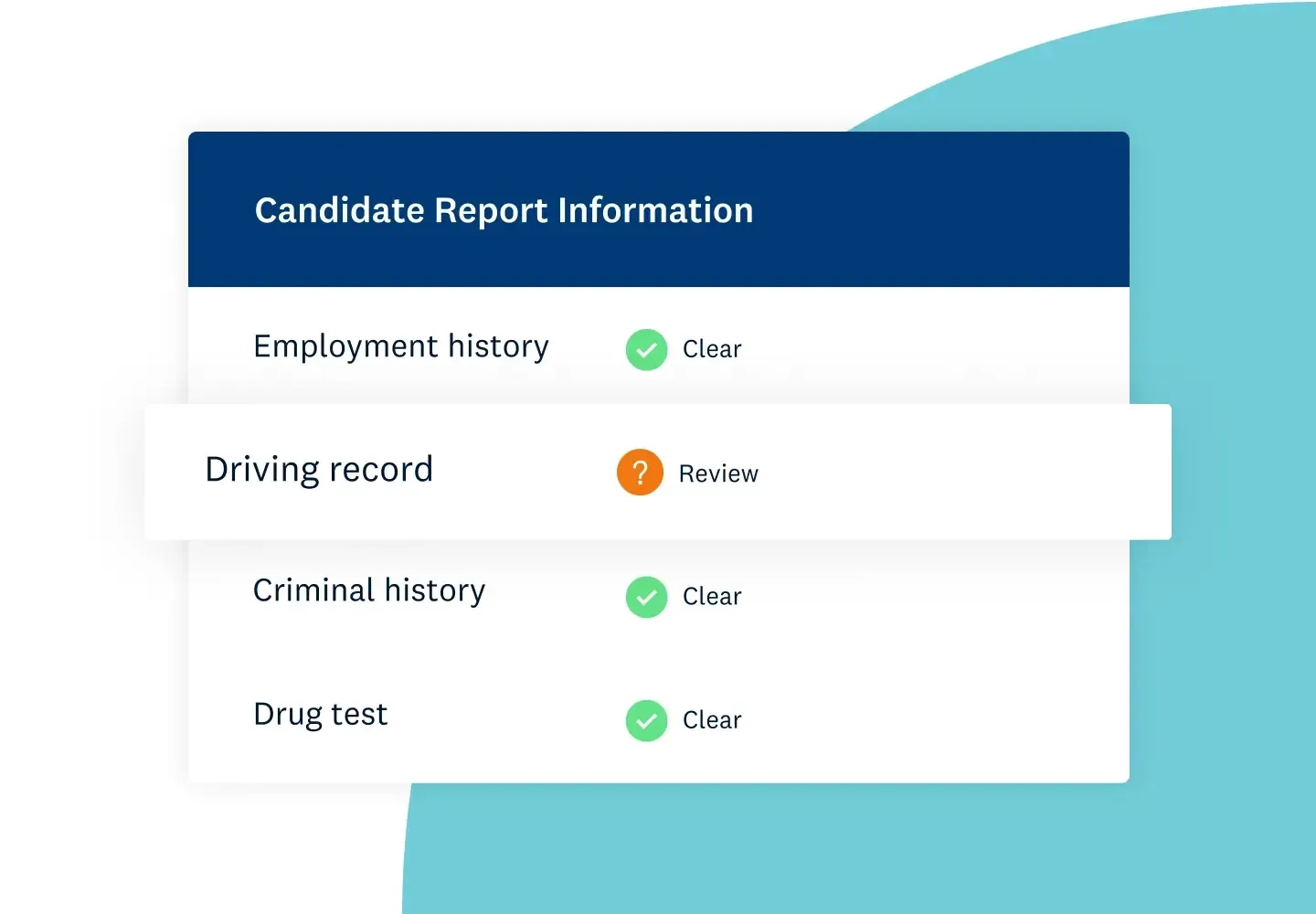
Outcomes typically fall into:
- Clear: No issues are found in the background check that would affect hiring eligibility. The employer can proceed with clearance and begin the final onboarding steps without delay.
- Needs review: Something in the report doesn’t fully align or requires additional context before a decision can be made. This could be a minor inconsistency (such as address history or name matching) or a record that needs clarification. The employer may pause progression briefly while they review details or request additional information.
- Adverse: Information in the report may affect the hiring decision and requires the employer to follow a legally required adverse action process before making a final decision. This includes notifying the candidate, sharing relevant information, and allowing time for review or dispute before any final determination is made.
Most teams can complete this review within 24 hours. To stay on track, assign a single owner for report review before the hire starts—not after the report lands in your inbox.
Step 5: Adverse action (if applicable)
If the report contains information that may adversely affect hiring eligibility, the employer must follow the adverse action process before making a final decision.
This process ensures compliance and allows the candidate to review the report, provide additional context, or dispute potentially inaccurate information.
Ownership:
- Hiring manager: Informed of potential impact and final decision context
- HR/Recruiting: Owns the compliance process, candidate communication, and documentation
- Screening provider: May provide updated information if the candidate disputes the report
The process typically includes:
- Sending a pre-adverse action notice to the candidate
- Providing a copy of the report and required disclosures
- Allowing the required waiting period for the candidate to respond
- Reviewing any additional information provided
- Making and documenting the final decision
- Sending a final adverse action notice, if applicable
Step 6: Confirm clearance and hand off to onboarding
Because adverse action requirements vary by state and locality, you should confirm all relevant requirements before proceeding. Consistent documentation is essential, and having a clear internal policy for how your team interprets report findings makes this step significantly faster when it comes up. (Including what to do when your candidate fails a background check.)
Ownership:
- Hiring manager: Confirms readiness to proceed and initiates onboarding handoff
- HR/Recruiting: Owns confirming clearance, issuing final confirmation, and closing the process
- Screening Provider: No involvement after report delivery
HR communicates:
- The background check is complete and cleared
- Start date is confirmed
- Next steps for onboarding
Internally, HR should document the final hiring decision, retain any required screening records, and close out the background check workflow. Responsibility for the candidate can then be handed off to onboarding, operations, or the appropriate internal team.
At this point, the offer-to-clearance process is complete. Before moving fully into onboarding, take two minutes to note anything that slowed this hire down. That's the only data you need to make the next one faster.
How to make this process consistent across every hire
Most hiring inconsistencies don't stem from complexity. They come from memory.
When each hire is handled slightly differently—a different person sends the offer, a different message goes to the candidate, a different timeline gets communicated—delays and confusion compound quietly until something breaks.
The six steps above are your process. The only thing left is to make them official:
- Write them down in one shared place your whole team can access
- Assign a named owner to each stage before the next hire starts — not during it
- Build two or three candidate message templates from the communication examples in this guide
- After each hire, note one thing that slowed you down—that's your improvement log
Over time, this turns hiring from reactive to repeatable.
Order a background check with Checkr
You now have a complete process: six steps, clear ownership, and a communication framework you can reuse from the first hire to the fiftieth.
The one thing that makes it faster: not coordinating background checks manually. Checkr automates the steps that slow most small teams down—candidate invitations, information collection, status tracking—so your process runs the same way every time without the administrative overhead.
Ready to take the manual work out of this process?
Still building out your hiring process?
The Small Business Hiring Guide covers everything from first hire to ongoing compliance—in plain language.
Disclaimer
The resources and information provided here are for educational and informational purposes only and do not constitute legal advice. Always consult your own counsel for up-to-date legal advice and guidance related to your practices, needs, and compliance with applicable laws.

About the author
Hayley Harrison began her career as a hiring manager at a mid-size regional bank in the Pittsburgh area. She now brings her experience and knowledge of hiring best practices to her work as a freelancer, helping employers refine and improve their processes.