

Ready to run background checks the modern way?
Checkr surveyed 1,000 business leaders to understand how the hiring landscape has shifted since 2023. What we found: the talent market is slowly recovering—but a new threat is quietly undermining it. AI-driven candidate fraud has arrived, and most companies aren't ready.
Where the data allows, we compare findings against our 2023 Recruitment Realities report, giving hiring leaders a three-year lookback at how the challenges, tools, and strategies of talent acquisition have evolved.
Hiring has never been easy. But the rules just changed in ways no one saw coming.
The candidate pool is wider than it was three years ago. Qualified applicants are easier to find. By some measures, the worst of the post-pandemic talent crunch is behind us.
But a new problem has moved in to take its place. Nearly half of business leaders say they've extended a job offer to a candidate who used AI tools to misrepresent their qualifications—and another quarter suspect it's happened but can't prove it. AI-generated resumes are now the norm, not the exception. And 62% of leaders say the rise of AI has made traditional resume screening obsolete, yet most haven't found anything better to replace it with.
The hiring market isn't just recovering. It's being reshaped by a threat that didn't exist when we ran this survey in 2023.
To understand how business leaders are responding, Checkr surveyed 1,000 hiring managers and executives across the country, building on our 2023 Recruitment Realities report with three years of new data, new challenges, and a few encouraging signs of progress.
The good news? Leaders who approach 2026 with the right strategies, tools, and mindset are well-positioned to win.
Summary of key findings
- The talent search is still hard, but improving: 59% of business leaders say finding qualified applicants is difficult or very difficult in 2026, down from 63% in 2023. The share of leaders reporting few or no qualified applicants collapsed from 9% to just 2%.
- Hiring goals are slipping: 48% of leaders say their company failed to meet hiring goals in the past year—up from 44% in 2023—suggesting that even a broader candidate pool is not closing the execution gap.
- AI fraud has entered the hiring conversation for the first time: Detecting AI-driven candidate fraud debuted as a brand-new challenge category in 2026, cited by 7% of leaders; a concern that did not exist in our 2023 survey at all.
- Nearly half of companies have unknowingly hired a fraudster: 49% of business leaders say they have extended a job offer to a candidate who misrepresented their qualifications using AI tools, and another 26% suspect it has happened but cannot confirm.
- AI-generated applications are now the norm, not the exception: 73% of companies have encountered AI-generated resumes, cover letters, or assessments, with 29% saying it happens frequently.
- Traditional resume screening is losing credibility: 62% of leaders agree or strongly agree that the rise of AI has made traditional resume screening obsolete, yet most organizations have not found a way to replace it with a better system.
- Salary transparency has overtaken flexibility as the top hiring strategy: For the first time, offering full salary transparency (19%) edged out work-from-home and flexible arrangements (18%) as the single most effective tactic for attracting quality candidates.
- Compensation conviction has strengthened: 75% of leaders agree that compensation is the single most important driver of talent acquisition, up from 69% in 2023; the share who disagree has dropped from 14% to just 9%.
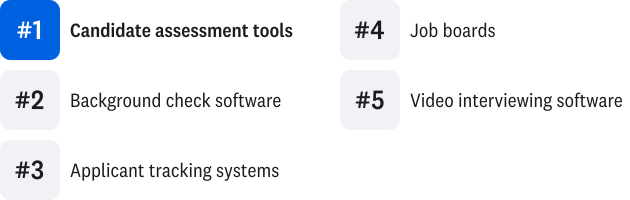
- Assessment tools and background checks are key: Candidate assessment tools jumped to the top spot at 21%, background check software was second, while ATS systems saw the biggest gain, rising from 11% to 16%.
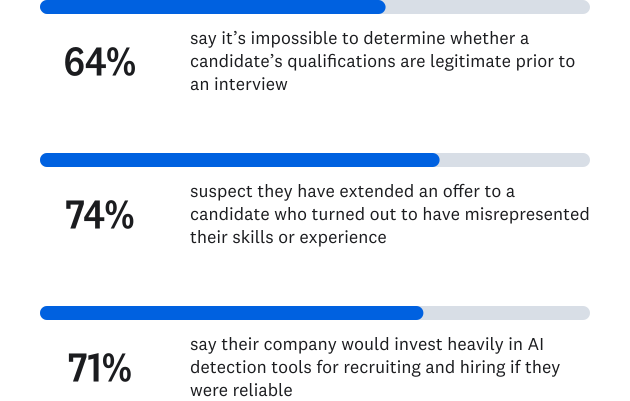
- Leaders are ready to fight back on AI fraud and willing to pay for it: 71% say they would invest heavily in AI detection tools for the hiring process if proven reliable, including 26% who strongly agree, signaling clear market demand for solutions that do not yet fully exist.
What leaders are saying about hiring challenges in 2026
How does the current landscape compare to three years ago, and where does the pressure remain?
The hiring landscape today
Three years after our inaugural survey, the picture of hiring difficulty has shifted. In 2023, an overwhelming 63% of business leaders described the search for qualified candidates as difficult or very difficult. In 2026, that number remains high, but the composition has changed. Today, 59% of leaders call the search difficult or very difficult, while 41% now say hiring is easy or very easy, up from just 37% in 2023.
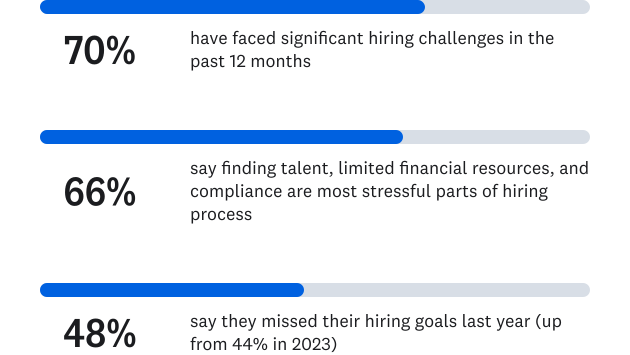
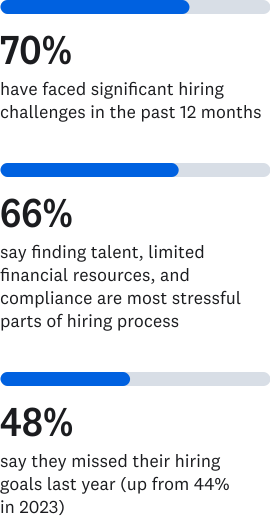
Despite these marginal improvements, hiring pressure persists. When asked whether their company faced significant hiring challenges over the past 12 months, 70% of respondents agreed or strongly agreed, consistent with the 72% who reported the same difficulty in 2023.
Three-year lookback
In 2023, 63% of business leaders called the search for talent difficult or very difficult. That number has eased to 59% in 2026, a meaningful shift, but still a clear majority struggling to fill roles. The share reporting few or no qualified applicants dropped sharply from 9% to just 2%, suggesting the candidate pool has broadened, even if finding the right fit remains hard.
Missing hiring goals: A persistent problem
Meeting hiring goals remains an elusive target for many organizations. Nearly half (48%) of business leaders say their company failed to meet hiring goals in the past year, up from 44% in 2023. That is a sobering signal that even as candidate availability improves slightly, the challenge of translating opportunity into successful hires remains very prominent.
The greatest challenges in hiring
When asked to name their single greatest challenge during the hiring process, business leaders in 2026 ranked their top obstacles as follows:
- Not enough qualified candidates: 30% (down from 36% in 2023, but still the top challenge)
- Difficulty identifying the right fit: 22% (up from 20%)
- Competition with other companies: 15% (down from 18%)
- Limited budget and resources: 14%
- Detecting rising candidate fraud due to AI: 7% (a brand-new category in 2026)
Three-year lookback
Three years ago, not enough qualified candidates was the dominant complaint at 36%. That figure has dropped to 30%, still the top concern, but the gap is closing. More striking is the emergence of AI-driven candidate fraud as a recognized hiring challenge, a category that did not exist in our 2023 survey at all. This signals a meaningful shift in the nature of hiring risk.
What lies ahead: Optimism tempered by caution
When asked what they expect in terms of hiring challenges for the remainder of 2026 and into 2027, business leaders expressed measured optimism:
- 39% expect challenges to stay the same
- 28% say challenges will slowly improve
- 26% say challenges will slowly worsen
- Only 6% expect things to quickly worsen
Three-year lookback
In 2023, 45% of business leaders expected hiring challenges to improve heading into 2024. By 2026, that expectation has moderated, with more leaders expecting conditions to hold steady or worsen slightly. The optimism of 2023 has given way to a more grounded pragmatism shaped by real experience.
The struggles behind the numbers
Beyond the statistics, what is actually making hiring harder, and where is the stress really coming from?
Where the stress really lives
Hiring is not just strategically difficult; it is emotionally and operationally taxing. When asked which part of the hiring process creates the biggest disadvantage for their company, leaders ranked their pain points as follows:
- 39% expect challenges to stay the same
- Lack of training: 14%
- Compliance during the hiring process: 13%
- Battling the rise of AI fraud in hiring: 13% (new in 2026)
- Lack of financial resources: 12%
Three-year lookback
In 2023, finding and acquiring talent dominated as the top stressor at 51%. That figure has dropped to 39% in 2026, a meaningful improvement. However, AI fraud in hiring has emerged as a significant new stressor at 13%, now rivaling compliance concerns. The nature of hiring stress is evolving.
The financial pressure is real as well. While the share of companies citing financial resources as a primary stressor held roughly flat at 12% in 2026 versus 14% in 2023, limited budgets continue to constrain the ability of many organizations to invest in the people, tools, and processes that could relieve other pressures.
Compensation: still king?
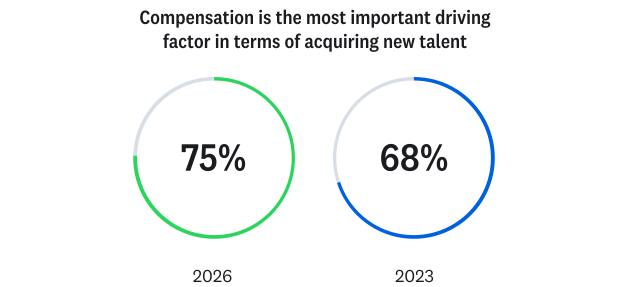
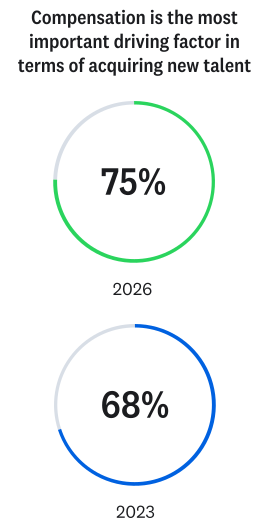
Has the role of compensation in talent acquisition changed? According to business leaders in 2026, not much. A strong 75% agree that compensation is the single most important driving force in acquiring new talent, up from 69% in 2023.
Three-year lookback
Three years ago, compensation was already seen as the top driver of hiring success. In 2026, that conviction has only strengthened. In a competitive talent market, salary and total compensation remain the sharpest tools in a hiring team's arsenal.
Winning strategies for 2026
The companies that attract top talent in 2026 are not doing it by accident. Here is what the data says about what works right now.
Top strategies to attract quality candidates
When asked for their top strategy to attract quality candidates and beat the competition, leaders identified a mix of compensation, flexibility, and transparency as their most effective levers:
- Offering full salary transparency: 19%, the top-ranked strategy in 2026
- Work-from-home or flexible work arrangements: 18%
- Career development opportunities: 16%
- Showcasing clear job requirements: 15%
- Increased salary offerings: 13%
- Employee referral programs: 11% (up from 7% in 2023, the biggest mover)
Three-year lookback
In 2023, WFH and flexible work topped the list as the most powerful talent-attraction tool. In 2026, salary transparency has moved to the top spot, a reflection of how candidate expectations have matured. Job seekers now expect to know what they will earn before they apply, and companies that lead with that information are winning more conversations. Employee referral programs have seen the biggest jump in priority, up 4 percentage points, suggesting companies are investing more heavily in their existing networks.
The takeaway for hiring leaders is clear: transparency wins. Whether it is salary, role expectations, or growth opportunities, candidates in 2026 reward companies that are upfront. Ambiguity in job postings or compensation discussions is increasingly a disqualifier, not just a weakness.
The tools powering modern hiring
What technologies are helping hiring teams move faster, screen smarter, and hire with more confidence?
Which tools are winning?
When asked to rank the hiring technology tools that best help their organization meet hiring goals, business leaders in 2026 ranked their preferences as shown in the graphic below:
Three-year lookback
Background check software held the top spot in 2023 at 23%. In 2026, it is still extremely important as a valued technology, still ranking near the top in second place.
The rise of candidate assessment tools also reflects a deeper challenge: in an era when resumes can be fabricated and credentials inflated, companies are leaning on tools that test actual skills rather than stated experience.
Background checks: still essential, now more critical than ever
Background check software remains a top tool for hiring teams in 2026, and for good reason. In a landscape where AI can generate plausible employment histories, education credentials, and professional references, verified identity and real-world record checks serve as a crucial counterbalance.
The message to hiring leaders is straightforward: do not deprioritize background checks in the rush to fill roles faster. They remain one of the most reliable signals of candidate authenticity in a process increasingly clouded by AI-generated noise.
AI in hiring: Challenge, opportunity, and the path forward
AI is the defining new variable in hiring. It is creating both unprecedented risk and unprecedented advantage, often simultaneously.
The scale of AI-assisted fraud
Perhaps the most significant finding from our 2026 survey is just how widespread AI-generated content has become in the hiring pipeline. When asked whether their company had encountered applicants using AI-generated content, including resumes, cover letters, or assessments, the data was striking.
A full 73% of companies say they have encountered AI-generated applications frequently or occasionally. And nearly half (49%) have extended a job offer to someone who misrepresented their skills using AI tools.
That second number is hugely important. Nearly half of all companies surveyed have, at least once, hired someone whose qualifications were artificially inflated or fabricated. Another 26% suspect it has happened but cannot confirm.
Only 21% are confident they have never made such a hire.
Additionally, 75% of business leaders agree that AI-generated applications have made it nearly impossible to determine whether a candidate's qualifications are genuine before the interview stage.
What concerns hiring teams most?
Not all AI fraud scenarios are equally worrying. When asked which concerns them most, business leaders ranked their top fears:
- AI-generated resumes that exaggerate or fabricate experience: 36%, by far the top concern
- AI-completed skills tests and take-home assessments: 20%
- Candidates using AI in real-time during video interviews: 17%
- All of the above equally: 16%
- Automated AI bots submitting mass applications: 6%
- Deepfake video interviews using a false identity: 6%
The rise of resume fraud as the top concern makes sense: it is the entry point of the hiring funnel. A fraudulent resume that clears the ATS wastes interview time and assessment resources and can lead to a costly mis-hire. When the problem is most acute at the top of the funnel, it affects everything downstream.
Traditional screening is being challenged
The rise of AI-assisted fraud has triggered a crisis of confidence in traditional screening methods. An overwhelming 62% of business leaders agree or strongly agree that the rise of AI tools has made traditional resume screening effectively obsolete.
This does not mean resumes should be abandoned entirely, but it does mean they can no longer be treated as reliable self-attestations of skill or experience. In 2026, every resume needs to be paired with verification.
The willingness to invest
With all of this in mind, business leaders are not giving up. They are ready to invest. When asked whether their company would be willing to invest heavily in AI detection tools specifically for the hiring process if they were proven reliable, the response was decisive. A full 71% said yes, including 26% who strongly agreed.
The data tells the story here. Hiring leaders understand the problem and are prepared to act.
Looking ahead in 2026 and beyond
Three years into tracking recruitment realities, the theme is unmistakable: hiring is hard, it’s evolving, and the challenges of 2026 would have been less recognizable in 2023.
But the data also tells a story of resilience and adaptability. Today’s leaders understand the AI threat and are preparing to meet it. And the fundamentals, compensation, transparency, verification, and culture, still matter more than any single technology or trend. In the end, people really matter.
The companies that will thrive in the hiring landscape of 2026 and beyond are not the groups who fear AI as a piece of the puzzle, but those who use it deliberately, using verification technology to cut through the noise, assessment tools to find the talent, and human judgment to make the final call.
For more information on Checkr’s research or to request graphics or commentary about this study, please contact press@checkr.com.
Survey methodology
All data found within this report is derived from a survey by Checkr conducted online via the survey platform Pollfish. In total, 1,000 adult American business leaders were surveyed. This survey was conducted over a three-day span in April 2026, and all respondents were asked to answer all questions as truthfully as possible and to the best of their knowledge and abilities.
Disclaimer
The resources and information provided here are for educational and informational purposes only and do not constitute legal advice. Always consult your own counsel for up-to-date legal advice and guidance related to your practices, needs, and compliance with applicable laws.

About the author
As VP of Product & Customer Marketing at Checkr, Bryan is responsible for educating current and prospective customers about the value and use of our products. He is passionate about understanding the needs of companies and candidates who use Checkr, and helping them get the most from the platform.