

Table of Contents
- How fraud shows up in manufacturing hiring
- What does rising fraud mean for your hiring funnel?
- Why HR owns fraud risk now and the future of prevention
- 3 Practical tools to fight fraud without slowing hiring
- Making modernization stick: Integration, metrics, and change management
- Checkr helps manufacturers go from overexposed to fraud-resilient
Ready to run background checks the modern way?
The 2026 Manufacturing CHRO Report shows a striking tension: 61% of manufacturing HR leaders say they don’t have strong fraud controls in place, and identity fraud detection has vaulted into the top five AI use cases in hiring.
Instead of rehashing generic warnings about “bad hires,” we can draw on fresh data from 500 manufacturing CHROs and new real‑world IDV use cases to answer a sharper question:
If AI is quickly becoming the backbone of hiring processes, what does it take to make it your strongest line of defense against fraud—not your biggest blind spot?
We’ll look at how to identify hiring fraud early on, why HR is increasingly accountable for managing that risk, and how three specific levers can reduce fraud without slowing down hiring:
- Modern identity verification (IDV)
- Automated adjudication actions
- Expanded screenings
Fraud confidence by the numbers
39%
of manufacturing CHROs say they have strong controls and technology in place to prevent hiring fraud.
61%
still report gaps, uncertainty, or low confidence in their fraud prevention programs.
31%
of HR teams across all industries feel they have strong controls—putting manufacturing slightly ahead, but still exposed.
Takeaway: Manufacturing leaders are more confident than most, but the majority still see room for improvement—especially as fraud tactics get more sophisticated.
How fraud shows up in manufacturing hiring
In manufacturing hiring, fraud tends to cluster around three pressure points: identity, qualifications, and process gaps.
Identity and document fraud
Candidates use synthetic or stolen identities, altered IDs, or expired documents to get through early screens—especially when plants depend on manual review or siloed systems.
Misrepresented skills and experience
Many manufacturers hire across multiple plants, shifts, and regions, with a patchwork of processes and vendors. Fraudsters look for the weak link: a facility with lighter checks, inconsistent adjudication, or slower adoption of modern tools like IDV and automated rules.
Exploiting high‑volume, decentralized hiring
With generative AI tools, it’s easier than ever to produce polished resumes and application materials that don’t reflect real capabilities, certifications, or safety training.
What does rising fraud mean for your hiring funnel?
HR leaders are reporting increasing fraud across the hiring funnel—from applications to interviews—and identity fraud detection has moved into the top tier of AI priorities for both manufacturing and all industries we surveyed. That’s a signal that HR now sees fraud prevention as part of the core hiring stack, not a separate security concern.
Across these patterns, the impact is consistent: wasted time on candidates who shouldn’t be in the funnel, elevated safety and compliance risk, and long‑term liability when bad actors make it onto the factory floor.
Top AI priorities in manufacturing
- Resume screening and early filtering automation
- Background check speed and accuracy
- Interview scheduling
- Managing recruiter workload at scale
- Identity fraud detection
Hope isn’t a hiring strategy
Start running modern, comprehensive manufacturing background checks at any scale.
Why HR owns fraud risk now and the future of prevention
Our CHRO survey data shows that manufacturers name quality of hire and retention as the most important HR metrics tied to business impact. Fraud directly erodes those metrics by introducing risk and instability into the workforce.
Compared with other industries, manufacturing HR is also more directly seen as responsible for reducing fraud and associated waste. When a fraudulent or underqualified candidate gets through—whether that leads to a safety incident, performance issue, or compliance failure—the question quickly becomes: How did our hiring and screening process let this happen?
At the same time, talent leaders say their top strategies for success include:
- AI‑driven hiring acceleration
- HR tech modernization and workflow integration
Fraud prevention can’t sit off to the side of those priorities. It has to fit inside them.
This is the new mandate for manufacturing HR:
Keep hiring fast and safe, with clear, measurable fraud controls that integrate seamlessly into your existing tools and processes.
3 Practical tools to fight fraud without slowing hiring
To move from exposed to resilient, manufacturing HR teams need tools that:
- Catch identity and document fraud early
- Apply consistent, defensible decisioning at scale
- Align screening depth to real‑world risk
- Integrate with existing ATS/HRIS systems to avoid extra work
Future-looking HR teams are already investing in AI and automation to do exactly that. Below are three practical pillars that align directly with what manufacturing leaders say they need most.
1. Strengthen identity verification (IDV)
In manufacturing, identity verification isn’t a checkbox—it’s a frontline safety and compliance control.
Before a candidate ever steps onto the factory floor or gains access to sensitive equipment, materials, or IP, you need to be confident they are who they say they are. That’s especially true when hiring is:
- High‑volume
- Distributed across multiple plants and regions
- Increasingly remote or hybrid in its early stages (applications, interviews, onboarding)
Modern IDV solutions are built to meet that challenge. At Checkr, our fast, secure IDV screenings stop hiring fraud at the source with capabilities like:
- Biometric face scan to detect spoofing and confirm the candidate’s live identity
- Document review to validate the legitimacy of government IDs and passports
- Device fingerprinting to confirm the candidate’s location and detect suspicious browsers or proxies
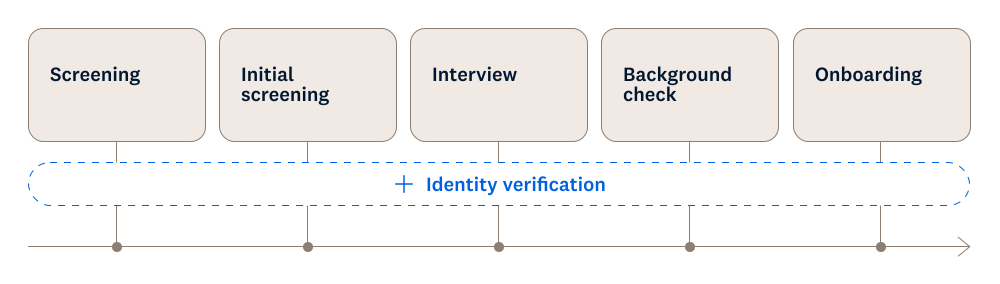
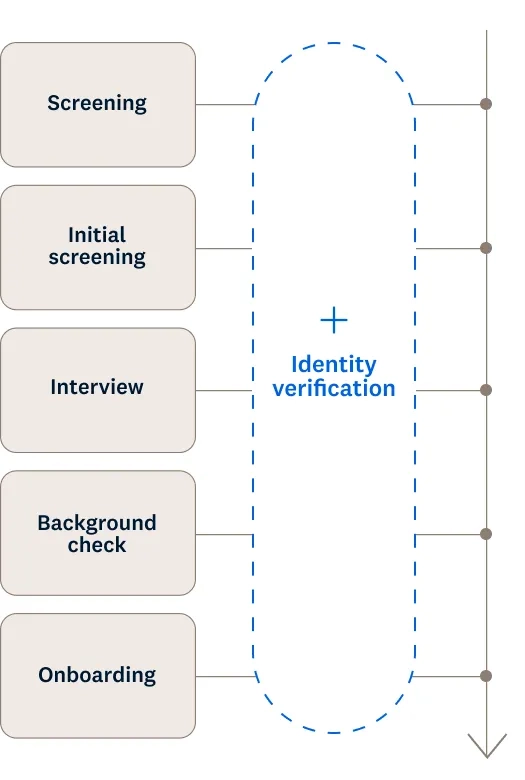
CHRO survey data backs up this investment, with identity fraud detection as a top AI priority, right alongside background check speed and early‑stage screening. Leaders are signaling that IDV is moving from “nice to have” to non‑negotiable.
Luckily, the best modern background check partners will make it easy to add IDV to your existing hiring flow and background check ordering process. Look for solutions that are mobile-friendly for the best candidate experience, integrate with your ATS/HRIS, and can securely store and transfer information to your background check workflow to eliminate redundant data entry for candidates and your hiring team.
IDV in practice for manufacturing HR
- Standardize IDV for high‑risk roles and locations first (safety‑sensitive, high‑access, regulated), then scale.
- Integrate IDV so results flow automatically into background checks and adjudication—not as a separate, manual step.
- Track IDV metrics like fraud attempts detected, time‑to‑clear, and cost savings from downstream checks avoided by catching fraud early. Get executive eyes on these KPIs to drive home HR’s strategic impact.
Add AI-proof verification to your manufacturing background checks now
2. Use automated adjudication for consistent, compliant decisions
Even the best fraud detection signals don’t help if your decisioning is slow, manual, or inconsistent.
Today, many manufacturers still rely on plant‑by‑plant or manager‑by‑manager adjudication processes. That creates:
- Legal risk from inconsistent decisions across locations or candidates.
- Quality risk as the result of uneven standards for similar roles.
- Fraud risk by leaving more room for exceptions and workarounds when teams are under pressure to fill roles fast.
This is also where survey results from HR leaders, asked about tech performance and roadblocks, come into play. Many manufacturing teams say their tools meet expectations rather than exceed them due to integration gaps and workflow friction.
Manufacturing
All industries
How manufacturing HR leaders rate their tech stack
- 46% say tools meet expectations
- 24% rate tools as marginal or unsatisfactory
- 29% say tools exceed expectations or are exceptional
Automated adjudication is one of the clearest levers to move from “mediocre tools” to reliable, scalable outcomes. With automated adjudication tools, like Checkr Assess, manufacturing HR teams hiring at scale can:
- Define location‑ and role‑specific adjudication matrices aligned with internal policy and local regulations
- Automatically apply those rules to screening results, making it easy for adjudicators to direct their attention to records that require consideration
- Centralize documentation and decision history for audits and compliance reviews
Together, these capabilities turn adjudication from a manual bottleneck into a consistent, auditable safeguard against fraud. By standardizing decisions across plants and directing human attention to the edge cases that matter most, manufacturing HR teams can protect speed, fairness, and compliance at scale.
Automated adjudication actions in practice for manufacturing HR
- Choose a background check partner with customizable automated adjudication actions, include case management tools, built to scale across regions and roles.
- Work with your screening partner’s customer success and solutions team to build custom adjudication rules that apply automatically to every check.
- Give your team time back. For example, Checkr’s automated adjudication technology redirects up to 75% of adjudication resources to other value-added work.
3. Expand and right‑size screenings to match real‑world risk
Finally, it’s not enough to check identity and apply rules—you also need the right mix of screenings to match the risk profile of each role.
Manufacturing customers consistently tell us they need comprehensive, accurate, and complete checks to reduce compliance gaps, especially in safety‑sensitive roles, regulated environments, and multi‑site operations with varying local requirements. This often includes specialized screenings like:
- Occupational health screenings
- Drug testing, including post‑accident or reasonable‑suspicion testing and onsite or rapid‑response options
- Verifications, like employment, education, and identity verification, to catch misrepresentation tied to fraud
In addition to critical background checks like criminal record checks and driving record (MVR) checks.
At the same time, with talent shortages and intense competition, over‑screening can hurt conversion. The goal is to balance risk and speed. HR teams should target expanding screenings where it matters most without dragging down the entire process.
Comprehensive screenings in practice for manufacturing HR
- Segment roles by risk tier and align screening depth accordingly (e.g., baseline checks for low‑risk roles; expanded packages for high‑risk or regulated roles).
- Standardize a baseline package across all plants to ensure consistency, then layer additional checks where exposure is highest.
- Revisit screening packages regularly based on fraud incidents, near misses, and regulatory changes.
Modernize your manufacturing background checks with Checkr
Making modernization stick: Integration, metrics, and change management
Knowing what to implement is only half the battle. Manufacturing CHROs say their biggest technology challenges aren’t just about features—they’re about integration, adoption, and complexity. To make fraud prevention sustainable, HR teams need to think beyond point solutions.
Focus on integration, not just tools
- Connect identity verification, background checks, and automated adjudication to your core ATS/HRIS. This creates one workflow and reduces manual re‑entry or workarounds.
- Use automation and AI to accelerate turnaround times and reduce manual touchpoints, rather than adding more steps on top of existing processes.
- Prioritize a mobile‑friendly candidate experience and an intuitive candidate portal so that added fraud controls don’t create confusion or drop‑off.
Measure what matters
Tie your modernization efforts back to the KPIs leadership already cares about, including those highlighted in the CHRO report:
Fraud‑related metrics
- Fraud attempts detected
- Percentage of attempted fraud caught pre‑hire
- Rescued revenue as the result of each fraudulent candidate uncovered
- Reduction in manual reviews due to automation
Business outcomes
- Quality of hire
- Employee retention rate
- Time‑to‑fill roles
- HR ROI and efficiency
- Safety or incident rates tied to workforce reliability
Checkr helps manufacturers go from overexposed to fraud-resilient
CHROs are clear: AI‑driven hiring acceleration and HR tech modernization are top priorities for manufacturing hiring teams. But credibility with the C‑suite will increasingly depend on how well HR manages fraud and integrity risks alongside speed.
By combining:
- Modern identity verification (IDV) to catch identity and document fraud up front
- Automated adjudication to apply consistent, compliant decisions at scale
- Risk‑aligned, expanded screenings that match the realities of factory work and regulatory oversight
- Integrated, candidate‑friendly workflows that keep hiring fast and transparent
…manufacturing HR teams can move from patchwork defenses to a scalable, measurable fraud prevention strategy.
The result isn’t just fewer incidents. It’s a more resilient workforce, greater confidence from executives and regulators, and a hiring engine that can keep pace with the demands of 2026 and beyond.
Checkr’s modern manufacturing background checks, including identity verification, integrate seamlessly with your hiring tech stack and provide transparency, automation, and trust at scale. 120,000+ customers use Checkr to prevent hiring fraud, improve backround check speed and accuracy, and deliver an outstanding candidate experience. We’re here to help hiring teams prevent fraud, improve quality of hire, and modernize hiring workflows with our AI-powered screenings.
Run fast, accurate manufacturing background checks with Checkr

About the author
Kate leads workforce research and editorial content at Checkr, covering HR strategy, background screening, compliance, and HR technology. She helps business and HR leaders translate industry trends into operational decisions and is passionate about expanding opportunity through fair chance hiring.