Sex offender registry background checks: Complete verification guide

Hayley Harrison
Author
Ready to run background checks the modern way?
Criminal background checks provide employers with valuable insights into a candidate’s history to facilitate informed hiring decisions. Often, sex offender registry checks are an important component of a comprehensive criminal background check, especially for safety-sensitive roles or those dealing with vulnerable populations. Here’s what you should know about these background screenings, whether you’re an employer or a jobseeker.
What is a sex offender?
A sex offender is an individual convicted of a sexual offense—a criminal offense that involves a sexual act or sexual contact with another person. Some examples of sexual offenses include rape, child molestation, and sexual assault.
The Sex Offender Registration and Notification Act (SORNA), sometimes referred to as the Sex Offender Registration Act, established baseline requirements for including sex offenders’ names on registries. Under this law, states can create stricter rules and regulations, leading to variations in what offenses may result in a sex offender designation. Typically, sexual offenses are classified into three levels: Level 1, Level 2, or Level 3. Classifications vary based on jurisdiction; some states and cities use a risk assessment as part of the classification process to determine the offender's likelihood of recidivism. See below for an overview of what each classification generally means.
What is a level 1 sex offender?
A Level 1 or Tier 1 sex offender typically has few or no identifiable risk factors, such as few previous non-sexual crimes or parole violations. Individuals who don’t meet the criteria for Level 2 or Level 3 sex offender classification usually receive a Level 1 designation.
What is a level 2 sex offender?
A Level 2 or Tier 2 sex offender is convicted of an offense punishable by more than one year of incarceration and meets one of the following criteria:
- The offense is comparable to or more severe than sex trafficking, coercion, and enticement, transportation with the intent to engage in criminal sexual activity or abusive sexual contact, particularly when committed against a minor, or if there is an attempt or conspiracy to commit such an offense against a minor.
- The offense involves the use of a minor in a sexual performance, solicitation of a minor to practice prostitution, or the production or distribution of child pornography.
- The offense occurred after the individual became a Level 1 sex offender.
States may set stricter standards than the above criteria for what warrants a Level 2 designation.
What is a level 3 sex offender?
A Level 3 or Tier 3 sex offender is convicted of an offense punishable by more than one year of incarceration and meets one of the following criteria:
- The offense is comparable to or more severe than aggravated sexual assault or abusive sexual contact with a victim under the age of 13 or involves an attempt or conspiracy to commit such an offense.
- The offense involves the kidnapping of a minor unless the offender is the minor’s parent or guardian.
- The offense occurred after the individual was designated as a Level 2 sex offender.
State laws may establish stricter requirements for what constitutes a Level 3 sex offender.
What is the sex offender registry?
The sex offender registry is a database of individuals convicted of sexual offenses. Sex offender registries usually include the individual's address, physical appearance, and crimes that caused their registration.
SORNA established the National Sex Offender Registry (NSOR) and requires all 50 states, the District of Columbia, the principal US territories, and federally recognized Indian tribes to establish their own sex offender registries.
Any individual convicted of a sexual offense whose sentence requires them to register as a sex offender must complete the sex offender registration process at the federal level and in every jurisdiction where they live, work, and attend school. Individuals who fail to register as required by their criminal sentences can face statutory criminal penalties. Here is an overview of the federal and state sex offender registries.
National Sex Offender Registry
The National Sex Offender Registry (NSOR), sometimes called the national sex offender list, is a public database maintained by the US Department of Justice in cooperation with state, territorial, and tribal law enforcement and government agencies. Accessible via the Dru Sjodin National Sex Offender Public Website (NSOPW), the NSOR links the databases maintained by all jurisdictions, allowing employers and individuals to access records from the entire US with just one search.
The NSOR typically shows the most up-to-date information as provided by the jurisdictions. Because each jurisdiction’s registry reports different information, the results of an NSOR search may vary by the locations where the individual has lived, worked, and attended school. Information that may appear in a search result includes:
- Individual’s name
- Jurisdiction where the individual has registered
- Identifying characteristics of the individual, like scars and tattoos
- Individual’s full address or zip code
- Individual’s date of birth
- List of specific offenses or codes that correspond to offenses
- Individual’s sex offender level designation
State sex offender registries
State sex offender registries are also generally accessible to the public via websites maintained by state government agencies. For example, the California Sex and Arson Registry (CSAR) is searchable through the California Department of Justice Megan's Law website; the New York Division of Criminal Services operates the public New York Sex Offender Registry. The NSOPW searches state sex offender registries when an employer or individual performs an NSOR search.
The results of a state sex offender registry search may vary based on the laws and regulations in each jurisdiction. In some cases, a state may send only select information about a sex offender to the national registry and provide additional information, like sex offender level or a list of the specific offenses an offender received sentences for, on the state website. As a result, employers typically perform a state sex offender registry search for every jurisdiction that appears on a NSOR search to gain as much information as possible.
How to check the sex offender registry
The process for checking the sex offender registry varies for employers and individuals, but typically involves searching databases independently or partnering with a background check provider, like Checkr.
For employers running background checks
Employers running background checks can search the NSOR and state sex offender registries on their own or with the help of a background check provider, like Checkr.
All criminal background checks available through Checkr include a sex offender registry search that accesses information from every US state, the District of Columbia, and tribal territories. Search results are confirmed using national and state sources, including the NSOPW.
For individuals looking for information
Individuals may wish to know how to check for sex offenders in their area when dating someone new, hiring a nanny or babysitter, or signing their children up for activities, among other circumstances. For individuals, the process usually begins with a search of the NSOR. If this search yields any records, you can then access the state, territorial, or tribal sex offender registry to verify the information and potentially learn more.
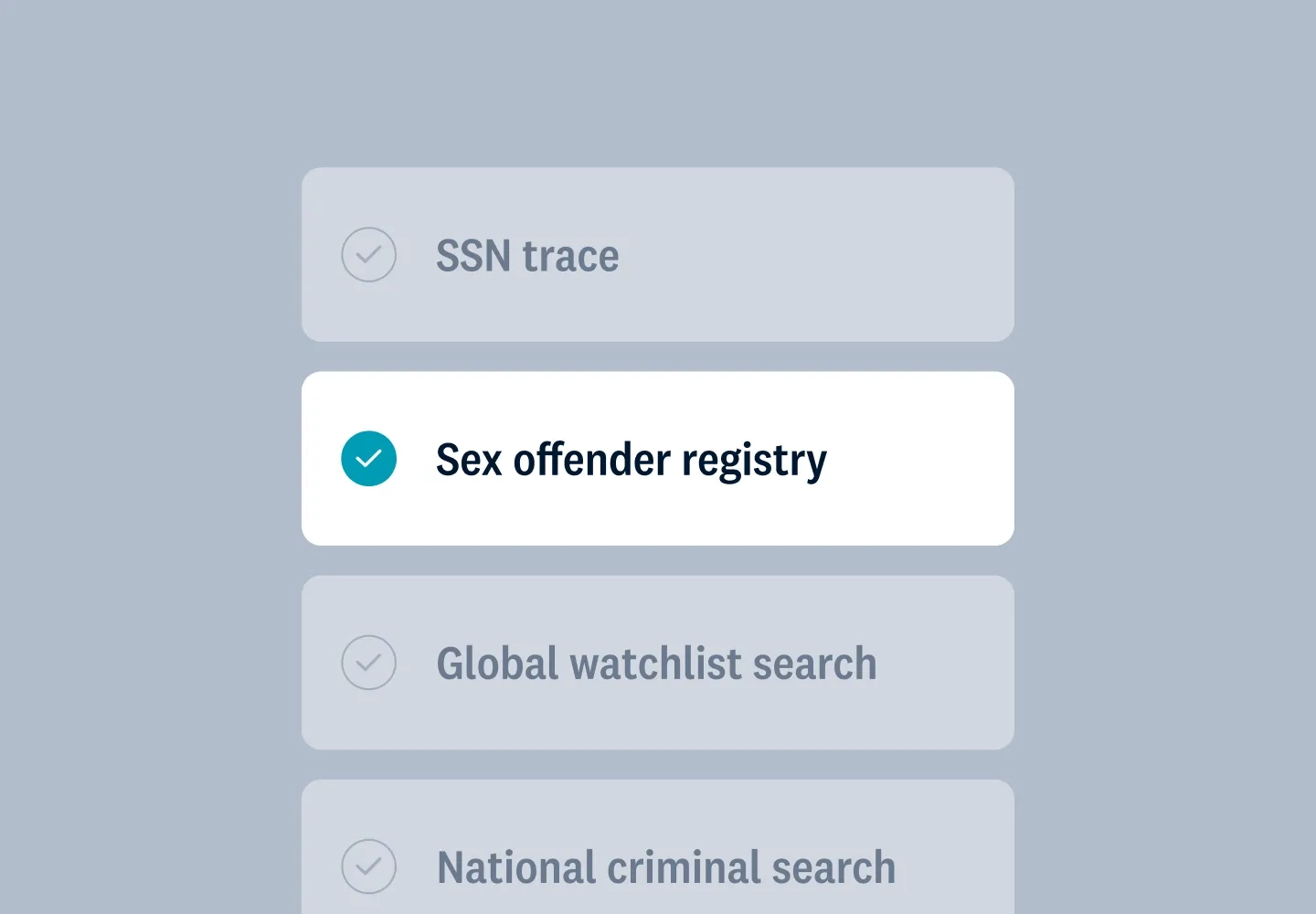
If you’re a job seeker, you can also run a background check on yourself to see what employers might see. Checkr offers personal background checks that include a sex offender registry check, an SSN trace, a global watchlist search, and national and county criminal records searches.
Benefits of knowing what's on your public record
As an individual, understanding your public record offers several benefits. Reviewing your personal background check can give you insight into what a prospective employer or landlord might see. A proactive approach allows you to anticipate potential questions or concerns and dispute any errors or inaccuracies.
Ordering your personal background check can save you time and money by providing fast results without the need to search multiple databases or pay records search fees. Order a personal background check today and see what’s on your public record.
Run a personal background check
Are you an employer? Run candidate background checks here >
Legal requirements for background checks
Employers that conduct background checks must comply with federal, state, and local laws. You may want to consider the following laws before ordering background checks and consult your legal counsel to learn if other background laws and regulations apply to your business.
Fair Credit Reporting Act (FCRA)
The Fair Credit Reporting Act (FCRA) is a federal law that establishes legal requirements for employers who perform background checks using a consumer reporting agency (CRA). Under the FCRA, an employer must provide written notification to candidates of their intent to conduct a sex offender registry search or any other background check and obtain the candidate’s written consent before performing the screening.
In addition, the law mandates that employers follow an adverse action process if information reported on a background check leads to the disqualification of a candidate or any other adverse action. See law.
Local laws
Some states, counties, and cities have passed Ban the Box laws and other fair hiring laws that require compliance when employers conduct background checks. For example, California law prohibits California public and private employers with at least five employees from asking about a candidate’s criminal conviction record on a job application and before offering them a job.
Run a background check with Checkr today
Sex offender registry searches are an essential part of criminal background checks, informing employers and individuals about a person’s status as a sex offender. The process typically begins with an NSOPW search followed by jurisdiction-level searches as needed to verify the information.
For employers
A sex offender search is a key component of Checkr’s criminal history searches. With 89% of all criminal checks completed within an hour, we help you hire faster. Plus, built-in compliance workflows give you peace of mind. Get started with Checkr.
For individuals
Running a background check on yourself can be a helpful step when looking for a new job. Checkr’s personal background check includes a sex offender registry search and other criminal records checks, giving you insight into what prospective employers may see during the hiring process. Order your personal background check
Average turnaround time
Type of screening | Average turnaround time |
Employment background check (a more comprehensive report that typically includes multiple screenings) | >1 hour to 1–5 days |
Criminal background check | 1–3 days |
Employment verification | 1–3 minutes (quick verification) to 2–7 days (manual entry) |
Reference checks | 2–5 days |
Driving record (MVR) check | >1 hour to 1–3 business days |
Drug testing | 10 minutes (onsite) to 3–10 days (lab-based) |
Frequently asked questions
What is a sex offender registry check, and is it the same as a criminal background check?
A sex offender registry check searches databases of individuals convicted of sexual offenses to confirm whether someone is registered as a sex offender. A criminal background check searches court records for a broader range of convictions and arrest history, which often includes sex offender convictions.
Does being on the sex offender registry show up on a standard background check?
Yes. When an employer runs a criminal background check through a provider like Checkr, a sex offender registry search is included. Checkr’s criminal checks access records from every US state, the District of Columbia, and tribal territories.
How do employers check the sex offender registry?
Employers can search the National Sex Offender Registry (NSOR) directly through the Dru Sjodin National Sex Offender Public Website, then follow up with state-level registry searches for any jurisdictions that appear in the results. Working with a background check provider like Checkr combines national and state searches into a single, integrated workflow.
What information does a sex offender registry search return?
Results vary by jurisdiction, but may include the individual’s name, date of birth, address or zip code, physical identifiers such as scars or tattoos, the offenses that led to registration, and the individual’s sex offender level designation (Level 1, 2, or 3). Because each jurisdiction reports different information, employers often search both the national registry and relevant state registries to get a complete picture.
Can I automatically disqualify a candidate because they appear on the sex offender registry?
Generally, you cannot use blanket disqualification policies for all candidates who have committed a specific offense. Federal, state, and local fair chance hiring regulations recommend and in some cases require that employers assess each situation individually. When you consider factors like the nature of the offense and its relevance to the role, then you may have a valid reason to disqualify the candidate. In some industries, you may also be required to disqualify candidates who are on the sex offender registry. Review the requirements that apply to your business and location before making a decision.
Can I run a sex offender check on myself before applying for jobs?
Yes. Checkr offers personal background checks that may include a sex offender registry search, an SSN trace, a global watchlist search, and national and county criminal records searches. Reviewing your own report lets you see what a prospective employer might see, spot any errors, and prepare to address questions that may come up during the hiring process.
Disclaimer
The resources and information provided here are for educational and informational purposes only and do not constitute legal advice. Always consult your own counsel for up-to-date legal advice and guidance related to your practices, needs, and compliance with applicable laws.

About the author
Hayley Harrison began her career as a hiring manager at a mid-size regional bank in the Pittsburgh area. She now brings her experience and knowledge of hiring best practices to her work as a freelancer, helping employers refine and improve their processes.