
Ban the Box Laws: What Employers Should Know

What exactly is Ban the Box today and how may it impact your employment practices?
“Ban the Box” is not a new term in the HR world. In 1998, Hawaii passed a law restricting employers from considering a candidate’s arrest or conviction record until after a job offer had been made. All of Us or None, a national organization that promotes the civil and human rights of incarcerated and formerly incarcerated people, is widely credited with successfully furthering the effort. In the early 2000s, the grassroots organization urged the removal of checkboxes – banning the box – asking about arrest and conviction records from employment applications in advance of a conditional offer.
In the years since its origins, Ban the Box laws have become much more than removing the section on a job application asking about a candidate’s arrest or conviction history. The Ban the Box movement has evolved into a variety of local, state, and federal laws, policies, and ordinances that are commonly referred to as Second Chance or Fair Chance laws.
What exactly is Ban the Box today and how may it impact your employment practices? In this article, we’ll examine the current state of Ban the Box policies, why Ban the Box laws benefit both job applicants and employers, and ideas for integrating fair hiring practices into your recruiting process.
What are Ban the Box policies?
As mentioned above, the law initially referred to the actual box on a job application where candidates would indicate whether they have an arrest or conviction history. Today, however, many Ban the Box laws also govern when employers are allowed to conduct a background check.
Currently, 37 states, Washington, DC, and over 150 cities and counties have adopted Ban the Box policies. These policies mainly cover the public sector, but many laws also apply to private sector employers.
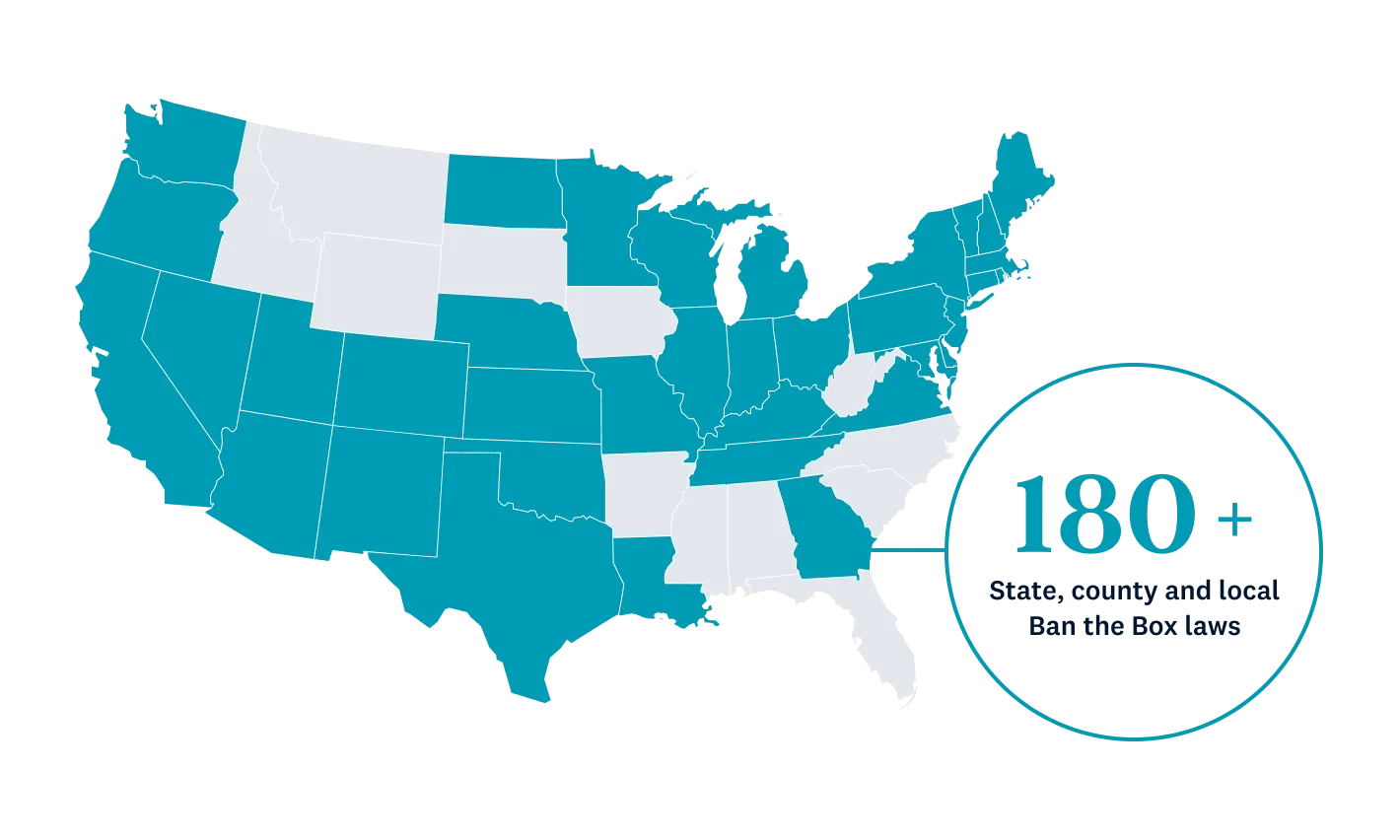
Local laws
Ban the Box laws can vary greatly based on location and jurisdiction. For example, California – the most populous state in the US – has both a statewide law as well as many city- or county-specific Ban the Box laws to encourage fair hiring practices.
The California Fair Chance Act (California Government Code § 12952) went into effect in 2018 and applies statewide. It prohibits public and private employers with five or more employees from requiring candidates to disclose whether they have an arrest or conviction record during the application process before making a conditional job offer. If a job offer is rescinded due to a candidate’s arrest or conviction history, employers must follow a comprehensive fair chance review process, including allowing the candidate to respond in writing to the decision.
There are currently ten cities or counties with additional Ban the Box laws in California. For example:
- The Los Angeles Fair Chance Initiative for Hiring, which went into effect in 2018, prohibits private employers and city contractors in the city of Los Angeles from inquiring about arrest or conviction records on job applications or before making a conditional offer of employment. If a job offer is rescinded due to a candidate’s arrest or conviction history, employers must follow a fair chance process and allow the candidate to respond.
- The San Francisco Fair Chance Ordinance, which went into effect in 2014, prohibits San Francisco city contractors and businesses with at least 5 employees from asking about arrest or conviction history until after making a conditional offer of employment. Pre-employment screenings cannot consider arrests not leading to conviction (except for pending cases), participation in diversion programs; juvenile convictions or those more than 7 years old (with some exceptions); or dismissed, expunged, invalidated, or inoperative convictions.
Other cities across the nation, like Chicago, have recently made changes to Ban the Box laws. The City made amendments to its 2015 Ban the Box ordinance, with changes taking effect at the end of April 2023, expanding coverage to most Chicago employers. The Ordinance prohibits the use of arrest records not leading to conviction; a juvenile record; or criminal history record information that has been expunged, sealed, or impounded. It also prohibits employers from taking adverse action unless certain criteria apply, requires an individualized assessment when conviction records are being considered, and contains strict adverse action notification requirements.
Federal laws
Continuing progress has also been made toward applying Ban the Box policies on a federal level.
- In April 2012, the Equal Employment Opportunity Commission (EEOC) clarified and strengthened its hiring guidelines by updating the Enforcement Guidance on Consideration of Arrest or Conviction Records in Employment Decisions.
- The Fair Chance to Compete for Jobs Act of 2019, which took effect in December 2021, prohibits federal agencies (including offices in the executive, legislative, and judicial branches) and federal civilian and defense contractors from seeking information on arrest and conviction history until a conditional job offer has been extended. (Certain positions, including law enforcement roles with access to classified or national security information, are exempt.)
In April 2023, a national Ban the Box bill (first introduced in March 2021) was reintroduced. The Workforce Justice Act would give states three years to enact policies that prohibit private employers from asking about an applicant’s arrest or conviction record before a job offer is extended or risk losing criminal justice funding.
Why does Ban the Box matter?
Nearly 80 million adult Americans have an arrest or conviction history. For many, having a conviction record makes it difficult to find gainful employment to support themselves and their families. More than one-quarter (27 percent) of formerly incarcerated individuals are unemployed.
Making hiring decisions based on a job candidate’s arrest or conviction record can lead to claims of disparate impact discrimination. According to EEOC guidance, hiring policies that appear neutral—such as denying employment based on a criminal history—can violate the law if they disproportionately impact employees and candidates protected by Title VII of the Civil Rights Act of 1964.
Title VII prohibits employers from discriminating against candidates on the basis of race, color, religion, sex, or national origin. Because Black and Hispanic Americans are disproportionately impacted by the criminal justice system, a blanket policy against hiring candidates with arrest or conviction records could result, among other potential issues, in claims that an employer is effectively discriminating against people of color in violation of Title VII.
Because Ban the Box laws aim to give candidates with arrest or conviction records a fair chance at employment, the terms Ban the Box and fair chance hiring are often used interchangeably. However, true fair chance hiring goes further than simply banning a check box; it actively recruits candidates with past justice system involvement.
How does Ban the Box impact employers?
More than four-fifths of the US population (over 267 million people), live in a jurisdiction that has banned the box, according to the National Employment Law Project. But job candidates aren’t the only ones to benefit from Ban the Box laws, there’s many advantages for employers, too.
Fair chance hiring can help:
- Boost the economy: According to a Center for Economic and Policy Research study, not employing formerly incarcerated individuals and those convicted of felonies costs the US $78 billion to $87 billion annually.
- Increase your labor pool: Jobs in many industries are still difficult to fill. Expanding the pool of available, qualified hires by banning the box can help employers remain competitive.
- Build more diverse teams: Diversity, equity, and inclusion (DE&I) is top of mind for HR professionals today. Fair chance hiring brings people with diverse skills and abilities—who may otherwise be overlooked—onto your team.
- Improve employee retention: Studies have shown that employees with arrest or conviction histories are more likely to stay with an employer than those without records.
- Enhance your organization’s image: Employees increasingly seek to work for companies that are aligned with their values, such as diversity and fairness.
How can you incorporate Ban the Box into your hiring process?
Compliance with any Ban the Box regulations affecting your business is essential. Without a national Ban the Box statute that applies to private employers, it can be challenging for organizations to navigate policies that vary widely across the country, and even from one city or county to another within the same state. Using a fair chance hiring process is one way to mitigate risk around EEOC guidelines and federal anti-discrimination law.
Here are several considerations for implementing fair chance hiring practices:
- Create a plan for change. Identify the main reason your organization should start a fair chance hiring program; this will guide your plan.
- Gain buy-in. Not everyone may be on board, but it’s important to enlist the support of key stakeholders within the organization and educate others to get them onboard.
- Educate your team. Dispelling myths about justice-impacted individuals is essential to the success of your fair chance initiative. Checkr’s resources for fair chance hiring are a good place to start.
- Train hiring managers. Conducting training to remove managers’ bias and improve sensitivity when talking to candidates will give your program a better chance at success.
- Partner up. Parole officers, probation departments, and local organizations that help formerly incarcerated people re-enter society can help you create a fair chance hiring pipeline.
Companies also need to walk a fine line between giving candidates a fair chance at available opportunities and taking steps to prevent negligent hiring. This is especially true in industries that deal with health, safety, education, and finances. Should an offense relevant to the job show up on a background check, these organizations may wish to conduct an individualized assessment to make an informed hiring decision.
Don’t fear Ban the Box
Untangling the web of Ban the Box ordinances can be complex, especially when you’re hiring in multiple locations. Choosing an accredited and experienced background check provider can help simplify the task. For example, Checkr’s Candidate Stories feature enables candidates to easily share context around past offenses, empowering them to have a voice while more easily facilitating individualized assessments. Our built-in compliance workflows, adjudication tools, and adverse action process support fair chance hiring and Ban the Box laws based on jurisdiction while enhancing your team’s efficiency.
Complying with Ban the Box regulations adds complexity to hiring, but ultimately pays off in a larger, more diverse, and more loyal talent pool. By working closely with your legal counsel and the right background check partner, you can conduct background checks and hire with confidence.
Frequently asked questions
What does "Ban the Box" mean?
Ban the Box is a specific type of law that prohibits employers from asking about a candidate's criminal history on job applications or before making a conditional job offer. These laws give individuals with criminal records a fair chance at employment by delaying background check inquiries until later in the hiring process. The goal is to reduce discrimination and ensure candidates are evaluated on their qualifications first.
What states have Ban the Box laws?
Currently, more than half of the states, the District of Columbia, and over 100 local jurisdictions have adopted some form of Ban the Box policy. However, the specific requirements vary significantly by jurisdiction. Some apply only to public employers, while others extend to private sector companies. Employers must understand their local regulations to remain compliant. Checkr's compliance resources can help you navigate these varying requirements across different locations.
Do Ban the Box laws apply to private employers?
Many Ban the Box laws apply to both public and private sector employers, though coverage varies considerably by location. For example, California's Fair Chance Act covers both public and private employers with five or more employees, while some jurisdictions only regulate public sector hiring. Private employers should verify whether their state or local Ban the Box laws apply to them. Understanding fair chance hiring practices helps your organization stay compliant while building diverse teams.
What is the Fair Chance to Compete for Jobs Act?
The Fair Chance to Compete for Jobs Act of 2019 is a federal law that prohibits federal agencies and federal contractors from asking about arrest or conviction history until after extending a conditional job offer. There are exceptions for law enforcement, national security positions, and certain other roles. This legislation represents the federal government's commitment to fair chance hiring. Organizations working with federal contracts should review background check laws so they can fully comply with them.
When can employers ask about criminal history under Ban the Box?
Under most Ban the Box laws, employers can ask about criminal history only after a candidate has been interviewed or has received a conditional job offer, not when the candidate initially applies. This limit generally applies whether you are asking the candidate directly or getting this information from a third-party source. The exact timing varies by jurisdiction: Some states allow inquiries after the first interview, while others require a conditional offer first. Employers must follow their specific local requirements. Implementing compliant criminal background check processes helps you ask questions at the right time.
Are there exceptions to Ban the Box laws?
Yes, Ban the Box laws typically include exceptions for certain positions where criminal history is directly relevant to job duties. Common exceptions include law enforcement roles, positions working with vulnerable populations like children or elderly individuals, and jobs in healthcare or financial services. Some jurisdictions also exempt small employers or specific industries. Employers should carefully review their applicable laws to understand which exceptions apply. Checkr's industry-specific solutions can help your team navigate these nuanced requirements.
What is an individualized assessment under Ban the Box?
An individualized assessment is a case-by-case evaluation that many Ban the Box laws require before someone can deny employment based on criminal history. Employers must consider factors like the nature of the offense, time elapsed since the offense, and its relevance to the job. This process is designed to give individuals fair treatment rather than blanket exclusions. Candidates must also receive notice and an opportunity to respond before the employer may take negative hiring action.
How do Ban the Box laws affect background check timing?
Ban the Box laws significantly affect when employers can conduct background checks during the hiring process. Instead of screening candidates at the application stage, employers must wait until later—typically after an interview or conditional offer. This delay allows candidates to demonstrate their qualifications before their criminal history is considered. Employers need background check providers who understand these timing requirements. Checkr's background check platform is designed to support compliant hiring workflows at every stage.
What penalties exist for violating Ban the Box laws?
Penalties for violating Ban the Box laws vary by jurisdiction, but they can include fines, civil penalties, enforcement actions, and potential lawsuits from affected candidates. Some states impose fines of a few hundred or several thousand dollars per violation, while California, Hawai’i, and Massachusetts allow private rights of action where candidates can sue for damages. Repeat violations may result in increased penalties. Employers may also face reputational damage and regulatory scrutiny if they fail to comply with Ban the Box laws.
How can employers stay compliant with Ban the Box laws?
Employers can stay compliant by understanding applicable federal, state, and local Ban the Box requirements, training their hiring managers on proper procedures, and implementing compliant background check workflows. Regular policy reviews help your team align with evolving regulations. Using modern technology to automate your compliance checks reduces the risk of non-compliance. It’s also important to document any individualized assessments and adverse action processes your team conducts.
Partner with Checkr to access compliance tools, expert support, and automated workflows that help keep your hiring process fair and legally compliant.
Disclaimer
The resources and information provided here are for educational and informational purposes only and do not constitute legal advice. Always consult your own counsel for up-to-date legal advice and guidance related to your practices, needs, and compliance with applicable laws.