Bank of America: Hiring, Background Check & Employment Verification FAQs
Want to see what's on your own background check? Run a check today.
Are you a mortgage lender?
Run an employment verification today.
Checkr is trusted by 140k+ businesses and 80 million individuals
Ready to run background checks the modern way?
Frequently asked questions
Bank of America: Company Profile & Background Check FAQs
Bank of America is one of the largest financial institutions in the United States, serving tens of millions of consumers, small businesses, and corporations across the country and internationally. Because employees may have access to sensitive financial accounts and customer data, the bank conducts a thorough pre-employment background check that includes criminal history, credit review, drug testing, and FBI fingerprinting before candidates begin work.
Run a personal background check
Are you an organization? Run candidate background checks here >
Bank of America: Company overview
Bank of America traces its roots to the Bank of Italy, founded in San Francisco in 1904 by Amadeo Giannini to serve immigrants and working-class customers. Over the following century, a series of mergers and acquisitions shaped the institution into its current form. The pivotal moment came in 1998 when NationsBank Corporation acquired BankAmerica Corporation, creating the modern Bank of America and establishing its headquarters in Charlotte, North Carolina, where the company remains based today. Bank of America's company overview spans more than 100 years of evolution in American banking.
Today, Bank of America is publicly traded on the New York Stock Exchange under the ticker symbol BAC and ranks among the largest banks in the world by total assets. The company reported total assets exceeding $3.3 trillion in recent years, making it one of the most significant financial institutions globally. Bank of America employs approximately 213,000 people across its operations, according to recent regulatory filings, with a workforce spanning consumer banking branches, corporate offices, call centers, and technology operations.
The bank operates across four primary business segments: Consumer Banking, which serves everyday customers through branches, ATMs, and digital channels; Global Wealth and Investment Management, which operates under the Merrill brand and serves high-net-worth individuals and institutions; Global Banking, which provides lending and advisory services to corporations and government entities; and Global Markets, which handles sales, trading, and research for institutional clients. This breadth of operations means Bank of America hires across a wide range of roles, from branch tellers and financial advisors to software engineers and investment bankers. More information about the company's business structure is available through Bank of America's investor relations page.
Bank of America's stated mission centers on responsible growth and connecting people to what matters most in their financial lives. The company operates branches and offices across all 50 U.S. states and has a presence in more than 35 countries, giving it both national and international reach in consumer and commercial financial services.
Company culture and employee programs:
Bank of America has built a range of employee programs around financial wellness, professional development, and workplace inclusion. The company offers competitive compensation, health and wellness benefits, a 401(k) plan with company matching, tuition assistance, and employee assistance programs. Bank of America has also established programs specifically focused on career mobility, allowing employees to explore internal opportunities across different business lines and geographies.
The company participates in various diversity, equity, and inclusion initiatives and has set workforce representation goals it reports on publicly. Employee resource groups exist for various communities within the company, including groups for veterans, employees with disabilities, and early-career professionals. These programs reflect a broader emphasis on long-term employee development rather than transactional employment relationships.
Bank of America background check FAQs
How long can a Bank of America background check take?
The Bank of America background check typically takes a few business days to complete after a candidate submits their information following a conditional offer. In straightforward cases where records are easily verified and no discrepancies arise, the process can move quickly. However, several factors can extend the timeframe.
Criminal history searches that span multiple counties or states may take longer because not all court systems have digitized their records. If the background check requires manual court research, a single jurisdiction can add several days. Credit history verification is generally fast since it pulls from national credit bureaus, but identity verification through a Social Security number trace is a standard first step that must resolve before other searches proceed. The FBI fingerprinting component, which is required for certain roles, may also add time depending on processing volumes at the time of the request.
Candidates who have lived in multiple states, have a complex employment history, or have records requiring additional review may see timelines extend beyond the standard window. For a detailed explanation of what affects turnaround times, see background check turnaround times.
What can be revealed in a Bank of America background check?
Bank of America's background check is multi-component and designed to verify identity and assess risk across several dimensions. The typical background check for a Bank of America candidate includes the following components:
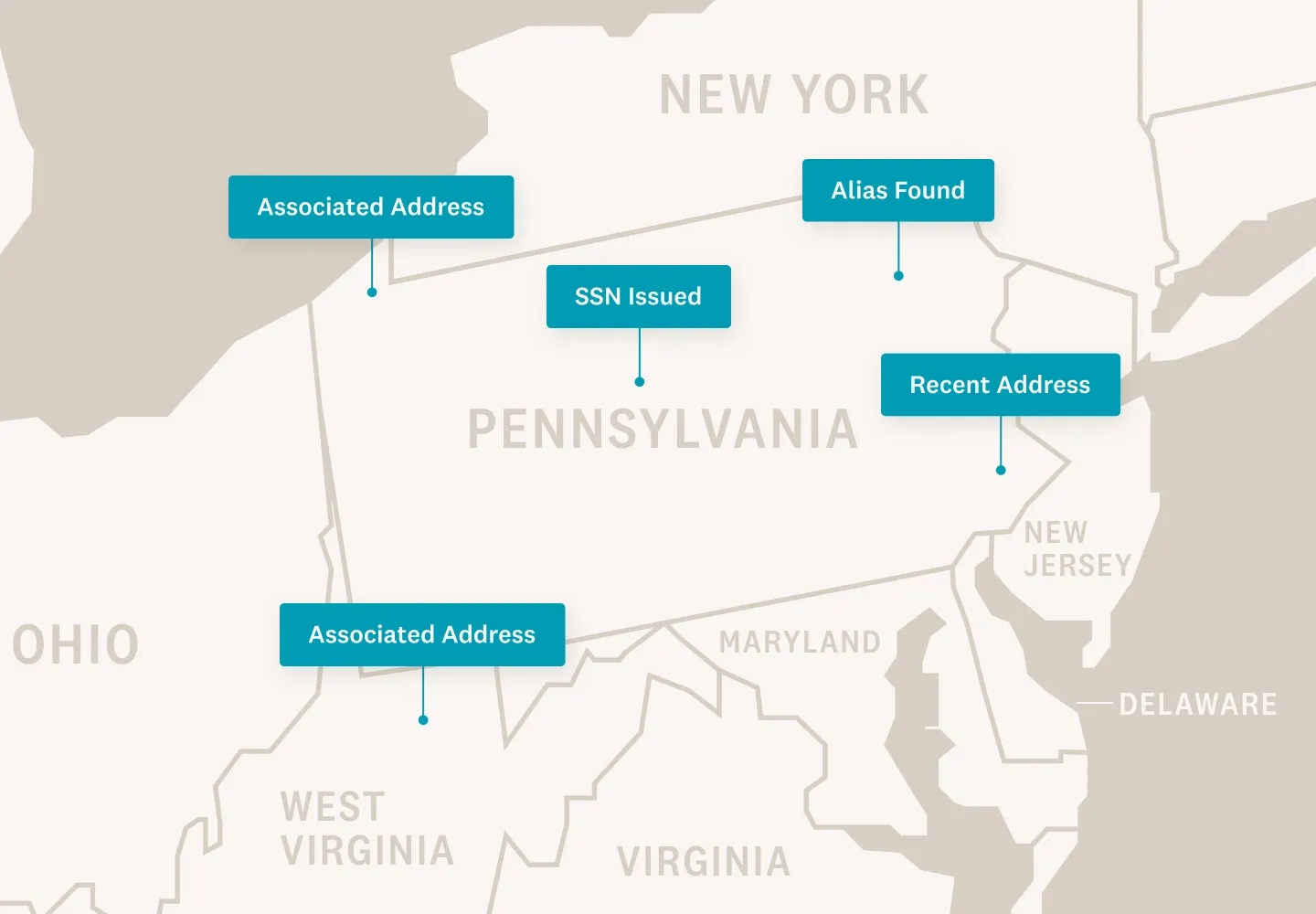
Social Security number trace: This is generally the first step in any background check. An SSN trace confirms the candidate's identity and surfaces the names and addresses associated with that SSN, which then informs where criminal history searches are conducted.
Criminal history search: Bank of America conducts criminal background checks at the county, state, and federal levels. This search may reveal felony and misdemeanor convictions, pending charges, and in some jurisdictions, arrests. For a financial institution, criminal history related to fraud, embezzlement, theft, money laundering, or other financially motivated crimes carries particular weight, as federal banking law places restrictions on individuals convicted of certain crimes from working in federally insured institutions.
Sex offender registry search: A search of state and national sex-offender registry is standard in most comprehensive background screening programs.
Global watchlist search: Candidates may be screened against global watchlists, including the Office of Foreign Assets Control (OFAC) list, the Terrorist Screening Database, and other sanctions and debarment lists. This is especially relevant for a financial institution with international operations.
Employment verification: Bank of America typically verifies prior employment history, including job titles, dates of employment, and in some cases, eligibility for rehire.
Education verification: For roles where specific degrees or certifications are a stated requirement, Bank of America may verify educational credentials directly with the issuing institution.
Drug screening: Drug testing is part of Bank of America's hiring process for many roles, though specific policies may vary by position, business line, and state. Candidates are typically instructed on the drug testing process as part of the pre-employment screening instructions.
FBI fingerprint background check: For roles involving access to financial institution funds, federal law requires a fingerprint-based criminal history check submitted to the FBI. This is separate from standard criminal database searches and draws directly from the FBI's national criminal records database.
Does Bank of America check credit history?
Yes, Bank of America conducts credit history checks as part of its background screening process, particularly for roles that involve direct access to customer finances, accounts, or assets. This is common practice among financial institutions and aligns with the nature of financial services work, where employees may handle significant sums of money or have access to sensitive account information.
A credit background check for employment purposes is not the same as a hard credit inquiry for lending. Employment credit checks are a "soft pull" and do not affect a candidate's credit score. The report provides information about credit accounts, payment history, outstanding debt, bankruptcies, and similar financial history, but it does not include the candidate's actual credit score.
Bank of America, like all employers using credit history in hiring decisions, is required to comply with the Fair Credit Reporting Act (FCRA). This means the company must obtain written authorization from the candidate before running a credit check and must follow specific adverse action procedures if credit history contributes to a decision not to hire. Some states and municipalities also restrict or prohibit the use of credit history in employment decisions for certain roles, and Bank of America is expected to comply with applicable "ban-the-box" laws and similar regulations in the jurisdictions where it operates.
Candidates concerned about how credit history may affect their application should be aware that a single negative item, such as a past-due account or a period of financial hardship, does not automatically disqualify an applicant. The assessment generally considers the overall financial picture and its relevance to the specific role being applied for. Bank of America background check bad credit outcomes are evaluated in context rather than applied as automatic disqualifiers.
Does Bank of America conduct fingerprint background checks?
Yes. Bank of America requires FBI fingerprint-based background checks for employees in roles covered under the Financial Institutions Reform, Recovery, and Enforcement Act (FIRREA). This federal law requires federally insured depository institutions to submit fingerprints for employees with access to financial institution funds so that the FBI can check those prints against its criminal records database.
This regulatory requirement makes Bank of America's background check process more rigorous than employers in many other industries. The FBI fingerprint check draws on a broader and more authoritative set of criminal records than standard commercial database searches, which may not capture records from all jurisdictions or may have data gaps. Candidates typically complete fingerprinting at a designated location or through a mobile fingerprinting service as part of the pre-employment process.
The fingerprint background check requirement applies regardless of whether a candidate has already consented to a standard criminal history search. Both components serve different purposes: the commercial criminal search covers breadth across jurisdictions, while the FBI fingerprint check provides a definitive record check tied to biometric identity.
How far back can Bank of America's background check go?
The look-back period for Bank of America's background check depends on the type of record being checked and the laws of the state in which the candidate will be employed.
For criminal history, the Fair Credit Reporting Act (FCRA) limits consumer reporting agencies to reporting most criminal records going back seven years from the date of disposition, release, or parole for positions where the expected salary is below a certain threshold. For higher-salary positions, some states permit reporting beyond seven years, and the FCRA's seven-year limit does not apply to all records in all circumstances. Convictions, unlike arrests, are generally reportable without a time limit in many states, though some states have enacted stricter caps.
Federal banking regulations add another layer. Under Section 19 of the Federal Deposit Insurance Act, individuals convicted of certain crimes involving dishonesty, breach of trust, or money laundering are prohibited from working at a federally insured institution without receiving prior written consent from the FDIC. This prohibition can apply regardless of how far in the past the conviction occurred, making the effective look-back period for certain financial crimes essentially indefinite for Bank of America and similar institutions.
Candidates with older records should be aware that state-specific rules vary significantly, and the role being applied for will influence how records are evaluated. For roles subject to federal banking regulations, criminal history related to financial crimes may be reviewed regardless of when it occurred.
What is the FCRA and how does it protect candidates?
The Fair Credit Reporting Act (FCRA) is a federal law that governs how background checks are conducted and how consumer report information is used in employment decisions. It establishes rights for candidates and obligations for employers and background check providers at every stage of the process.
Under the FCRA, Bank of America must obtain the candidate's written authorization before ordering a background check. The authorization must be a standalone document, separate from the general employment application. The candidate has the right to receive a copy of the report and a summary of their FCRA rights.
If Bank of America intends to take an adverse action based on information in the background check, such as rescinding a conditional offer of employment, the FCRA requires a specific two-step process. First, the company must provide the candidate with a pre-adverse action notice, a copy of the background check report, and a summary of FCRA rights. This gives the candidate an opportunity to review the report and dispute any inaccurate or incomplete information before a final decision is made. After a reasonable waiting period, the company may then issue a final adverse action notice if it proceeds with the decision not to hire.
In addition to the FCRA, the Equal Employment Opportunity Commission (EEOC) provides guidance on how criminal background check information may be used in employment decisions to avoid disparate impact on protected classes. Employers are generally expected to conduct an individualized assessment that considers the nature of the crime, the time elapsed, and the nature of the job rather than applying blanket exclusions. For a fuller explanation of how these laws interact, see the FCRA and EEOC.
Candidates who believe their background check contains errors have the right to dispute inaccurate information directly with the consumer reporting agency that produced the report.
Order your own background check
Candidates preparing to apply for positions at Bank of America or any other financial institution may find it useful to review their own background before an employer does. Ordering a Checkr Personal Background Checks through Checkr allows individuals to see what criminal records, if any, are likely to appear during employer screening. Reviewing your own report in advance gives you the opportunity to identify and dispute inaccurate information before it affects a hiring decision.
Checkr also offers Checkr Profile, a portable background check that candidates can share directly with employers, streamlining the screening process and reducing wait times on both sides.
Are you a candidate with an open background check with Checkr?
If Bank of America is using Checkr to process your background check, you can track the status of your report through the Candidate Portal. The portal allows you to view your report status, submit any required documents, and see what information has been returned. If you have questions about your background check or need assistance, the Checkr Help Center provides candidate-specific resources and support options.
The resources and information provided here are for educational and informational purposes only and do not constitute legal advice. Always consult your own counsel for up-to-date legal advice and guidance related to your practices, needs, and compliance with applicable laws.
Run a personal background check
Are you an organization? Run candidate background checks here >
Disclaimer
The resources and information provided here are for educational and informational purposes only and do not constitute legal advice. Always consult your own counsel for up-to-date legal advice and guidance related to your practices, needs, and compliance with applicable laws.

Run a personal background check today.
Preview your own background check results to see what employers might see.