
Table of Contents
Ready to run background checks the modern way?
Key takeaways
- Most small businesses choose a background check provider based on price or familiarity, but long-term performance depends on workflow fit and consistency
- Turnaround time claims can be misleading unless you understand how consistent results are across different checks and jurisdictions
- Compliance support directly impacts how confidently teams can move forward when issues arise during hiring
- Switching providers is easier than most small businesses assume — the real cost is usually in staying with one that isn't working, not in moving
Why most small businesses choose the wrong background check provider
Most small businesses don’t realize they’ve chosen the wrong background check provider until they’ve already built hiring processes around it.
At first, everything looks similar: pricing is comparable, turnaround times sound fast, and every platform promises compliance support. The differences usually appear later, when background checks take longer than expected, candidates stop responding, or your team discovers important steps that still require manual follow-up.
The typical process includes:
- Search for the best background check service for small businesses
- Compare pricing pages
- Pick the option that feels fastest, cheapest, or most familiar
This works at low volume. But as hiring increases, gaps show up—delayed checks, unclear results, or compliance steps that weren’t anticipated.
The three most common mistakes businesses make when evaluating a background check provider
- Choosing based on price alone
- Not digging into real turnaround performance
- Not asking how compliance and adverse action are handled
Over time, these gaps lead to slower hiring cycles and more manual follow-up than expected.
The strongest background check vendor evaluations focus on real-world performance, not demo environments. That requires applying six practical criteria to providers' behavior in actual hiring workflows.
If you’re still narrowing your options, resources like Best Background Check Companies & Services can help you identify potential providers to evaluate. Once you’ve identified a few options, comparisons like Checkr vs. HireRight and Checkr vs. First Advantage can help you apply the criteria below to specific vendors.
Six criteria that matter the most when evaluating a background check provider
To execute a structured evaluation, teams should apply six core criteria that reflect real hiring conditions.
What matters most when evaluating a background check provider?
- Turnaround time
- Pricing transparency
- Compliance support
- Candidate experience
- Workflow simplicity
- Integrations
1. Turnaround time—and what actually drives it
Averages can mask inconsistency—some checks may complete quickly, while others may take significantly longer, depending on the type or jurisdiction. What matters is predictability:
- What percentage of checks are completed within 24 hours: to understand real-world consistency, not peak performance
- Whether performance varies by check type or geography: to identify where delays occur
- How delays are surfaced in the platform: because visibility reduces manual chasing
- How candidates are updated when action is required: when well-managed, this reduces drop-off risk
Variability is the real issue. Two background check providers with the same average turnaround time can deliver very different hiring experiences.
Red flag: providers that only publish headline averages without showing distribution or breakdowns by check type.
2. Pricing transparency
A key part of any background check provider checklist is understanding total cost, not just headline pricing. There are three layers: base price per check, pass-through fees, and all-in cost. Pass-through fees are external charges (court access, data sources, verification costs) that vary by jurisdiction and may be bundled or added separately.
What to evaluate:
- Whether base pricing is clearly defined per check: vague base pricing usually means the real cost shows up later
- How pass-through fees are handled: unclear handling here is where "cheap" quietly becomes expensive
- Whether providers can estimate realistic all-in costs upfront: you shouldn't need a spreadsheet to find out what you'll actually pay
- Whether pricing varies by geography or check type, and whether it's public or sales-led; gated pricing is often a signal of gated flexibility later
- Whether setup fees, minimums, or volume discounts are disclosed upfront; surprises here compound over a year of hiring
Red flag: providers that make it difficult to estimate your all-in cost before you commit.
For small businesses, predictability matters more than small price differences; the cheapest provider is rarely the cheapest once manual work, delays, and candidate drop-off are factored in.
3. Compliance support
Most small businesses don't need in-house legal expertise. They need a system that helps them avoid mistakes. Compliance becomes most visible during adverse action, when decisions must follow a structured process.
What to evaluate:
- Whether adverse action workflows are guided step-by-step; this is what keeps missed steps and compliance risk out of a process no one on your team has run a hundred times before
- Whether jurisdiction-specific requirements are surfaced automatically: manual tracking is exactly where things get missed
- Whether notices are generated and tracked automatically: consistency here is what makes the process auditable later
- Whether the system flags a missed step before it happens rather than after: prevention beats cleanup every time
Red flag: providers that place full compliance responsibility on the customer.
Good systems don't remove legal responsibility—they reduce the risk of getting it wrong.
4. Candidate experience
Candidate experience directly impacts completion rates and time-to-hire.
What to evaluate:
- Mobile vs. desktop usability: most candidates complete background checks on their phones, so the experience needs to be built for that, not adapted to it
- Time required for submission: the shorter, the better—long or complex forms are where candidates drop off
- Communication during waiting periods: clear updates reduce frustration and confusion about status
- Clarity of next steps: candidates should know what happens after submission and when to expect updates
- Speed of missing-information prompts: flagging gaps quickly prevents unnecessary stalls
Red flag: clunky, multi-step workflows, or desktop-only processes.
Candidate drop-off during screening can slow the entire hiring flow and increase time-to-hire.
5. Workflow simplicity and ease of use
Ease of use is not about feature count—it's about operational speed. Many platforms look good because they offer many features, but that doesn't mean they're easy to use day-to-day. For small businesses, the key question is: how quickly can someone run a background check without training?
What to evaluate:
- Time from account setup to first check: how quickly a team can move from onboarding to live hiring without support
- Number of steps required to launch a check: fewer steps mean fewer chances to make a mistake
- Whether non-specialists can use the platform without HR or technical expertise: this is the real test of "easy"
- Whether the workflow stays simple across multiple hires or team members at once: single-hire simplicity doesn't always scale
- Amount of manual coordination required between steps: every handoff is a place things get dropped
Red flag: enterprise systems that still require configuration to function smoothly.
The best tools fit naturally into hiring workflows rather than adding extra steps.
6. Integration with tools you already use
As hiring scales, integration becomes more important than features. Most small businesses don't need integrations on day one. They usually need them six months later, when hiring volume increases.
What to evaluate:
- ATS, HRIS, or payroll integrations: direct connections reduce manual data entry and the errors that come with it
- Ease of integration setup: it should be straightforward, with minimal implementation time
- Whether developer support is required: if engineering resources are needed, that's a barrier to adoption most small teams can't clear
- How data flows between systems: candidate status, check progress, and results should sync automatically, not manually
- How integrations hold up as hiring volume grows: they should stay stable without needing extra support
Red flag: integrations that require technical implementation for basic use or ongoing support.
Good integrations reduce manual work—they don't create new dependencies.
Want the compliance side spelled out in plain language?
Adverse action, jurisdiction requirements, and what "compliance support" actually needs to cover—without the legal jargon.
Questions to ask during a demo or trial
Turnaround time tells you what to look for. The demo is where you test whether a provider can actually deliver it.
Most demos focus on features. The better ones reveal how the system behaves under real hiring conditions—and this is where vague answers tend to surface. The goal isn't to collect more claims. It's to force specificity.
Questions to ask during a background check trial or demo
- What percentage of checks are completed within 24 hours, in real conditions—not the marketing average?
- What percentage of your customers are small businesses? This tells you whether SMBs are a core use case or an afterthought to an enterprise roadmap.
- How long does implementation usually take, start to finish?
- What typically causes delays, and how are they surfaced to you when they happen?
- Who owns follow-up when a check stalls—you, or them?
- Can you walk us through an adverse action workflow, step by step?
- How are candidates notified when something is missing?
- Can you show us a real delayed case, and how it was resolved?
Red flag: answers that stay high-level ("it depends," "usually fast," "we strive for efficiency") without operational detail.
Upskill and reskill your existing workforce
Developing your team internally reduces your business’s dependence on the hiring industry, especially with labor shortages. Common methods of investing in your current employees include:
- Apprenticeships: Structured earn-while-you-learn programs for employees learning new skills can pair classroom learning with paid shop-floor rotations.
- Cross-training: Skills matrices identify the employees who can cover critical stations, which can reduce spikes in overtime.
- Microlearning: Short digital lessons and QR-linked standard operating procedures (SOPs) help workers learn gradually without pulling them off the line for long training sessions.
One more thing: Switching costs are lower than you think
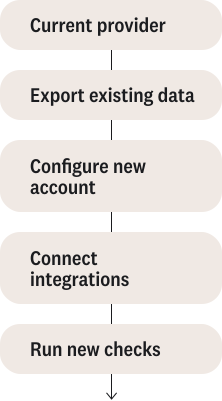
Many small businesses stay with their current provider because switching feels disruptive, not because it's optimal. The biggest cost of switching providers isn't usually migration—it's the months spent tolerating a workflow that isn't working.
In practice, switching background check providers at a small business is often more straightforward than expected. Before deciding to stay, ask:
- How is historical data exported, and in what format: can candidate records, reports, and compliance documents come with you without manual rework?
- What does implementation actually involve: is setup self-serve, or does it require onboarding support?
- How long does migration take in practice: get a real timeline, not a best-case estimate
- What parts of the workflow need to be rebuilt: will existing processes transfer, or start from scratch?
- How are active checks handled during transition: do in-progress checks continue as normal, or require manual coordination?
- What support is provided during onboarding: hands-on help, or mostly self-managed?
If your current provider can't clearly answer these, the friction of switching is often lower than the cost of staying put.

What this means for your background check evaluation
The goal isn't finding a provider that works today—it's finding one that keeps working as hiring increases, workflows get more complex, and new tools get added.
Evaluating providers on turnaround time, pricing transparency, compliance support, candidate experience, workflow simplicity, and integrations surfaces the differences that matter before they show up in your hiring outcomes, not after.
See how Checkr holds up against these six criteria.
Run a real background check, on your own hiring workflow, before you decide.
Disclaimer
The resources and information provided here are for educational and informational purposes only and do not constitute legal advice. Always consult your own counsel for up-to-date legal advice and guidance related to your practices, needs, and compliance with applicable laws.

About the author
Hayley Harrison began her career as a hiring manager at a mid-size regional bank in the Pittsburgh area. She now brings her experience and knowledge of hiring best practices to her work as a freelancer, helping employers refine and improve their processes.