How to build a fraud-resistant hiring program

Stage-by-stage verification strategies for organizations hiring at scale
Hiring fraud often comes to light only after teams have spent time on interviews, screening, and offers. This guide explains how to verify identity earlier, improve screening accuracy, and reduce unnecessary friction.
Keep reading to learn how to:
- Identify fraud risks across each stage of hiring
- Sequence identity verification and background checks effectively
- Evaluate providers, processes, and detection capabilities
- Measure the business impact of your screening program
Hiring fraud is being caught too late
When HR leaders were asked, “What makes a background check accurate?” 58% said the report has to reflect relevant reportable history, with nothing missing or outdated. An identical 58% said the identity used to gather that information has to match the candidate who shows up on day one, according to Checkr’s 2026 report, Unlocking HR’s Strategic Potential with Better Verifications, a survey of 1,000 senior HR leaders hiring at scale.
Both expectations are reasonable. Yet many programs verify a candidate’s identity only once, then assume it stays consistent from application through onboarding.
Before AI made hiring fraud easier to attempt, many employers verified identity once during the background check. That approach may have felt sufficient when fabricated identities and documents were less sophisticated. Today, any candidate and (in rarer cases) organized criminal organizations can produce convincing documents, licenses, images, and online personas. That leaves hiring teams with two practical questions:
Is that really enough anymore? What do we do when we suspect fraud during early interviews or after a candidate has accepted an offer?
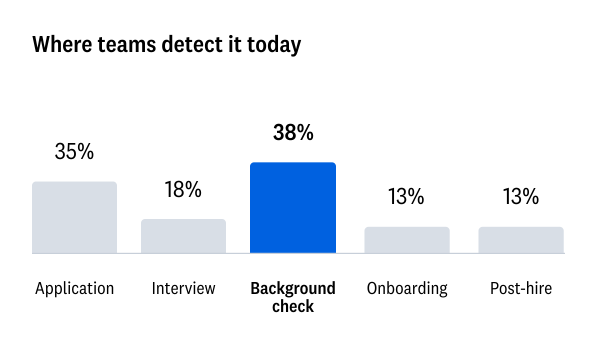
Where hiring fraud is identified today
Source: 2026 State of Screening Compliance Report
Data may not add up to 100% due to rounding
The answer is to verify identity and look for fraud at more than one point in the hiring process. A progressive approach helps qualified candidates keep moving while automated checks catch risk earlier and reduce the burden on hiring managers.
Here’s how that approach works at each stage, along with the tools that can help catch fraud without slowing down qualified candidates.
1
Confirm identity before you gather records
To catch fraud earlier, start verification earlier. Confirm identity at the beginning of the process, then carry that verified identity through each screening step.
Identity verification confirms the person
A live selfie and government-issued ID help confirm that the document belongs to the candidate and that the candidate is a real person.
A background check confirms history
A background check searches records such as criminal history, employment, education, and credentials tied to the candidate’s verified identity.
Starting with identity verification gives every later step, including the background check, a more reliable foundation. Without a liveness check, you could end up with a complete and accurate report for the wrong person.
Checkr uses government-issued ID authentication, live selfie matching, liveness detection, device and behavioral signals, and deepfake detection certified at Level 2 by the National Institute of Standards and Technology (NIST). The process takes about two minutes, requires no external account or digital wallet, and can be placed at application, background check, onboarding, or at high-risk moments after the employee has started.

What to ask your verification provider
Deployment and sequence
- At which points in the hiring process can identity verification run, and can we change that sequence later without re-implementation?
- Can we configure it differently by role, business unit, or jurisdiction?
Candidate experience
- What does the candidate actually do, how long does it take, and does it require an account, an app, or a redirect?
- What happens when verification fails for a benign reason such as poor lighting or a blurry image? How many retries does a candidate get, and at what cost?
Technical assurance
- Which certifications cover your liveness and deepfake detection, issued by whom, and when were they last renewed?
- What proportion of verifications complete without any intervention from our team?
See identity verification in action for hiring teams
2
Map automated fraud detection to every hiring stage
Look for coverage across application, interview, background check, onboarding, and post-hire in one connected screening flow. Fraud can appear differently at each stage, and manual review becomes harder as hiring volume grows.
Fraud capabilities HR leaders say their program is missing
Respondents selected all that applied. Asked separately, only 10% said their fraud coverage has no gaps.
Source: Unlocking HR’s Strategic Potential with Better Verifications
Four of these six gaps fall outside a traditional background check. A modern provider should be able to surface fraud signals at any stage from one dashboard, without making your team or candidates switch tools.
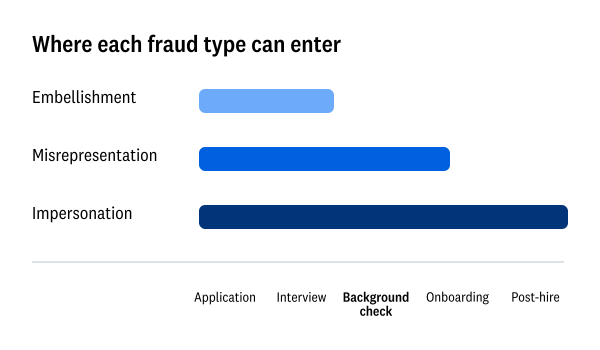
Here’s where common types of fraud tend to appear and which fraud detection tools can help detect them at any scale.
Fraud type | What it looks like | What stage you detect it | Which solutions find it |
Embellishment | Elevated job titles, hidden employment gaps, exaggerated responsibilities | Application review | Resume fraud detection |
Misrepresentation | Fabricated paystubs, degrees, transcripts, professional licenses, or work authorization documents | Application through background check | Document authentication and credential verification |
Impersonation | A synthetic or real person’s identity used by someone else | Every stage from application through post-hire | Identity verification, liveness and deepfake detection, and identity-misuse signals |
Source: 2026 State of Screening Compliance Report
Application
Interview
Background check
Onboarding
Post-hire
Validate identity upfront and flag synthetic or fraudulent submissions before interview time is committed. Look for solutions like resume fraud detection, which flags falsified employment, education, and identity claims by cross-referencing proprietary data and applying forensic analysis to resume content, metadata, and candidate history.
Confirm that the same verified person attends each call, video interview, and onsite visit. When appropriate and with the candidate’s consent, recording interviews can give your team a consistent record of those interactions.
Photo analysis and location confirmation can help detect impersonation as AI-generated images become more convincing. This gives teams more reliable signals than asking interviewers to notice blurry edges, unusual facial details, or something that simply looks off.
Checkr’s image comparison verification places photos captured at different hiring stages side by side. This makes it easier to spot inconsistencies that might otherwise be missed when images live in separate systems and are reviewed by different people days apart. Location comparison also flags conflicting location signals across application, interviews, and onboarding, without asking hiring managers to track them manually.
Before ordering a background check, confirm that the identity being screened belongs to the person your team interviewed. This can catch attempts to introduce a stolen or fabricated identity between disconnected hiring steps.
Then run any background checks you need to determine eligibility or maintain compliance. Your background check partner should make it easy for your team to automatically trigger each verification, without manually building workflow or screening packages every time. If an identity verification comes back flagged, background checks shouldn’t be ordered until a human signs off on next steps.
When choosing a background check provider, look for one that offers automated document authentication, so a forged license or diploma is caught by the system rather than by a recruiter noticing something off.
Verify identity again during onboarding, especially when hiring teams are distributed or roles span multiple locations. The person meeting a new hire on day one may not be the same person who conducted interviews, reviewed the background check, or validated I-9 materials.
At scale, those steps are often handled by different people or teams. A final identity check can help confirm that the person who arrives onsite or receives access to internal systems is the same person who completed the previous screenings.
Consider re-verifying identity at higher-risk moments such as privilege escalations, password resets, device changes, or jobsite changes. Continuous checks can complement this by alerting your team to record, credential, or license changes that may affect continued employment eligibility.
Questions you need answered
Coverage
- Which of the five stages does your fraud coverage touch, and which does it not?
- How is a verified identity carried forward from one stage to the next, or is each check independent?
Specific capabilities
- Can we compare the images and location signals captured at different stages, and where does that comparison surface?
- Do you support a customer-controlled blocklist, and can we configure it to our policies?
- What triggers post-hire re-verification, and can we automate certain triggers based on continuous checks or integrated HRIS status changes?
What 1,000 senior HR leaders say about fraud, accuracy, and where their programs fall short
3
Sequence checks progressively to raise screening quality
Many teams still detect fraud through a single batch of checks or an inconsistent manual process. A sequential flow spreads verification across the hiring journey, makes results easier to track, and helps teams avoid spending time and money on fraudulent candidates.
Only 21% of large organizations currently use a tiered approach, with lighter verifications early and more time-intensive checks later. Half run the same full set for every candidate in a role, simultaneously. Sequencing checks is at the forefront of the evolution of screening and fraud detection, and hiring teams that start to rethink their screening journey now will be leading the pack down the road.
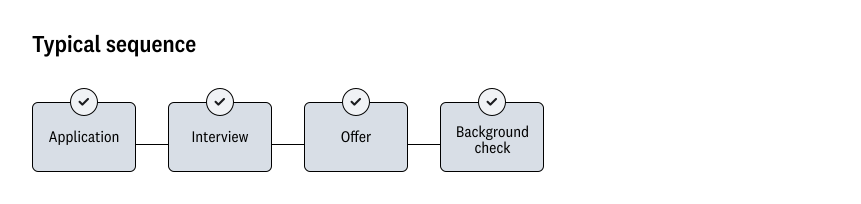
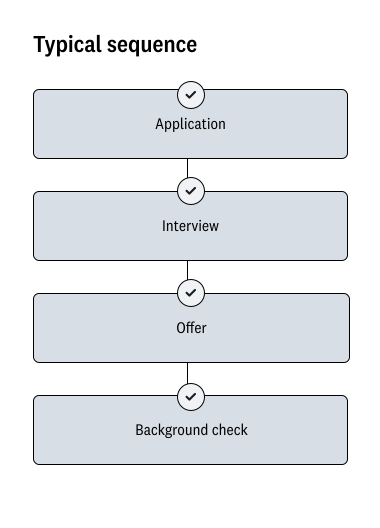
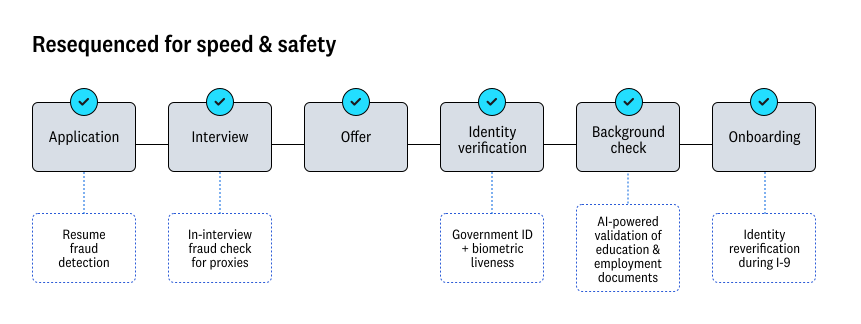
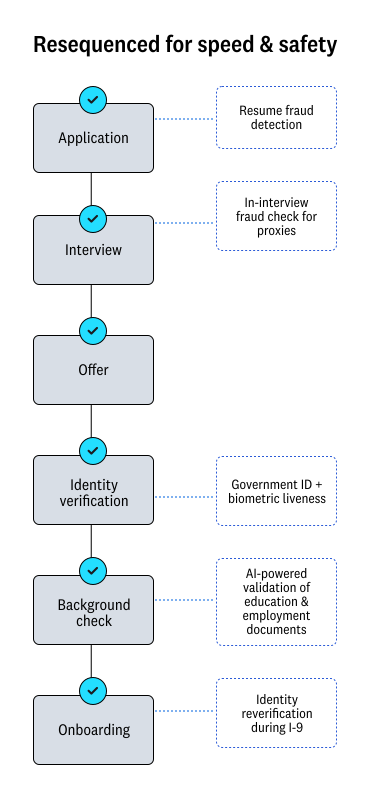
Progressive checks change the quality of what reaches each hiring stage:
- Candidates who reach your interview loop are confirmed real people
- Candidates who reach adjudication are confirmed real people whose claims have already been cross-referenced against trusted records
- Your recruiters spend their hours on a cleaner pipeline
- Your adjudicators review records that describe the right person
This approach also makes the process more efficient. Teams spend less time interviewing, checking references, and reviewing candidates who will not move forward. More in-depth searches run only after candidates clear earlier verification, creating a cleaner and more reliable pipeline.
Activus Connect, a remote-first business process outsourcing company running roughly 3,000 to 4,000 background checks a year, rebuilt its sequence around exactly this. Identity verification runs after application and live interview, and before anything else.
“When a candidate doesn't pass IDV, the savings are exponential. We're no longer paying for the rest of the background check, spending man-hours on training, or sending them assets. We’re able to save time and money by being able to catch fraud upfront with Checkr.”
Dawn Nash
Director of Recruiting and Enculturation, Activus Connect
What changed at Activus Connect after moving verification to the front
60+
fraudulent candidates identified in a single hiring season
90%
estimated reduction in day-one identity mismatches
70%
increase in qualified candidate conversations (per recruiter, per day)
Will candidates be scared off by multiple verification steps?
Some teams worry that added verification will hurt the candidate experience. But candidates also want confidence that real, qualified people are being considered fairly, especially as AI-generated applications become more convincing.
A short, clearly explained verification step can build trust when candidates understand why it is needed, how their data is protected, and what to expect from the process.
In fact, before Activus adopted automated identity verification, it tried solving the same problem itself by asking job applicants to go on camera and hold up an identification document. Drop-off ran up to roughly 85%. Candidates were being asked to share sensitive identification, on the spot, over a video with someone they had never met.
Whether verification builds trust or creates friction depends on three things: how much effort it requires, how clearly you explain its purpose, and how transparent you are about data security and results.
Questions you need answered
Sequencing
- Can we run different verifications at different funnel stages within a single candidate flow, or does the candidate move between systems?
- Can we configure the sequence per role, business unit, or jurisdiction?
- If a candidate’s identity is flagged at an early verification or we need to initiate adverse action, how do we automate next steps?
Candidate flow
- How many times does a candidate re-enter the same information across a multi-stage sequence?
- How easy is it to view and build reports about verification status, drop-off rates, fraud detection rates, and similar screening metrics?
4
Run fraud detection, background checks, and onboarding in one connected workflow
Bring fraud detection and screening into the same workflow within your ATS, HRIS, or HCM platform. That gives teams one place to review signals and results instead of piecing them together across separate tools.
“The hardest fraud cases aren’t the obvious ones where a single signal stands out—they’re the invisible ones where every individual stage looks clean. A résumé checks out, an interview goes well, and references respond. Fraud becomes visible only when you can correlate identity, behavior, and performance across the full hiring journey.”
Tim Bachman
Global VP Human Resources and Talent Acquisition, Phenom
41% of HR leaders named integrated fraud detection, verifications, and background checks in one progressive flow as a capability their program is missing in 2026.
When systems share data, teams can spot inconsistencies while a candidate is still in the hiring process and retain the records needed for reporting later.
Look for pre-built, customizable integrations
Fraud detection and background checks should both live inside your hiring and employee management platform. Checkr integrates with more than 200 ATS/HRIS platforms, plus a flexible API means Checkr solutions are built to work the way you do.
Confirm implementation and support resources
Ask how long deployment takes for your specific platform and how often the integration is updated. Also ask what happens if your tech stack changes. If you switch applicant management systems, can your screening and fraud detection program move with you? The answer will show how well a partner can support your organization as it grows.
Questions you need answered
Integration
- When was the integration for our specific ATS or HRIS last updated, and what changed?
- Do fraud signals and background check results appear in multiple point-check solutions?
- If choosing a new vendor: What is deployment time from contract signature for that integration, and what does our team have to do during it?
- Where is candidate identity data stored, for how long, and who can access it?
5
Choose a partner with cross-employer fraud signals
HR teams are taking on more responsibility for fraud, often without more specialists or budget. Many programs still depend on individuals noticing problems, which becomes harder as hiring volume grows.
More training and careful manual review will not close the gap on their own. Teams also need detection systems that draw on fraud patterns seen across employers, data that no single employer can build alone.
That means shifting the primary fraud control from manual inspection to cross-employer data. For example, Checkr’s identity misuse detection flags candidates who provide a Social Security number or other deterministic PII belonging to another person, drawing on patterns found across relationships with more than 140,000 customers.
AI’s role is to surface risk. People make decisions.
AI-powered screenings help teams spot risk earlier by surfacing signals and applying criteria consistently. It narrows the field to candidates who may need a closer look.
Each flag gives your team an insight to act on. Your team reviews the information, adds context, and makes the final decision. That’s where leaders want automation: supporting human judgment, not replacing it.
AI capabilities HR leaders most want in a verification platform
Source: Unlocking HR’s Strategic Potential with Better Verifications
The capability leaders want most, automated cross-verification at 45%, is also the largest reported gap at 53%. They are not waiting for a new solution to be invented. They want to automate verification work they already know is necessary but cannot handle manually at their hiring volume.
Questions you need answered
Data foundation
- Which of your fraud signals come from data we could not generate ourselves, and what is the source?
- How large is your identity data foundation, how is it maintained, and can you share the methodology?
Accuracy and handling
- What is your false positive rate, how is it measured, and what does a flagged candidate experience?
- Who makes the decision on a flagged candidate, and what does your system do automatically versus recommend?
Measurement
- How do we measure which of your controls actually caught fraud, and can you report that back to us by hiring stage?
6
Assign a fraud program owner and connect results to business outcomes
Fraud prevention is already becoming a strategic priority: 51% of HR leaders say their organization treats it as a formal, distinct objective within its background check program, according to Checkr’s 2026 CHRO Insights Report. The next step is to give one person or team clear ownership and the support to move the work forward, then connect progress to metrics leaders already care about.
Who owns fraud prevention in the background check program?
Source: Unlocking HR’s Strategic Potential with Better Verifications
Shared contribution isn’t the problem. Fraud prevention is a shared effort across HR, security, legal, and IT. What matters is defining how those teams work together and empowering one function to lead.
Security can help assess threats, legal can advise on risk, and IT can support the systems involved. Because identity fraud enters through the hiring process, HR is well positioned to coordinate the response and keep the work moving.
Three metrics to start tracking
- Prevented fraud attempts. Flagged candidates who didn’t advance, broken out by hiring stage.
- Identity verification pass rate. Reported alongside completion rate, so friction stays visible separately from fraud.
- Credential discrepancy rate. Claims that didn’t match trusted records, broken out by role type.
What hiring fraud actually costs, as ranked by HR leaders at large organizations
- Wasted recruiting and talent acquisition time
- Increased sourcing costs from re-filling roles
- Additional spend on fraud detection tools
- Direct financial loss
- Team burnout
Start with the metrics leadership already cares about. Quality of hire was the top metric HR leaders said they need to improve this year, named by 41% of respondents, and it ranked first across every industry surveyed. Fabricated credentials can directly undermine that metric. Connecting fraud prevention to quality of hire shows its value without adding another KPI.
This connection can also make budget conversations easier. If jurisdictional compliance and fraud prevention are funded separately, present them as two parts of the same hiring risk. A coordinated investment may be easier to support than a separate new budget request.
Score any provider against these criteria
0 OUT OF 8 COMPLETE
Coverage across the hiring process. Ask which of the five hiring stages the solution supports and where gaps remain. The answer should be direct.
Flexible timing. Identity verification should work during application, background checks, or onboarding. It should also adapt by role and jurisdiction without requiring a new implementation.
Candidate experience. Look beyond pass rates. Ask for completion rates and median completion times from customers with a similar hiring volume and role mix.
A connected workflow. Fraud signals and background check results should appear in the same interface. For your ATS or HRIS, get the deployment timeline and most recent integration update in writing.
Data you can’t produce in-house. The provider should identify which signals come from independent data and share its methodology.
A clear role for your team. The provider should explain what the system does automatically, what it recommends, and where your team makes the decision.
Evidence that it works. Ask which controls have caught fraud at each stage, and at what average rate.
A reliable audit trail. The provider should be able to retrieve the record behind a fraud determination made a year ago and tell you how long that process takes.
Teams making the most progress tend to do three things: give someone clear ownership, verify identity both before and after the offer, and automate reporting. You can start all three in a matter of weeks with the right verification and background check partner.
See how Checkr's Fraud Detection Suite catches fraud at every stage of the hiring funnel


Disclaimer
The resources and information provided here are for educational and informational purposes only and do not constitute legal advice. Always consult your own counsel for up-to-date legal advice and guidance related to your practices, needs, and compliance with applicable laws.