Table of Contents
- Manufacturing leads on certain types of fraud, but may lag on the tools to detect it
- Why fraud finds manufacturing first, and where HR should direct its focus
- How to stop fraud across the hiring funnel with human-in-the-loop automations
- Fraudulent actors are automating their process—HR needs to keep pace
- What to do this quarter
- Verification at every stage of hiring
Ready to run background checks the modern way?
Fraud doesn't enter manufacturing's hiring funnel at one point. It surfaces during sourcing, again during interviews, and again after a hire clears onboarding. Closing the exposure means verifying identity and credentials at more than one stage and getting HR, screening, and payroll teams looking at the same signals.
"Manufacturing HR teams have built strong programs at the background check stage," said Dr. Shari Simpson, Senior Manager of Thought Leadership at Paylocity. "The next step is end-to-end fraud prevention, one workflow from application through payroll, with consistent verification at every stage."
Manufacturing leads on certain types of fraud, but may lag on the tools to detect it
Checkr’s 2026 State of Screening Compliance Report revealed that manufacturers are seeing the highest rate of resume and credential fabrication of any industry we surveyed. Manufacturing HR’s rate of suspected interview fraud sits above the all-industry rate as well. Identity verification technology and biometric verification—the two controls most directly suited to identity-based fraud—are both underused in manufacturing relative to peers.
And, notably, confidence in current fraud controls actually runs a bit below the all-industry benchmark.
What do HR leaders need to take away from this data? The fraud types manufacturing sees most often aren't the ones its current controls are set up to catch.
Fraud encounter rates and control effectiveness in manufacturing v. all industries
Manufacturing
All Industries
Resume/credential fabrication encountered
Interview fraud encountered
Suspected identity fraud encountered
Fraud controls rated highly effective
Benchmark your HR team. Read the 2026 State of Screening Compliance Report for Manufacturing now.
Why fraud finds manufacturing first, and where HR should direct its focus
Credentialed, regulated roles
CDL holders, forklift operators, welders, licensed engineers—manufacturing depends on roles where verifying credentials is essential to confirming a candidate is qualified for the work. A fabricated certification resulting in an unqualified hire has big ripple effects: slowed-down production, safety liability, and compliance risk.
TAL Building Centers, which operates 32 building centers in the Pacific Northwest and runs a fleet of CDL and non-CDL trucks, discovered this risk firsthand. When TAL began working with Checkr through their Paylocity integration, Checkr identified a gap in their pre-employment DOT employment verification: a Driver Qualification file requirement their previous process had missed entirely.
"Checkr took the initiative to understand the vehicles we drive and our drivers' expectations," said Erin Doehring, HR Director at TAL Building Centers. "They were able to identify a gap in our pre-employment DOT employment verification. As a result, we were able to implement those verifications using Checkr—ensuring compliance moving forward with our Driver Qualification files."
Distributed, multi-site hiring
Many manufacturing organizations hire across plants in multiple states, with distributed, local teams making hiring decisions. Recruiters may not meet candidates in person until Day 1. Contingent and agency labor adds another layer of complexity. The conditions that make fraud harder to catch are structural.
Speed pressure
Hourly, shift-based roles run on tight production timelines. When a line position needs to be filled, verification steps are where shortcuts accumulate, or massive bottlenecks occur when you rely on outdated screening methods.
"Manufacturing HR teams face two competing pressures: keep production moving, and make sure the people on the line are who they say they are," said Simpson. "When those pressures collide, verification is usually what gets skipped. That's how risk builds up in places no one is checking."
How to stop fraud across the hiring funnel with human-in-the-loop automations
Manufacturing background checks capture what happened before a candidate applied. Fraud today enters earlier, and the signals at each stage of hiring look different.
"The background check is one moment in a longer story," said Simpson. "Tax document mismatches, I-9 discrepancies, or direct deposit accounts that change in the first week can also be signals that something upstream didn't get verified the way it should have."
The strongest programs use automated verification as the default at each stage, with trained human review for outliers or reports needing further review.
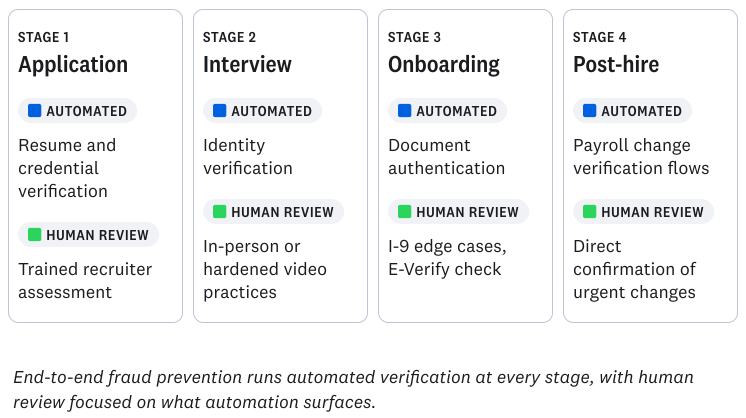
Application stage
Automated resume and credential verification flags the patterns that AI-generated applications consistently produce: fabricated employers, compressed or illogical job timelines, inconsistent dates between systems.
"Recruiters still need to know what the tells look like," said Simpson. "Vague language, business buzzwords, and overuse of phrases from the job description are some of the patterns that show up when applicants stuff resumes with AI-generated content. Trained recruiters catch what automation flags as borderline."
Reference validation and professional profile cross-checks belong in the same workflow—automated where possible, escalated to a recruiter when something doesn't match.
Interview stage
Automated identity verification before the interview confirms the candidate is who their application says they are, before a stand-in has the chance to substitute. A Gartner survey of 3,000 job candidates found 6% admitted to participating in interview fraud—either posing as someone else or having someone else pose as them.
"For plant roles, in-person interviews eliminate most of the remaining risk," Simpson said. For video interviews, she recommends asking candidates to share their screen during an assessment, disallowing virtual backgrounds, and asking unscripted questions the candidate isn't expecting. "That's where a stand-in or an AI assistant breaks down."
Onboarding stage
Onboarding stage I-9 fraud is one of the most consequential types of fraud to uncover after someone has already started. When identity or work-authorization issues surface late, teams are forced into disruptive, last-minute fixes that can create compliance exposure and operational risk. A strategy that pairs automated document authentication with clear escalation paths for HR helps keep those issues from slipping through and resolves them before they impact the workforce.
Because I-9 review often happens at the local level, training local teams on what to watch for is a critical part of that process. These are the teams who ultimately work alongside the employee day to day, and they can quickly lose confidence in HR if they feel unqualified or potentially fraudulent hires are being pushed through. Equipping local managers and site-level staff to recognize common warning signs—and giving them a clear path to raise concerns—helps strengthen fraud detection while reinforcing trust between local operations and HR.
"When something gets escalated, that's where the trained eye matters," said Simpson. "Missing holograms, invalid Social Security numbers, and mismatched information. HR needs to know how to act on these indicators when an AI-powered verification partner, like Checkr, surfaces them."
A second onboarding risk worth flagging: equipment fraud, where someone applies for a remote-eligible role to have hardware shipped with the intent to resell. Confirming the shipping address matches the verified I-9 closes most of that exposure.
Post-hire and payroll
Payroll diversion happens when someone impersonates an employee to redirect paychecks to fraudulent accounts. "Treat urgent requests to change payroll information, especially through email, as a trigger for verification," said Simpson. "Most legitimate employees can wait a day for confirmation. A fraudulent one cannot."
Add verifications to your trusted hiring workflows
Fraudulent actors are automating their process—HR needs to keep pace
According to Checkr’s 2026 survey of 2,500 HR leaders, manufacturing’s current fraud prevention processes tend to rely on labor-intensive methods. Manual HR review is used more heavily in manufacturing than across industries overall, and structured reference verification follows the same pattern. Adoption of the controls best suited to the fraud that manufacturing teams are actually encountering—identity verification technology and biometric verification—runs below the all-industry average.
Manual processes quickly fall behind as hiring volume grows, and they just can’t scale with the distributed, agency-heavy models many manufacturers run.
Fraud control adoption in manufacturing v. all industries
Manufacturing
All Industries
Manual HR review
Structured reference verification
Identity verification technology
Biometric verification
The mismatch is straightforward: manufacturing is relying on manual review in an environment where fraud is increasingly machine-assisted.
A layered approach rebalances the mix. Identity verification before the background check confirms a candidate is who they say they are before any credential claims are taken at face value. Document authentication on licenses and certifications adds a verification step that reference checks alone can't replicate.
Automated adjudication through tools like Assess from Checkr removes the manual inconsistency that gives false credentials room to pass unnoticed, while also helping hiring teams keep pace in a market where speed matters. That creates more room to consider candidates who may not fit a conventional profile, while still applying consistent screening for fraud, risk, and job-related fit.
Recruiters and hiring managers stay in the loop—but their attention goes to what automation has already flagged, not to checking every application by hand.
What to do this quarter
- Review your background check reporting from the past twelve months for credential and education verification flags, grouped by role type. Look at safety-sensitive, licensed trades, salaried engineering and R&D, and hourly production. The role categories where discrepancies cluster are where identity verification and document authentication will return the clearest value first.
- Walk one candidate journey from job posting to first paycheck with HR and payroll in the same room. Map every stage where identity is assumed rather than verified. Those are the fraud entry points.
- Calculate the share of fraud detection running on manual review versus automation. If manual review is the largest single control, the program will not scale with hiring volume or keep pace with machine-assisted fraud. In a labor market where manufacturers can lose candidates over as little as $1 an hour, reducing dependence on labor-intensive review is also critical to keeping qualified candidates moving through the funnel.
- Enable recruiters and hiring managers as the second layer behind automated verification. "Automation handles the volume, but the people doing the hiring still need to know what they're looking at," said Simpson. "Recruiters who can recognize an AI-generated resume, hiring managers who know how to ask specific situational questions—that's the layer that catches what automation surfaces and makes the whole program stronger."
A strong employee referral program is another underused lever. Referred candidates come with an existing employee who can vouch for them, which fraudulent applicants rarely have.
Verification at every stage of hiring
Manufacturing's hiring fraud shows up at application, interview, onboarding, and after hire. A complete fraud prevention program runs automated verification at each of those stages—background screening, identity verification, document authentication, and payroll change controls—with trained human review handling what automation surfaces. The gap worth closing this year is the one between what manufacturing teams are encountering and what their current programs cover.
Integrating Checkr with Paylocity helps manufacturing teams build screening and onboarding programs that close that gap. By managing background checks end-to-end within Paylocity, HR teams reduce manual data entry, shorten time-to-hire, and give candidates a clearer, more transparent experience. With a single, integrated workflow from application through payroll, manufacturers can keep production moving while strengthening the controls that prevent fraud.
Get fast, accurate manufacturing background checks and identity verification

About the author
As Solutions Marketing Lead, Kristen researches the impact of the Checkr product and ensure our teams are set up to provide the greatest value to our customers. Kristen has built customer-centric marketing programs at enterprise technology companies in cybersecurity and process automation.