The staffing leader's guide to faster, fraud-resistant screening at scale

Speed, audit-readiness, and candidate trust don't have to be trade-offs
Screening impacts two of staffing's most important performance measures: How fast you can put someone to work, and how much your clients trust you to send them qualified talent.
Comprehensive screening programs flow candidates through checkpoints like identity verification, background checks, I-9 verification, and post-hire checks. Requirements for each screening type always differ by role and by client, and what separates a strong screening program is where those requirements live. Are yours built into a centralized workflow and applied automatically? Carried in the head of a branch coordinator managing a dozen accounts? Somewhere in the middle?
This guide follows that flow from the first verification through the audit record it leaves behind, and shows what you need from a modern, fraud-focused screening partner to stay ahead.
Key Takeaways
- Fraud detection is the first step in the flow. The most effective progressive checks put identity and credential confirmation at the front of the same flow as the background check.
- Custom screening settings make automation scalable. When you can easily set and update screening packages by role, client, and placement type, then ordering checks, automating adjudication actions, and updating candidates shift from manual, branch-level processes to a consistent system.
- Transparency keeps top candidates engaged. A screening flow that explains what's being asked and why builds the kind of trust that keeps qualified candidates from dropping out before they see a result.
- Audit-readiness can signal risk or reliability. If it isn't easy to generate the reports you need for both an internal budget review and an external audit, it's time to switch vendors.
- Every verification should run through one integrated workflow. Efficiency and accuracy rely on each screening tool living in the same comprehensive dashboard, inside the ATS/HRIS for each client.
1
Fraud detection is the first step in the flow
A candidate sitting in a screening queue without a clear next step takes the assignment from whichever firm called them back first. So the order in which your screenings run does two jobs at once: it determines how quickly a qualified candidate reaches a start date and how early a fraudulent one is stopped.
Background checks typically run once a candidate is matched to a role and a client, around a conditional offer or assignment, depending on legal and compliance requirements for the role or region. But following the rise of AI-powered candidate fraud, hiring leaders are increasingly asking: How do we even know that a candidate is who they say they are?
A background check searches records for the identity it's ordered against. If that identity was stolen, the results come back on a real person with a real history, and you learn nothing about who will show up at your client's site on Monday. If their resume or credentials were expertly generated in a few minutes by AI, any human reviewer will have a hard time spotting the signs of fraud.
By the time the mismatch surfaces—often during the background check or after onboarding, at payroll—your firm has paid for comprehensive screening, spent recruiter hours on the placement, and, in some cases, shipped equipment or run a training class. A misrepresented worker who reaches a client's floor poses safety, financial, and brand-reputation risks to both your firm and your client’s business.
51%
of staffing teams detect fraud through manual review by an HR or compliance team
64%
don’t identify fraud until it’s flagged during a background check, onboarding, or payroll
Source: 2026 State of Screening Compliance Report for Staffing
Automating identity verification with AI-powered biometric checks that use a live selfie taken by the candidate to verify a match against their government ID is a cost-effective, fast solution with an outsized impact on your screening program. Add in early, automated resume and credential verification designed to spot AI-generated fakes, and you’ve just saved your team time, money, and client trust.
Modern, fraud-oriented background check partners should make it easy to add fraud detection screenings to customized, one-click packages that your team uses to order checks by role and client. Your team sets the sequence once, and then each progressive screening runs in the correct order without anyone deciding it candidate by candidate.
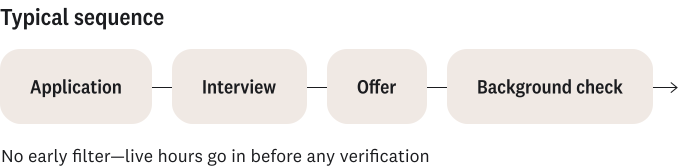
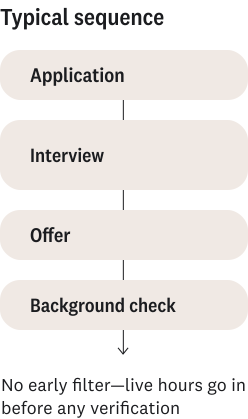
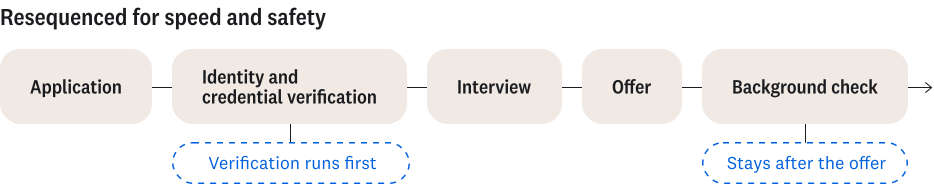
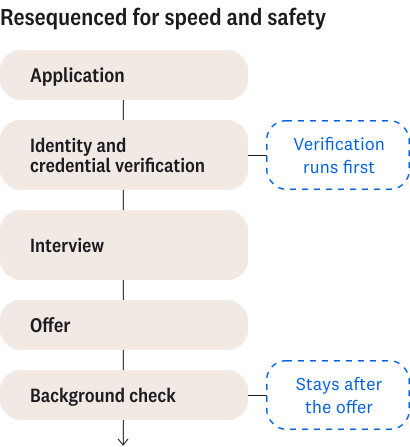
Automating fraud screening as an initial step in your screening strategy means every background check runs against a verified candidate, so you're not paying to pull an accurate record on someone who isn't in your funnel. Identity verification takes a candidate about two minutes and requires no external account or digital wallet. When a verified candidate reaches the comprehensive background check required by your client's contract and compliance requirements, you can be confident you’re reporting information about the real person who’ll show up to work.
Ask your background check partner
- Can identity verification and resume or document fraud detection be ordered ahead of the background check, inside the same workflow?
- Can we preset that order by role and client, or does someone configure it per candidate?
- For accounts where the client mandates their own background check vendor, can we still run fraud detection first?
- How long does it take a candidate to complete identity verification on a phone?
- Does your platform create internal blocklists for fraudulent candidate profiles to ensure flagged candidates can’t simply reapply under a new application?
See how Activus Connect cut fraud to about 10% of prior volume
2
Custom screening settings make automation scalable
It’s ramp season, and a client needs 40 workers on the floor in 30 days, or a cohort of ten starting the same Monday, and fill-rate penalties are attached to those dates.
And the screenings you need completed for each? They change depending on the role, site location, client, and compliance regulations. Your team is jumping between platforms to manually assemble and track specific packages, drug panels, credentials—all while top candidates wait for their report to be completed. A handful of screenings stalled in a queue or got stuck in disputes due to inaccurate results, leading to missed deadlines or rushed tasks, with an increasing rate of errors and candidate drop-off.
This is the scenario many high-volume firms face today, and the secret to scaling is automating every step that doesn’t require a human touch. Your background check partner should give you all the tools you need to improve accuracy and eliminate busywork, giving your team time back to focus on quality of hire and client relationships.
Automate or customize | What it replaces |
Screening packages, including fraud detection, preset by role, client, and placement type | A coordinator assembling packages for each client or role, for every candidate |
Bulk ordering for cohort starts | Ordering candidate by candidate through a ramp |
Account structure, report visibility, and billing mapped to branches and clients | Untangling one pooled account at invoice time |
Adjudication rulesets set by role and client, with built-in compliance tools filtering records that aren't reportable or relevant | Inconsistent manual review across branches |
Adverse action notices and mandatory waiting periods generated on schedule | Someone tracking notice deadlines by hand |
Status updates and estimated completion dates shared automatically with candidates | Coordinators fielding "where is my check" calls from candidates |
Calendar reminders for post-hire requirements in a client contract |
A modern screening partner should let your team build and change all of this without a support ticket: packages you create and edit yourself, rulesets you apply by role and client, and reporting that shows what your program cost and how long it took, broken out according to how your accounts are structured.
Ask your background check partner
- Can we create and modify our own screening packages directly in your platform, or do we submit a request and wait on a response?
- Can one account hold different adjudication rulesets for different roles and clients, and apply them automatically?
- Can our team’s access, report visibility, and billing follow our branch, franchise, and client structure?
- When a report comes back, what happens automatically, and what still requires someone on our team to act?
- Does your platform have built-in compliance tools that account for regional regulations and each client’s policies?
3
Transparency keeps top candidates engaged
As AI anxiety grows on both sides of the hiring desk, candidates are becoming wary of ID and document requests from a staffing firm they don't recognize yet. This shows up with even more prevalence for seasonal and entry-level roles, where hiring moves so quickly that a request for a photo ID or document upload can feel invasive without context for why it's being asked.
Transparency does more work here than speed alone. When candidates can see why they're being asked for information, what happens to it, and where they stand in the process, they have less reason to abandon the process partway through. The same clarity that keeps a real candidate moving forward also removes the cover a fraudulent one might otherwise use: confusion isn't a place to hide when the process explains itself at every step.
That's what a mobile-first, integrated screening flow is built to solve. 85% of candidates in Checkr's candidate portal use mobile to complete their screening and check their status, with error detection that catches a problem before it turns into a stalled check.
Ask your background check partner
- How do automated messages and workflows explain each screening step to candidates—especially IDV, document upload, and background check requirements—so candidates understand what’s being asked, why it matters, and what happens next?
- What mobile-first tools do you provide to help candidates complete screening quickly from any device, and can you share mobile completion rates, drop-off rates, or other benchmarks for staffing or high-volume hiring customers?
- How does your platform proactively catch missing information, upload errors, or candidate questions before they become stalled checks that put fill-rate deadlines at risk?
- What visibility do candidates and recruiters get into screening status, estimated completion timing, and next steps, and how does that reduce “where do I stand?” outreach to branch teams?

"The candidate experience [with Checkr] has always been strong, smooth, and quick, especially for those who have access to a smartphone. It's a seamless experience."
Sarah Hayden
Director of Risk Management, PrideStaff
4
Audit-readiness can signal risk or reliability
A budget reviewer wants your screening record broken into cost and turnaround, ready to defend at a renewal conversation. A compliance auditor wants an unbroken chain of custody across every check, with nothing summarized away. Most screening programs answer one of those questions well and scramble on the other.
For professional and client-facing placements, this is where it hits hardest. A client's own compliance review can ask a staffing firm to produce records the firm doesn't own outright, and a stitched-together vendor stack makes that request a scramble. A modern background check dashboard makes that record retrievable in a few clicks instead of a search across multiple systems: fraud detection, background checks, I-9 verification, and post-hire checks, all pulled from one place.
Ask your background check partner
- Can your platform produce a complete, candidate-level audit trail that shows which checks were ordered, when each step was completed, who reviewed the results, and how the final decision was made?
- How do you document client-specific screening requirements by role or placement type so we can prove the right package was ordered for the right worker before the assignment started?
- What reporting can we pull for adverse action, disputes, exceptions, and candidate communications, and how are those records retained for future client, regulatory, or legal review?
- If a client or regulator asks for proof across background checks, I-9 verification, credentials, and post-hire checks, can we retrieve those records from one system—or would our team need to reconcile data across multiple tools?
Benchmark your fraud controls against your peers in staffing
5
Every verification should run from one integrated workflow
Every verification should run from one integrated workflow
Screenings often live in more than one system: a background check vendor that came with a client contract, a separate I-9 tool, an identity check added after a fraud incident. Each one works on its own. Together, they mean a candidate enters the same personal information three times, and a coordinator opens three systems to answer one client's question about where a worker stands.
One platform for every screening your firm is responsible for, integrated with the systems your team and your clients already use, gives you one candidate flow, one dashboard, and one record per placement.
What screenings should run from one centralized hiring dashboard?
- Fraud detection
Identity verification plus resume and document checks, ordered ahead of the background check. - Background checks
Criminal, employment, education, MVR, drug testing, and credential checks, packaged by role and client. - I-9 verification
Candidate information gathered during the background check informs I-9 employment eligibility verification and E-Verify, if applicable. - Post-hire checks
Scheduled rechecks and continuous checks that run on their own automated cadence.
Integrations are what keep that platform from becoming another system to log into. In staffing that has to work twice over, for your own ATS or HRIS and for the systems your clients run. Choosing a vendor with pre-built integrations across 200+ ATS, HRIS, and HR tech platforms, plus flexibility for accounts that need a custom flow, means consolidating screenings doesn't require replacing tools your team or your clients already trust.
When the client determines your tech stack, standardize on one workflow across every account you control, and make that your firm's screening standard. For accounts where a client mandates a different screening vendor, plan for a conversation instead of accepting a permanent exception. Track turnaround time, cost per check, and candidate completion rate consistently across both providers, and note the placements where the mandated vendor's timeline cost you a fill date. Bring both to the renewal or the next quarterly business review, where a client watching their own fill rates has reason to care that other accounts move faster with your preferred screening partner.
Ask your background check partner
- Can we order every screening from one dashboard: fraud detection, background checks, I-9 verification, and post-hire checks?
- Which of our ATS and HRIS systems, and our clients', do you already integrate with, and how long does deployment take?
- Can you help us build a cost and turnaround comparison against another vendor for a client conversation?
- How quickly can we onboard a new client account and its integration once we win the vendor decision?
85%
reduction in turnaround time for DeployHR, from one week to one day with Checkr
5 minutes
TalentBurst's candidate onboarding time since switching to Checkr
81%
of Checkr's staffing customers have seen improved accuracy on background checks since switching
6
Checkr delivers on speed, trust, and audit-readiness for staffing firms
You don't have to choose between filling a role fast and being able to prove you filled it right. When every screening runs from one comprehensive system, the same process that clears a candidate quickly is the one that holds up when a client's auditor asks for the paper trail, and the one that keeps candidates from dropping out along the way.
Built-in compliance tools, customizable screening packages, automated adjudication actions, mobile candidate updates, and centralized reporting help teams move faster while keeping a clear record of every check. Fraud detection starts with automated identity verification before the background check begins, post-hire checks can run without manual reminders, and client-specific requirements can be managed from the same system your teams already use.
The result is a screening program that scales with your staffing business: fewer late-stage surprises, less manual review, stronger audit trails, and a better experience for qualified candidates from application through post-hire.
See what one connected platform could replace in your screening stack



Disclaimer
The resources and information provided here are for educational and informational purposes only and do not constitute legal advice. Always consult your own counsel for up-to-date legal advice and guidance related to your practices, needs, and compliance with applicable laws.