
Table of Contents
- Study methodology
- Saving time, cutting costs, generating value: Checkr’s economic impact
- Key findings
- Faster screenings: Five days saved per background check
- Expedited business growth
- More efficient, less manual adjudication
- Streamlined package building and compliance confidence
- Cost savings through consolidation
- Explore Checkr’s impact for your organization
- Frequently asked questions
Ready to run background checks the modern way?
As HR leaders work to enhance efficiency in their organizations, their choice of a background check provider is pivotal. Checkr's platform helps customers optimize their screening program, streamlining their hiring operations and accelerating time to hire.
To help organizations better understand the benefits, costs, and risks associated with Checkr deployment, Checkr commissioned Forrester Consulting to conduct a 2025 Total Economic Impact™ (TEI) study analyzing the potential return on investment (ROI) enterprises can realize after implementing Checkr.
Study methodology
Forrester conducted interviews with six representatives at four companies, three of which switched to Checkr from another background check vendor. Based on the characteristics of these companies, Forrester designed a composite organization and constructed a financial model to evaluate Checkr’s potential financial impact. The composite organization has the following characteristics:
- $250M of annual revenue
- In the supply chain and logistics industry
- Runs 8,000 background checks annually to support hiring requirements across their North American operations
- Complexities include variable worker types that span both full-time employees and part-time employees, as well as those required for temporary positions or project-based work
- 75% of background checks fill roles that impact revenue
Here’s a closer look at the Forrester Consulting research on Checkr’s economic impact.
The Total Economic Impact™ of Checkr
Saving time, cutting costs, generating value: Checkr’s economic impact
Deploying Checkr delivered a 169% return on investment (ROI) over three years for the composite organization and generated a net present value (NPV) of $2.1 million, with a payback period of less than six months, according to Forrester’s analysis.
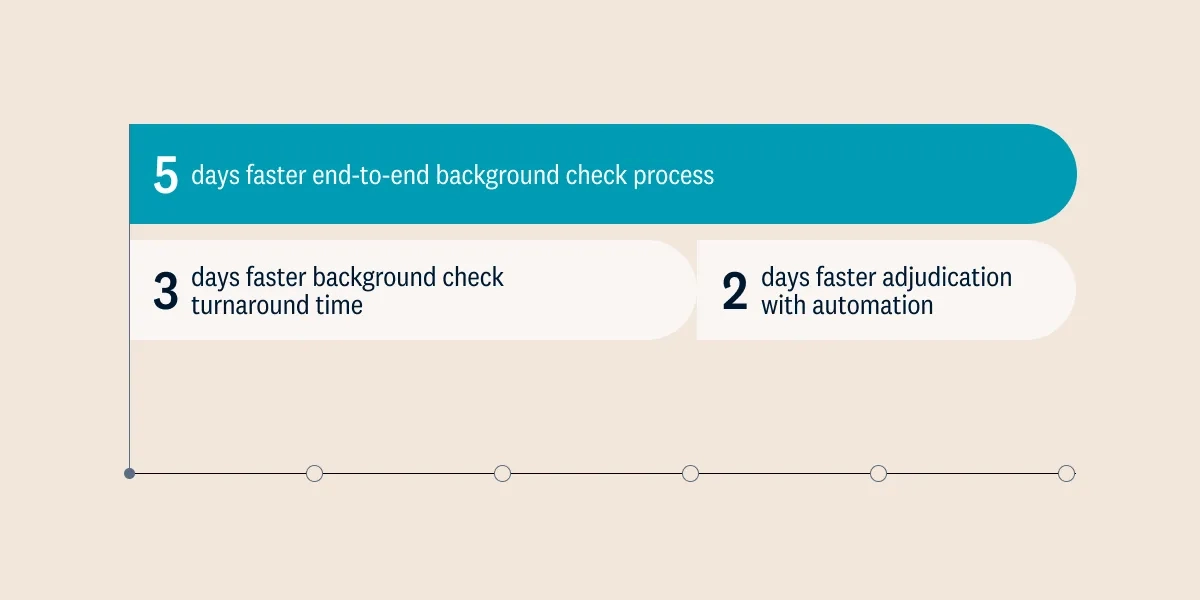
Additionally, Forrester’s analysis found that Checkr reduced the end-to-end screening process time by five days, generating faster incremental profit and significantly lowering costs.
In addition to the quantifiable economic outcomes of implementing Checkr, Forrester researchers identified several areas where Checkr had a positive qualitative impact. These included:
- Higher-quality data for more timely hiring decisions.
- More timely background check report delivery, resulting in fewer lost candidates.
- Greater confidence in meeting compliance requirements, supporting business growth.
Key findings
Before using Checkr, the interviewees’ organizations utilized background check vendors that lacked modern functionality and required manual intervention and additional administrative time. These limitations extended background check turnaround times and obscured underlying data, hindering the organizations from making timely onboarding decisions. This ultimately led to the loss of qualified candidates and revenue due to delays in time to hire.
Forrester’s analysis showed that Checkr delivered quantifiable benefits, including:
Faster screenings: Five days saved per background check
Implementing Checkr reduced the screening process by five days, Forrester found. With a three days faster turnaround time and a two days faster adjudication process, enterprises could fill open positions for revenue-producing roles more quickly. The TEI study reports that over three years, this faster screening process generated $2.7M in incremental profit for the composite organization running 8,000 checks per year.
Slow turnaround times from the interviewees’ prior background check vendors often required pushing back start dates, negatively impacting both internal hiring teams and candidates. Checkr’s more transparent candidate communications made it easier to collect necessary documentation throughout the background check process and keep all parties in the loop.
Expedited business growth
Interviewees said using Checkr helped them better meet the demands of a scaling business, such as acquiring new customers, adding new locations, or expanding into new territories. By digitizing the background check process, Checkr arms hiring decision-makers with more data more quickly, facilitating growth strategies.
For example, Checkr helped one interviewee expedite opening locations in a new territory by ensuring that the system had the right components to trigger the appropriate paperwork for hiring packages and background checks.
“Having [Checkr] has made it a lot easier to move into new countries,” said another HR leader.
More efficient, less manual adjudication
Checkr’s automated adjudication technology enhances efficiency by reducing the need for manual review. As a result, the TEI Study showed up to 75% of adjudication FTEs could be redirected to other value-added work. “With our previous vendor, we had to basically monitor or adjudicate each and every report that came in based on our matrix,” said one TA professional Forrester interviewed. Checkr eliminated most of that manual work.
Within the adjudication process, I do feel like it is very clear how [Checkr has] reports labeled and laid out so that it is easy to quickly identify what requires a review and adjudication decision.
People services and delivery leader, Technology organization interviewee
Teams saw savings across individual background check reviews, improved throughput rates, reduced risk of bias in adjudication, faster adjudication processes, and centralized documentation of adjudication processes.
Streamlined package building and compliance confidence
The TEI study found that Checkr’s centralized platform, ease of use, and customer service reduced the time that users spend building screening packages by 75%.

The composite organization representative of interviewed customers cut the time needed to build and launch screening packages by ten days (from 14 days to fewer than four). Interviewees attributed the greater efficiencies to improved candidate communication and a better customer service experience when Checkr assistance was required.
As the volume of hiring package creation increases due to expansion into new locations, users can expect additional results, the TEI study said. Before Checkr, “it could take days just for legal to do their local compliance research,” said one interviewee, adding:
Over the last few years with the economy and [COVID-19] pandemic and everything that’s happened the last several years, we’ve had to fluctuate hiring numbers quite quickly and unexpectedly, and we can use the flexibility built into Checkr to quickly pivot according to new hiring.
People services and delivery leader, Technology organization interviewee
With Checkr, HR teams can easily translate current screening packages into centralized and digital packages that can be quickly reviewed by legal teams, customized or updated with ease, and deployed quickly as new roles are added at scale.
Cost savings through consolidation
Organizations using Checkr found they needed fewer tools and employee hours to manage the background check process. Time spent on managing background check and verification vendors decreased by 50% after adopting Checkr, the TEI study reported.
We have been able to consolidate a lot of our outside vendors and make our primary focus Checkr. And, we have communicated that we want Checkr to be our primary vendor to our account managers.
HR CoE manager, Supply chain and logistics organization interviewee
Checkr also provides a candidate portal and a candidate support team, decreasing the time TA and HR teams spend answering candidate questions. This generated additional time and cost savings.
Explore Checkr’s impact for your organization
In today’s business environment, enterprise HR professionals must be able to justify every investment in new technology. Forrester’s analysis shows that a strategic investment in Checkr’s modern platform supports a digital transformation of the background check process and delivers financial and operational results.
Checkr’s advanced data platform optimizes processes and reduces manual work, increasing the productivity of your HR, legal, and operation teams. Our compliance engine and programmatic adjudication features enable enterprises to hire confidently at scale. A flexible API and pre-built integrations with 100+ popular ATS/HRIS systems streamline hiring processes, letting your team easily integrate thorough background checks into one cohesive hiring flow.
What kind of impact could Checkr have on your organization’s bottom line? Read the complete TEI study to find out or get in touch with our team today.
Learn how Checkr helped customers achieve 169% ROI
Frequently asked questions
What ROI did Forrester find for Checkr customers?
Forrester's Total Economic Impact study found that Checkr delivered a 169% return on investment over three years for the composite organization. This ROI was accompanied by a net present value of $2.1 million and a payback period of less than six months.
The study analyzed data from interviews with six representatives at four companies, three of which had switched to Checkr from another background check vendor. These findings demonstrate the significant financial value that enterprises can realize by implementing Checkr's modern background screening platform, which optimizes screening programs and streamlines hiring operations across customers’ organizations.
How does Checkr support compliance and reduce legal risk?
Checkr's compliance tools help enterprises become more confident in meeting regulatory requirements across different jurisdictions and industries. The platform's centralized system makes it easier to conduct local compliance research, which could previously take legal teams days to complete for each new location. Checkr's automated adjudication features help reduce the risk of bias in hiring decisions by standardizing the review process and documenting adjudication decisions.
Our platform also keeps pace with changing regulations. This supports business growth initiatives while minimizing legal exposure and helping your team apply consistent hiring standards across your business.
How does Checkr reduce manual adjudication work?
Checkr's automated adjudication technology significantly improves efficiency by reducing the need to manually review background check reports. The Forrester TEI study found that up to 75% of adjudication FTEs could be redirected to other value-added work after implementing Checkr.
Before using Checkr, organizations had to manually monitor and adjudicate each report based on their internal matrix. Checkr's platform eliminates most of that manual work through clear labeling and layout that makes it easy to quickly identify what requires review and adjudication decisions. Additional benefits include improved throughput rates, reduced risk of bias in the adjudication process, faster overall timelines, and centralized documentation of adjudication processes.
What integration capabilities does Checkr offer for enterprise systems?
Checkr offers a flexible API and pre-built integrations with over 200+ popular ATS and HRIS systems, enabling enterprises to streamline their hiring processes. These integrations allow teams to easily incorporate thorough background checks into one cohesive hiring flow. They also reduce manual data entry, minimize errors, and help create a better experience for both internal users and candidates. Organizations can leverage Checkr's advanced data platform to optimize processes across their existing technology stack, reducing the need for multiple point solutions.
What methodology did Forrester use for the TEI study?
Forrester conducted in-depth interviews with six representatives at four companies that use Checkr, three of which had switched to Checkr from another background check vendor. Based on the characteristics, experiences, and outcomes shared by these organizations, Forrester designed a composite organization that represents a typical Checkr customer. It then constructed a detailed financial model to evaluate Checkr's potential financial impact over a three-year period.
This methodology, known as Total Economic Impact (TEI), is Forrester's established framework for analyzing the potential return on investment that enterprises can realize from technology investments. The approach combines quantitative financial analysis with qualitative benefits to provide a comprehensive view of a vendor’s economic impact.
How much faster are background checks with Checkr?
Checkr reduces the end-to-end screening process by five days per background check compared to traditional vendors. This acceleration comes from two key improvements: three days faster turnaround time for completing the actual background check, and two days faster adjudication process for reviewing and making hiring decisions.
For the composite organization running 8,000 background checks annually, this time savings was worth $2.7 million in incremental profit over three years. The faster screening process enables enterprises to fill revenue-producing roles more quickly, reducing the risk of losing qualified candidates to competitors and minimizing the cost of unfilled positions.
What qualitative benefits did Forrester identify beyond the financial ROI?
In addition to the quantifiable economic outcomes, Forrester researchers identified several areas where Checkr had a positive qualitative impact on organizations. These included:
- Higher-quality data that enables more timely and informed hiring decisions
- More timely background check report delivery that results in fewer lost candidates during the hiring process
- Greater confidence in meeting compliance requirements that supports business growth initiatives
Interviewees also noted that Checkr helped them better meet the demands of scaling businesses, such as acquiring new customers, adding new locations, or expanding into new territories. The platform's digitized background check process arms hiring decision-makers with more data more quickly, facilitating growth strategies and making it easier to move into new countries or regions.
What type of organization did Forrester model in the TEI study?
Forrester designed a composite organization based on the characteristics of the companies interviewed for the study. This representative organization has $250 million in annual revenue and operates in the supply chain and logistics industry. The composite runs 8,000 background checks annually to support hiring requirements across its North American operations, with variable worker types including full-time employees, part-time employees, and temporary and project-based positions. 75% of the background checks that are conducted fill roles that directly impact revenue generation, making a fast and efficient screening process critical to the organization's bottom line.
What vendor consolidation benefits does Checkr provide?
Organizations using Checkr found that they needed fewer tools and employee hours overall to manage the background check process. The TEI study reported that time spent managing background check and verification vendors decreased by 50% after adopting Checkr. Interviewees noted they were able to consolidate multiple outside vendors and make Checkr their primary focus for background screening needs.
Beyond vendor consolidation, Checkr provides a candidate portal and dedicated candidate support team, which decreases the time talent acquisition and HR teams spend answering candidate questions throughout the screening process. This comprehensive approach generates additional time and saves on cost while improving the candidate experience and reducing the administrative burden on internal teams.
How much time does Checkr save on building screening packages?
The TEI study found that Checkr's centralized platform, ease of use, and customer service reduced the time users spend building screening packages by 75%. The composite organization cut the time needed to build and launch screening packages from 14 days to fewer than four days, which saved them ten days per package.
Interviewees attributed these greater efficiencies to improved candidate communication and a better customer service experience when Checkr’s assistance was required. Before Checkr, legal compliance research alone could take days. With Checkr, HR teams can easily translate their current screening packages into centralized, digital packages, which legal teams can quickly review, customize or update, and deploy rapidly as new roles are added at scale.
Disclaimer
The resources and information provided here are for educational and informational purposes only and do not constitute legal advice. Always consult your own counsel for up-to-date legal advice and guidance related to your practices, needs, and compliance with applicable laws.

About the author
As Solutions Marketing Lead, Kristen researches the impact of the Checkr product and ensure our teams are set up to provide the greatest value to our customers. Kristen has built customer-centric marketing programs at enterprise technology companies in cybersecurity and process automation.