The 2026 State of Screening Compliance for Transportation

Introduction
Compliance and safety-first hiring define transportation's edge
This report draws on survey responses from 500 HR leaders at transportation organizations with 1,000+ employees, benchmarking where compliance, fraud detection, and credential verification stand in an industry where failures can mean accidents, penalties, and lives at risk.
Three priorities define transportation’s competitive edge in 2026:
- Maintaining compliance execution momentum (despite high confidence, 45% still report errors)
- Strengthening credential fraud detection (65% encountered falsified documents or credentials)
- Building AI governance for safety-sensitive roles (22% have enforced policies, leading all industries)
Transportation organizations that execute on these priorities can turn regulatory requirements into operational advantages.
Fast facts from the field
Confidence is high and failures still happen

61% report complete confidence in compliance policies, yet errors persisted in nearly half of organizations this year.
Compliance doesn’t just live in HR
52%
of transportation orgs put screening oversight in HR, but 14% assign it to operations.
Fake credentials are on the rise
61%
Document fraud leads at 34%, with 61% of transportation orgs encountering some form of fraud last year.
IDV is your earliest line of defense against fraud
45%
of transportation orgs catch fraud at the background check, often the final step in hiring. IDV can run any time in the funnel, flagging fraud upfront so it doesn't cost you time and budget downstream.
Improving in fraud prevention, but not done yet
53%
still rely on document authentication and 44% on manual review. 62% rate their fraud controls below highly effective.
AI governance developing in real-time
22% of transportation orgs have documented, enforced AI policies, but 78% still lack formal frameworks as AI-assisted fraud accelerates.

1
Compliance foundations give transportation a 2026 edge
Transportation enters 2026 with structural compliance advantages. Federal regulations and safety-sensitive hiring requirements have built systematic policy and accountability frameworks that outpace most industries.
That foundation matters because credential fraud in transportation creates public safety risk, regulatory exposure, and litigation potential.
Confidence doesn't eliminate execution failures. The challenge for transportation HR leaders is leveraging regulatory experience while fixing the process breakdowns still affecting 45% of organizations.
Policy confidence hits a 2026 high
Transportation HR leaders in our survey rated their confidence that their background check policies comply with federal, state, and local screening requirements.
Complete confidence more than doubled in two years, jumping from 25% in 2024 to 61% in 2026. That's meaningful ground gained. 39% still aren't completely confident their policies hold up against federal, state, and local rules, leaving room for audit gaps and regulatory exposure.
Transportation HR’s level of confidence in their background check compliance
2026
2024
Completely confident
Not completely confident
Disclosure compliance confidence jumps 26% since 2024
Missing authorization and disclosure forms during background checks are cited by survey respondents as the top source of compliance violations year over year. Once again, we see a slight boost in confidence since 2024, and 89% of manufacturers agree or strongly agree that they're sending the right documents to candidates (up from 84%).
Transportation HR leaders: Are you sure you're providing the right disclosure and authorization forms for background checks?
2026
2024
Strongly agree
Agree
Neither, disagree, or strongly disagree
Perception v. reality
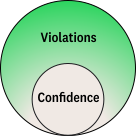
Just 7% of transportation respondents were unsure about their authorization compliance, yet 15% reported authorization and disclosure violations at their organization in the past 12 months.
That gap is small but meaningful. Actively tracking and reporting authorization metrics keeps positive confidence from overshadowing real violations, and helps you surface and close gaps fast.
Multi-jurisdiction screening creates friction
Interstate operations create compliance challenges as federal requirements layer with varying state screening laws, Ban the Box ordinances, and local regulations.
59% of transportation organizations face friction applying consistent screening across regions, business units, franchisees, or roles. Teams reporting no difficulty likely run centralized processes built around federal compliance or operate within limited geographic footprints.
How difficult is background check consistency across your org?
41%
Not difficult
25%
Moderately difficult
23%
Slightly difficult
8%
Very difficult
3%
Extremely difficult
What this tells us:
Transportation HR leaders reporting no difficulty with multi-jurisdiction screening likely already have centralized processes built around federal compliance mandates, or operate within a limited geographic footprint.
More than half of respondents coming up against multi-region roadblocks are dealing with real operational challenges of layered state laws, Ban the Box ordinances, and local requirements that don't always align with federal transportation rules.

Internal HR’s ownership of risk management is rising
This survey confirms a trend from the 2026 CHRO Insights Report for Transportation. Transportation HR leaders are taking on more responsibility for risk and fraud management, especially around driver qualification files, ongoing monitoring, and fleet safety.
Since 2024, transportation HR or onboarding teams have absorbed most of this growth, climbing 22 percentage points from 30% to 52%, while dedicated background check teams have halved from 20% to 10%.
Who owns the screening process in transportation?
2026
2024
Hr or onboarding team
Operations team
Dedicated background check team
Recruiting team
Another non-HR team (legal, trust, or third-party)
Despite growing responsibility, 58% report no increase in resources
AI-powered fraud is getting more sophisticated and state-level regulations keep multiplying. Compliance responsibility is climbing for transportation HR leaders, but most teams aren't getting the headcount or budget to support it.
So how do you handle a heavier compliance load with the same resources? The answer isn't more headcount, it's better tooling. A screening and verification partner that automates the manual work, keeps up with regulatory changes, and surfaces issues before they become violations turns a growing workload into a managed one.
How has compliance headcount and budget changed in the past 12 months?
How to Seamlessly Switch Background Check Providers for High-Volume Hiring
Compliance breakdowns hit 45% of transportation organizations
High confidence and strong authorization compliance don't prevent all failures. Transportation's breakdown reveals where centralized policy stops scaling at the role and location level.
Compliance errors among transportation organizations with 1,000+ employees
Top violations in transportation organizations
Both top categories are process control failures, not policy gaps. Without documented matrices and routine audits, centralized policy can't enforce role-by-role consistency.
Strengthen execution where it breaks
Most transportation organizations have built strong policies and authorization processes. Execution is where the gaps surface, in compliance errors, lagging resources, and multi-jurisdiction friction.
Stronger execution means better controls, clearer accountability, and capacity where it's needed.
Ask your team
- Pull background check docs from three recent hires in different states. Can you trace authorization timing, screening criteria, and adverse action notices for each?
- List every role type you hire. Do you have a documented screening matrix showing what checks apply to each role in each state?
- Map who owns the final call on adjudication at each location. If ownership varies across sites, document a single decision standard this quarter.
- Pull the past 12 months of compliance violations by location and role type. Is the same root cause showing up, or are issues scattered across the org?
Take this action
- Confirm your background check dashboard surfaces authorization completion, adverse action timing, and screening criteria consistency in real time. If you can't see it without manual pulls, your tooling is the bottleneck.
- Check whether your screening platform builds your adjudication matrix automatically. The right one lets you set role and state requirements once, then applies them every time a hiring manager kicks off a check.
- Audit how much compliance review is happening in spreadsheets. Verifying authorization timing, check selections, and adverse action procedures should be automated by your screening provider, not a monthly manual exercise.
- Confirm your screening vendor builds disclosure forms into the candidate flow and aligns them with regional regulations automatically. If you're still managing form templates, you're carrying work the platform should own.
2
Transportation HR teams race to identify fraud at scale
Credential fraud in transportation is a public safety issue first and an HR efficiency issue second. Undetected falsified CDLs, altered medical certificates, and AI-assisted impersonation may put unqualified drivers behind commercial wheels, exposing organizations to accidents, regulatory penalties, and liability that dwarf the cost of a single bad hire.
61% of transportation organizations encountered fraud in the past year. The fraud types and detection stages show where verification dollars matter most.
Most common types of hiring fraud encountered in transportation
34%
Document fraud (falsified degrees, certifications, licenses, or work history)
31%
Resume or credential fabrication
24%
Interview fraud (proxy interview or AI-assisted impersonation)
19%
Identity fraud (stolen identity or fabricated personal details)
39%
We have not encountered any hiring fraud
Where is fraud caught in the hiring process?
Fraud's operational cost in transportation
Beyond the direct cost of a fraudulent hire, transportation organizations identified the operational consequences that compound when bad credentials slip through. Top responses ranked in order:
- Wasted recruiting or talent acquisition team time
- Increased sourcing costs due to re-filling roles
- Additional spend on fraud-detection tools or technology
- Financial loss from theft, fraud, or liability
- Workplace safety incidents
- Litigation or legal exposure
The impact is mostly operational. Workplace safety incidents and litigation are rarer but carry the highest stakes when forged credentials reach the road.
Late detection carries transportation's biggest cost
AI-powered candidate fraud has put pressure on transportation HR teams to detect issues earlier in the funnel. Most aren't catching fraud until background check adjudication, a stage that depending on Ban the Box regulations may not happen until candidates have completed interviews, road tests, and received conditional offer letters. Or even later, during I-9 verification or onboarding, once the candidate has accepted an offer.
About a third of transportation teams identify fraud during application screening, but that leaves 63% finding it later, after recruiter hours, hiring manager time, and road test scheduling have gone toward candidates who shouldn't have advanced.
Verify credentials before the interview pipeline
Transportation organizations already run sophisticated fraud detection. The harder question is which tools are actually catching fraud, which create false positives that drain investigation hours, and which duplicate verification without adding value.
Effective fraud prevention starts with measurement. Track detection performance, retire underperformers, and invest in background check workflows that scale with transportation hiring volume.
Ask your team
- Calculate fraud's true cost. Count fraudulent candidates from the past year, recruiter hours invested before detection, and downstream costs. That number justifies prevention investment.
- Measure days between application and CDL verification for driver hires. Every day in that gap is another day a fraudulent candidate moves closer to a conditional offer.
- Review your five most recent fraud cases. At what stage was each caught? Fraud surfacing at I-9 or post-hire means you're catching it after the damage is done.
- Identify how many of your last fraud cases involved altered CDLs, fabricated employment history, or AI-generated documents. The pattern shows where verification investment matters most.
Take this action
- Run FMCSA license verification at application instead of post-interview. The check takes minutes and flags falsified CDLs before recruiter hours go in.
- Add automated document authentication to your background check workflow this quarter. It runs alongside traditional checks and catches forged DOT medical cards and training certificates that manual review misses.
- Audit your background check partner's coverage of identity verification, document authentication, and motor vehicle records. Fragmented vendors leave gaps where fraud slips through.
- Train interviewers this quarter to spot proxy candidates, AI-assisted impersonation, and inconsistencies in driving history. Modern fraud passes automated screens but breaks under structured questioning.
3
Fraud prevention strengthens transportation compliance
Transportation HR leaders are better positioned than most to get ahead of credential fraud. Federal oversight, safety-sensitive hiring rules, and ongoing monitoring already produce the verification discipline that fraud prevention demands.
This isn't about adding a new program. It's about folding credential verification into the workflow you've already built, where the strongest detection happens at the stages you already run.
Inside the fraud detection stack
Transportation's verification stack mixes automated and manual controls. The shape of that mix reveals where investment has scaled and where teams still lean on human review.
Tools and processes used to detect fraud in transportation
Most transportation organizations layer multiple controls, but the lean on manual review signals room to automate. Human review takes time and varies by reviewer, both of which work against fraud prevention's need for speed and consistency.
Tool adoption outpaces effectiveness
How effective are transportation teams' fraud prevention strategies?
38%
Highly effective
36%
Fairly effective
27%
Somewhat, slightly, or not effective
Strong tool deployment hasn't translated to strong confidence. The path forward requires measuring which tools are actually catching fraud, cutting underperformers, and doubling down on what works.
Evaluate verification performance and target fraud-focused upgrades
Transportation organizations already run sophisticated fraud detection. The harder question is which tools are actually catching fraud, which create false positives that drain investigation hours, and which duplicate verification without adding value.
Effective fraud prevention starts with measurement. Track detection performance, retire underperformers, and invest in the controls that actually work.
Ask your team
- Document which tool caught fraud and at what stage for every case in the past year. After 90 days, calculate catch rate per tool. Zero catches means cut or replace.
- Divide annual spend on each verification tool by the number of fraud cases it identified. High cost-per-catch tools need justification or reallocation.
- Audit your verification stack for redundancy. Layered verification adds security, redundant verification adds cost.
- Compare effectiveness ratings across tools your team has confidence in versus tools they question. Low confidence means digging into whether the tool is failing or whether teams just need training.
Take this action
- Build a fraud detection dashboard with cases identified, detection stage, tool attribution, and cost per catch. Review monthly. Replace gut-feel decisions with performance data.
- Replace fragmented verification vendors with a background check partner that integrates identity verification, document authentication, and motor vehicle records in one workflow. Fragmentation creates the seams where fraud slips through.
- Run a 90-day pilot on any underperforming verification tool. If catch rate doesn't improve with training and configuration tweaks, replace it instead of renewing.
4
AI governance lags adoption in transportation
AI is reshaping fraud in both directions. Candidates use it to fabricate credentials and slip past verification, and transportation teams use it to screen faster and catch patterns human reviewers miss. Neither trend is slowing.
Most teams are missing a governance framework that makes AI use intentional and defensible. The organizations defining what's allowed, what gets reviewed, and how decisions get made will be ready when regulations catch up.
Candidate-driven AI fraud tops the worry list
Transportation HR leaders worry about AI on multiple fronts. The pattern of concern shows where governance should focus first.
What concerns transportation HR teams the most about AI in hiring?
Transportation's AI governance maturity
Risk awareness alone doesn't protect transportation organizations, documented and enforced governance does. The maturity gap matters because AI capability is moving faster than the policies meant to govern it.
How do transportation HR leaders rate their team’s AI maturity and policies?
Transportation views on AI risk are split
Transportation organizations assessed whether AI reduces or increases their overall compliance and fraud risk, revealing divided perspectives that likely reflect implementation quality differences.
Build frameworks now instead of reacting to future issues
AI is both a fraud enabler and a fraud detector. Success comes from formal governance that defines acceptable use, required reviews, bias testing, and candidate disclosure before regulations force reactive scrambling.
Most transportation teams either lack frameworks or are still developing them. The window to build proactive governance is closing fast.
Ask your team
- List every AI capability touching your hiring workflow. For each one, document governance gaps. Anywhere you don't have a governance answer is a blind spot.
- Ask each vendor three questions. What AI does your platform use? What data trains it? Can you explain how flagged decisions get made? Vendors who can't answer are a governance risk.
- Review the AI-enabled fraud you've encountered in the past year. How did candidates use it, and what caught it? The pattern defines what your governance needs to address.
- Map who at your organization can actually approve, retire, or override an AI-driven hiring decision. If the answer is "nobody owns it," that's the gap to close first.
Take this action
- Draft a one-page AI governance policy this week. Define approved tools, data permissions, review requirements, and candidate disclosure. Get legal sign-off. Refine as you go.
- Require vendors to document AI capabilities, training data, and decision explainability before deployment. No clear answers means no approval.
- Build a quarterly AI audit cadence. Document every AI tool in use, every approved use case, and every flagged decision in the prior quarter. Adjust policy where reality doesn't match the documented framework.
Compliance leadership is 2026's competitive edge
Transportation HR leaders enter 2026 from a position of strength. The industry leads on compliance, confidence and authorization execution, advantages built through years of federal oversight and safety-sensitive hiring rules that forced systematic approaches before other industries had to.
The strategic question isn't whether you have strong compliance foundations. You do. The question is whether you'll widen that lead or let execution gaps erode it as fraud sophistication and regulatory complexity intensify.
Apply the verification discipline that federal oversight demands to state-level variations and emerging fraud patterns. Measure fraud detection effectiveness, not just deployment. Build AI governance before regulations force reactive compliance.
Organizations that execute on these priorities can turn regulatory requirements into operational advantages.
Turn compliance into a competitive advantage with Checkr
Checkr is the data platform behind safer, fairer hiring decisions. Our transportation background check technology integrates with your hiring stack and delivers transparency, automation, and trust. 140,000+ customers use Checkr to modernize their verifications without losing the human touch.
Ready to unlock HR’s strategic potential with better background checks?



Survey methodology
All data in this report comes from an online survey conducted through a third-party platform. 500 HR managers and senior HR leaders at transportation organizations with 1,000+ employees responded, all screened to confirm their involvement in background check decision-making. Participants were asked to answer truthfully and to the best of their knowledge.
Disclaimer
The resources and information provided here are for educational and informational purposes only and do not constitute legal advice. Always consult your own counsel for up-to-date legal advice and guidance related to your practices, needs, and compliance with applicable laws.