Understanding background check statuses and results

Making informed hiring decisions requires a clear understanding of the background check process and how to interpret the results. Whether you're a current Checkr customer or seeking a background check provider with user-friendly reports, this guide will help you navigate the information presented in the Checkr dashboard.
Need to know the status of a check?
You can easily scan the Checkr dashboard to see the stage of each background check and note those which may require further action. Here are the six statuses:
| Invitation Sent | Checkr has sent a link to the candidate to begin the background check process, but the candidate hasn't responded yet. The candidate needs to respond to the invitation before Checkr can proceed. |
| Pending | The candidate has responded to the invitation and Checkr is conducting the searches that are part of your package. |
| Invitation Expired | The candidate didn't respond to the invitation within the given time frame. A new invitation must be sent to proceed with the background check. |
| Suspended | The report is on pause due to missing information or incomplete searches. |
| Canceled | The report has been suspended for over 30 days or the candidate has withdrawn their consent. |
| Dispute | The candidate contacted Checkr to dispute information in a completed report. |
Streamline the decision-making process with Assess
To help you increase consistency and reduce potential bias during adjudication, Checkr offers a dashboard feature called Assess. This decisioning tool enables users to pre-set guidelines on which charges to surface that you flag as relevant to your hiring decisions, based on your company’s background check policy. All customers are enabled with free access to Assess Lite, which also includes five industry-best standards to help get started and customize across these statutory records.
For customers running a higher volume of checks, paid versions of Assess are available with further customization and broader record filtering options to increase operational efficiency.
Ready to review the report results?
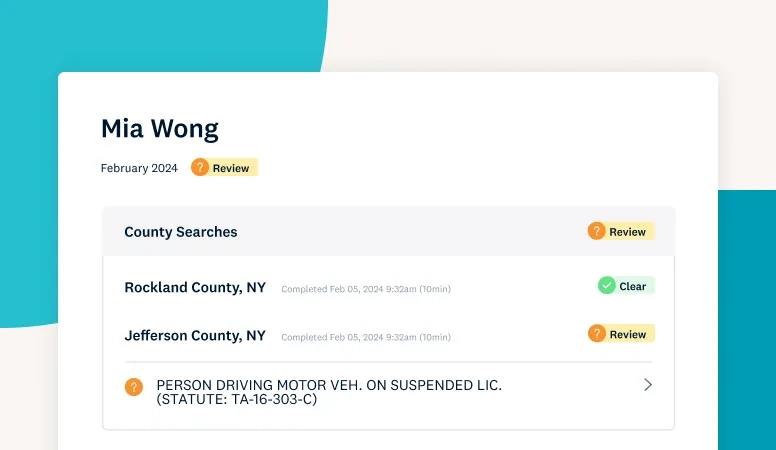
Once a report is complete, the results are displayed with one of three statuses. These statuses are based on your specific Assess guidelines, which helps you speed next steps:
| Clear | The report is complete and the searches didn't return any records. |
| Eligible | The report didn’t return any relevant records that would make the candidate ineligible for the position. |
| Review (Formerly known as Consider) | The report returned at least one record that needs evaluation. |
Understanding Dashboard information
Candidate information
To kick-start the background check process, candidates are asked to provide key details. This section shows that information which includes their full name (middle name included), date of birth, Social Security number (note their full SSN will not be displayed), current zip code, phone number, and email address. Other information may depend on which screenings are included, such as driver’s license number for a motor vehicle report.
Post-hire safety
To meet the needs of specific business and industry requirements, we provide an option to establish recurring screenings. The details related to the frequency of these repeat screenings—rechecks and subscriptions—are found in the section.
Report information
This portion of the report highlights specifics related to the screening package chosen, along with the report's current status, creation and completion dates, candidate’s location for compliance purposes, assessment, and adjudication. You can also download a PDF of the completed report.
Actions
Additional steps for recording the outcome of the adjudication process can be captured here, including the built-in adverse action workflow. You can also request Candidate Stories to empower candidates to easily share additional context around their records, prior circumstances, and steps toward rehabilitation.
Screening results
The results for each screening are displayed within the specified package. For example, a county search may be flagged as “Review” because a criminal record was returned. You can click into the record to read detailed information about the case, which typically includes the candidate’s PII, case number, jurisdiction where the charge occurred, and charge details. The charge details may include the type of charge (misdemeanor or felony), date of the offense, and disposition. Motor vehicle reports and health screenings (like drug testing) will show the related details.
Get a background check with Checkr
Checkr's modern platform is designed to save time while reducing human error and bias. In fact, 89% of our criminal checks, including county searches, complete in under one hour. To further improve efficiency, the Checkr platform is designed to be intuitive and easy-to-use, so you can easily review results and hire faster.
Log in to your Checkr dashboard to order a background check.
New to Checkr? Get started.
How to Read a Background Check
Watch our on-demand webinar to see
a full walkthrough of a Checkr report.
Frequently asked questions
How do I know if my background check came back clear?
You'll know your background check was clear when your employer or hiring manager directly confirms the results with you. In some cases, companies will extend a formal job offer that isn't contingent on completing the background screening process. Some employers may send you a notification through their applicant tracking system or via email stating that your background check has been cleared. If you're a candidate who submitted to a Checkr background check, the hiring company controls when and how they communicate results to you.
Keep in mind that no news isn't necessarily bad news—processing times vary, and employers often wait until all screening components are complete before reaching out. If you have questions about your background check’s status, it's perfectly acceptable to follow up with your point of contact at the company.
What does "Review" status mean on a Checkr background check?
When a background check shows a "Review" status in the Checkr system, it means the report has returned at least one record that requires human evaluation according to your company's adjudication guidelines. This status doesn't automatically disqualify a candidate from employment. Instead, it calls for a closer look at the findings to determine whether they're relevant to the position and comply with fair chance hiring practices.
Companies using Checkr Assess have customized criteria that help them make consistent, compliant hiring decisions. These criteria include the nature of the offense, how much time has passed since the offense, and the responsibilities of the specific role. The review process helps give candidates individualized consideration rather than automatic rejections, which aligns with the guidelines of the Equal Employment Opportunity Commission and many state and local fair chance laws.
What are red flags on a background check?
Potential red flags on a background check are findings that may raise concerns about a candidate's suitability for a specific role. Common red flags include:
- Criminal records that are relevant to the job duties
- Significant discrepancies between what a candidate reported and what the screening revealed about their employment or education history
- Failed drug tests when substance screening is required for certain roles
- Problematic driving records for positions that involve operating vehicles
It's important to note that not all findings are automatically disqualifying, and context matters significantly. Employers should evaluate each case individually, considering factors like how long ago an incident occurred and whether it directly relates to job responsibilities.
How long does a Checkr background check take to complete?
Checkr is known for industry-leading turnaround times, with 89% of criminal background checks completing in under one hour. However, the total time required to complete your background check depends on several factors, including which screening package your employer selected, the number of jurisdictions that need to be searched, and whether any records need to be manually verified. Some components like employment verification or education verification may take longer because they depend on third-party response times. Federal criminal searches, motor vehicle records, and drug testing results each have their own typical timeframes.
While many Checkr customers receive results within one to three business days, more comprehensive screenings or ones that involve multiple verifications may take up to a week or longer. Checkr's technology platform is designed to expedite the process wherever possible while maintaining accuracy and compliance.
Can I dispute information on my background check?
Yes, you have the legal right to dispute any information on your background check that you believe is inaccurate or incomplete. Under the Fair Credit Reporting Act (FCRA), if you receive a pre-adverse action notice indicating that information from your background check may negatively impact a hiring decision, you'll have an opportunity to review the report and submit a dispute. If you identify errors, you should contact the background check company directly—in this case, Checkr—to initiate the dispute process. Checkr is required to investigate your dispute, usually within 30 days, by reverifying the information with the original source.
Common reasons for disputes include incorrect criminal records, cases of mistaken identity, sealed or expunged records that shouldn't appear, or inaccurate employment dates. Throughout the dispute process, employers are encouraged to pause their decision-making until the investigation concludes. You can learn more about your rights and the candidate dispute process through Checkr's candidate resources.
What shows up on a Checkr background check?
What appears on a background check from Checkr depends entirely on which screening package your potential employer has selected:
- Common information on a background check includes county, state, and federal criminal record searches, which reveal felony and misdemeanor convictions within the jurisdictions being searched.
- Many employers also request employment verification to confirm your work history, education verification to validate degrees or certifications, and motor vehicle record checks for driving positions.
- Other options include sex offender registry searches, credit reports (where legally permitted for certain roles), professional license verifications, and drug testing results.
Checkr offers customizable screening solutions that allow employers to build packages appropriate for their industry and specific job requirements. It's worth noting that Checkr adheres to FCRA guidelines and applicable state laws, which means certain information—like arrests without convictions or records older than seven years—may be excluded depending on your location and the position you're applying for.
How far back does a Checkr background check go?
The lookback period for a Checkr background check varies based on federal and state regulations, as well as the type of information being searched. Under the FCRA, most criminal convictions can be reported indefinitely. Many states have enacted laws that limit reporting to seven years for non-conviction records or for positions with salaries below certain thresholds. Some states, including California, have specific rules about what can be reported and how far back searches can go.
For employment and education verification, there typically aren't strict time limits, though employers usually focus on recent history that’s relevant to the position. Checkr's platform automatically applies the appropriate lookback periods based on the candidate's location and applicable laws. The specific criminal background check your employer chooses will also influence what timeframe is covered; some industries may require more extensive historical searches than others.
Will a misdemeanor show up on a Checkr background check?
Yes, misdemeanors typically appear on Checkr’s background checks when employers include criminal record searches in their screening package. Misdemeanors are less serious offenses than felonies but are still part of your criminal record and can be discovered through county, state, or federal criminal database searches. However, whether a misdemeanor will affect your employment prospects depends on several factors. Many employers use individualized assessment processes that consider the nature of the offense, how long ago it occurred, and whether it's relevant to the specific role.
Some misdemeanors may be excluded from reports based on state-specific Ban the Box laws or fair chance hiring ordinances. Additionally, certain misdemeanors may have been expunged or sealed, which would prevent them from appearing on your report. If you have concerns about how a misdemeanor might impact your application, understanding fair chance hiring practices can give you more insight into how progressive employers evaluate candidates with criminal records.
Can I run a background check on myself through Checkr?
Yes, you can run a background check on yourself through Checkr. Checkr offers personal background checks that allow you to see what information might appear when employers screen you. Running your own background check before applying for jobs helps you understand what's in your record, verify that the information is accurate, and prepare explanations for any findings that might require additional context. This proactive approach gives you confidence during the hiring process and reduces surprises.
Personal background checks can include criminal records, employment history, education verification, and other components depending on the package you select. By reviewing your background in advance, you can address any inaccuracies and present yourself as a transparent, prepared candidate to potential employers.
What is Checkr Assess and how does it work?
Checkr Assess is an automated adjudication tool that helps employers make consistent, compliant, and fair hiring decisions based on background check results. Rather than manually reviewing each report, employers can configure Assess with customized guidelines that automatically evaluate findings according to their specific criteria, industry requirements, and legal obligations. The system considers factors such as the nature and severity of offenses, how much time has passed since the incident, and the relevance to the position being filled.
Assess helps companies comply with EEOC guidance about considering criminal records, as well as state and local fair chance hiring laws. When a background check returns findings, Assess applies these predetermined rules and assigns a status—such as "Clear," "Review," or "Suspended"—that indicates whether the candidate meets the employer's hiring criteria. This approach reduces bias, speeds up the hiring process, and evaluates all candidates using the same standards.
Disclaimer
The resources and information provided here are for educational and informational purposes only and do not constitute legal advice. Always consult your own counsel for up-to-date legal advice and guidance related to your practices, needs, and compliance with applicable laws.