
Why continuous checks are important
Background checks are critical to gaining an understanding of your risk before hiring a candidate. But once a background check is complete, the results remain static and could become outdated. Even if you re-run checks annually, you still lack visibility into behavior between them, increasing your risk.
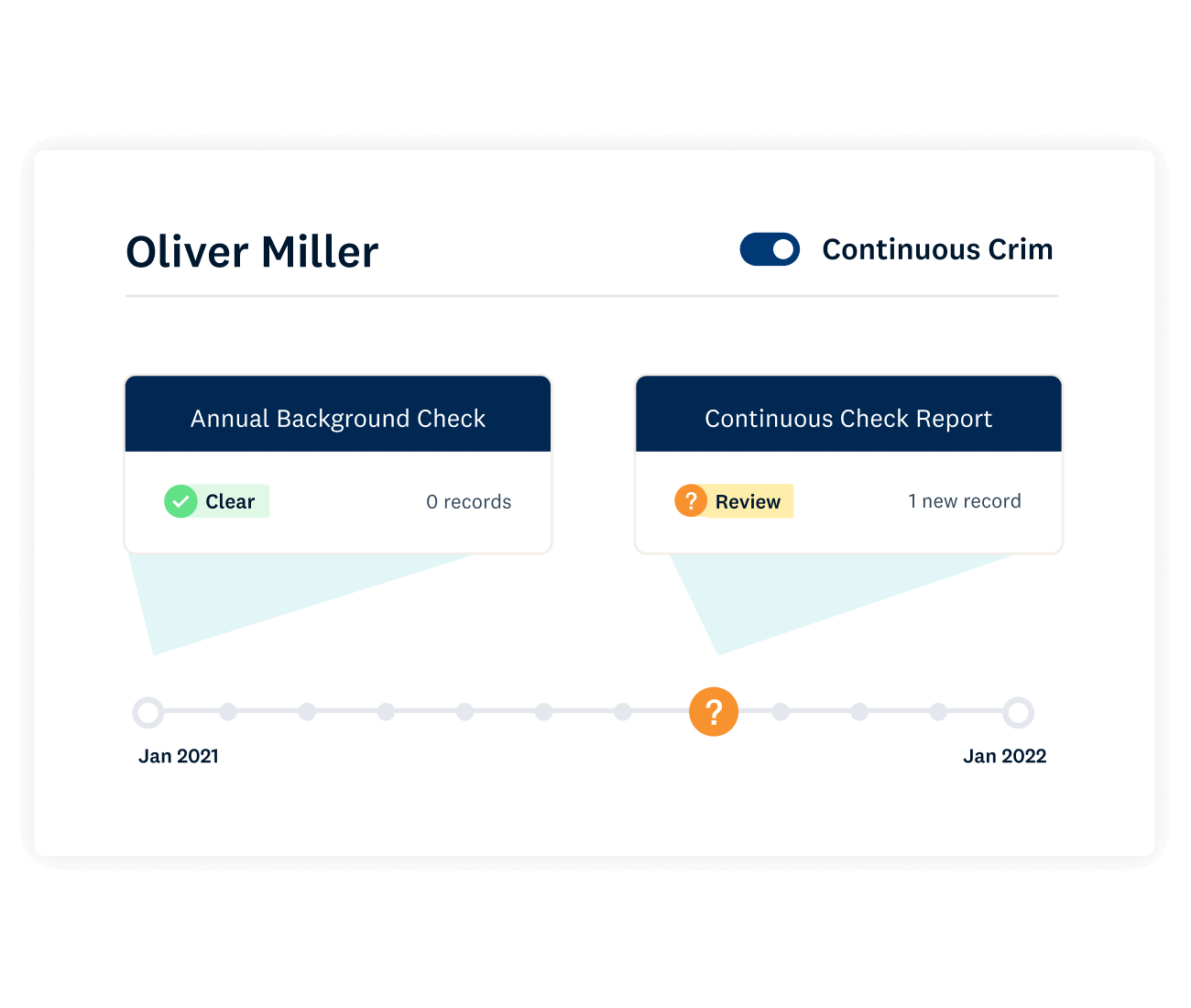
Increase visibility with continuous criminal search
Continuous criminal search is a monitoring service that surfaces changes in your candidates’ records in real-time so you can take immediate action and:
Reduce legal and compliance risks
Identify criminal records before it impacts your business
Build and maintain trust with customers
Prove to your customers that you take their safety seriously
Keep customers safe
Reduce safety gaps with ongoing screening
How it works
Checkr leverages six key data sources to power continuous criminal checks:
Arrest records
Direct data integrations with prisons and holding cells across the US provide near real-time arrest records as pointer searches. If new arrests are detected, they are verified at the county level before being reported.
Checkr proprietary data
Individuals are monitored against Checkr’s live feed of background check data. If a change is detected in an individual’s data from another report on the same individual, a new search is executed and reported.
Electronic county search
Provided that an individual has a current address within a county with electronic records, a search is conducted every 30 days to identify any new criminal records.
Global watchlist search
Every 30 days, a search is conducted to identify whether the individual has been added to a domestic and/or international watchlist.
National criminal database
A search of this pointer database is conducted every 30 days to identify potential records. Any new records will be verified through an additional county search.
Sex offender search
Every 30 days, a search is conducted of all public sex offender registries nationwide.

Guide
How ongoing background checks build trust
Data shows that recent behavior is far more reflective of current risk than past behavior. Today, companies can reduce risk by adopting a real-time approach to background checks.